aımnova
DashboardMy LearningPaper MasteryStudy Plan

Aimnova site navigation

Stay in the loop

Get the latest study resources and updates

New features, study tips and exam insights — straight to your inbox.

IB Diploma

  • IB Past Papers
  • IB Study Notes
  • IB Question Bank
  • IB Mock Exams
  • IB Revision

IB Subjects

  • IB Math AA
  • IB Math AI
  • IB Economics
  • IB Business Management
  • IB Physics
  • IB Biology
  • View all IB subjects→

IB Past Papers

  • IB Math AA HL Past Papers
  • IB Math AA SL Past Papers
  • IB Math AI HL Past Papers
  • IB Math AI SL Past Papers
  • IB Economics HL Past Papers
  • IB Economics SL Past Papers
  • IB ESS Past Papers
  • View all past papers→

Study Resources

  • Study Notes
  • Question Bank
  • Mock Exams
  • Flashcards
  • Revision Guide
  • Exam Skills
  • Command Terms
  • Grade Calculator
  • Exam Timetable 2026

Aimnova

  • Features
  • Pricing
  • For Teachers
  • For Schools
  • For Parents
  • About Us
  • Blog
  • Contact
aımnova

IB study, practice and feedback built around the real exam.

TermsPrivacyCookies·© 2026 Aimnova. All rights reserved.1b845d5

Aimnova is not affiliated with or endorsed by the International Baccalaureate Organization (IB).

NotesEnglish A: Lang & LitTopic 2.3Text type: the blog
Back to English A: Lang & Lit Topics
2.3.14 min read

Text type: the blog

IB English A: Language and Literature · Unit 2

AI-powered feedback

Stop guessing — know where you lost marks

Get instant, examiner-style feedback on every answer. See exactly how to improve and what the markscheme expects.

Try It Free

Contents

  1. 1What is a blog?
  2. 2Try it yourself
In a nutshell: A blog is an informal, personal piece written online — like a public diary, or a friend talking straight to you.

You know the type of post — chatty, honest, a bit all over the place:

“Okay so I tried the 5 a.m. club. Reader, I am barely a person before 9. But… it kind of worked?”

The slang, the fragments, the jokes aren't sloppy — they're choices that make the writer feel real and likeable.

What to look for

1

Direct address

‘you’, ‘we’, ‘Reader,’ — a one-to-one feel.

2

Chatty structure

Short lines, fragments, dashes and ‘…’ that sound like speech.

3

Humour & honesty

Jokes and laughing at themselves make the writer likeable and trustworthy.

4

A closing nudge

‘Tell me in the comments’ — a warm invitation that builds community.

‘you’ · fragments · humour · a nudge

The key move: The informal voice is crafted to build trust. Show how it makes the writer feel real and relatable — that's the analysis.

Free preview

This is the free notes preview

You're reading the free notes. Aimnova Pro unlocks the full study experience — and you can try it with your first topic free to keep:

  • FlashcardsLock in vocabulary and key terms with spaced repetition.
  • Practice questionsAnswer exam-style questions and get instant AI marking.
  • Mock exams & past-paper vaultSit full mocks and see exactly how examiners award marks.
  • Personalised study planA daily plan built around your exam date and weak areas.
Start Studying Free Full access to Aimnova Pro · cancel anytime
Why it matters in the exam: A Paper 1 blog asks how the writer creates a personal voice or bonds with readers. Show how the informal choices build trust.
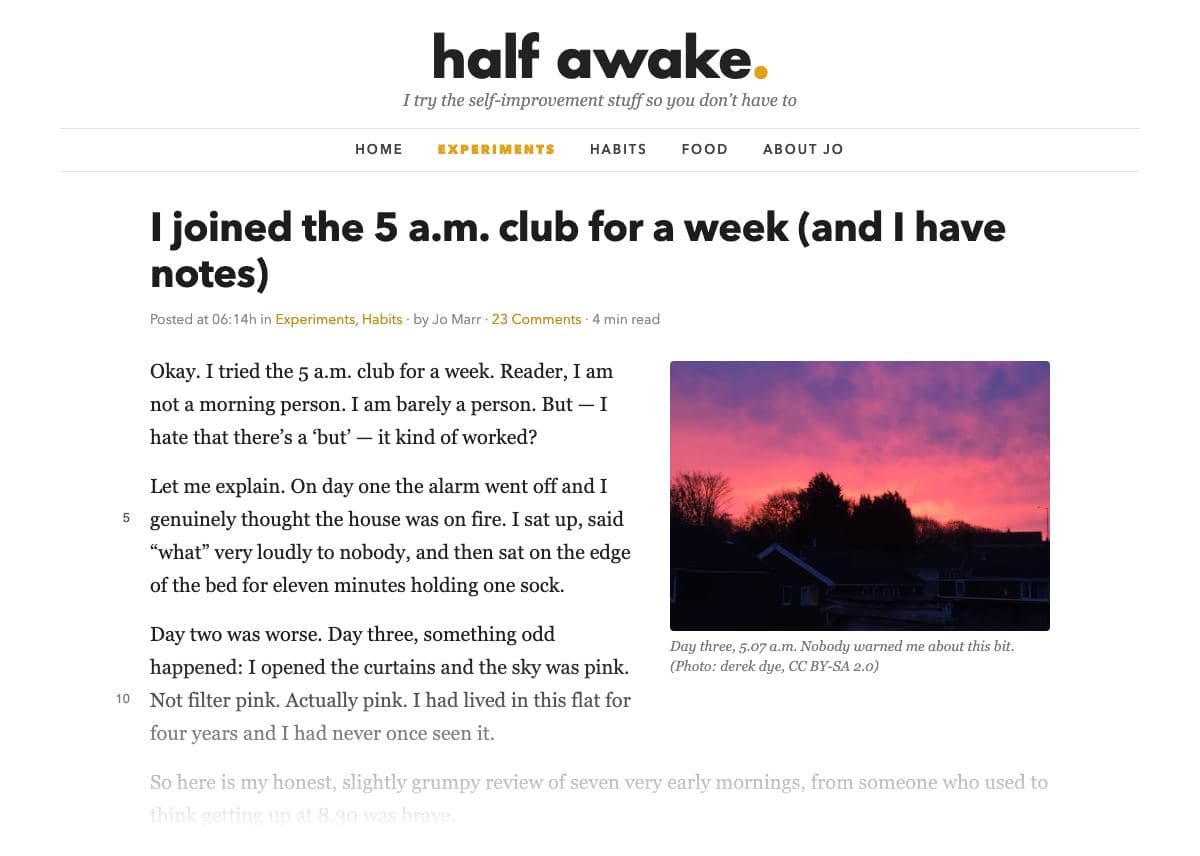
The top of a blog post on ‘half awake.’, a blog with the tagline ‘I try the self-improvement stuff so you don't have to’ and a menu (Home, Experiments, Habits, Food, About Jo); the post title ‘I joined the 5 a.m. club for a week (and I have notes)’; the meta line ‘Posted at 06:14h in Experiments, Habits · by Jo Marr · 23 Comments · 4 min read’; then the opening lines, ‘Okay. I tried the 5 a.m. club for a week…’, wrapped around a photograph of a pink dawn sky over dark rooftops captioned ‘Day three, 5.07 a.m. Nobody warned me about this bit.’, fading out at the foot of the clipping.
Blog post, opening (an original text written for Aimnova; photograph by derek dye, CC BY-SA 2.0 via Wikimedia Commons, cropped with text added)
IB-style questionAnalyse[6 marks]

Analyse how the opening of this blog post builds a friendly voice.

Model answer plan

See the mark-by-mark plan — for / against / judgement, with marking guidance — in study mode.

Claim your free topic
Watch out: Don't call the fragments ‘mistakes’ — they're deliberate. And don't miss the bond: the whole point is feeling spoken to personally.

IB Exam Questions on Text type: the blog

Practice with IB-style questions filtered to Topic 2.3.1. Get instant AI feedback on every answer.

Practice Topic 2.3.1 QuestionsBrowse All English A: Lang & Lit Topics

How Text type: the blog Appears in IB Exams

Examiners use specific command terms when asking about this topic. Here's what to expect:

  • Define

    Give the precise meaning of key terms related to Text type: the blog.

    AO1
  • Describe

    Give a detailed account of processes or features in Text type: the blog.

    AO2
  • Explain

    Give reasons WHY — cause and effect within Text type: the blog.

    AO3
  • Evaluate

    Weigh strengths AND limitations of approaches in Text type: the blog.

    AO3
  • Discuss

    Present arguments FOR and AGAINST with a balanced conclusion.

    AO3

See the full IB Command Terms guide

Related English A: Lang & Lit Topics

Continue learning with these related topics from the same unit:

2.1.1Text type: the advertisement2.1.2Text type: the poster2.1.3Text type: the brochure or leaflet2.1.4Text type: the campaign material
View all English A: Lang & Lit topics
Improve your exam techniqueCommand terms, paper structure, and mark-scheme tips for English A: Lang & Lit
Previous2.2.6Text type: the reviewNextText type: the website2.3.2

4 exam-style questions ready for you

Students who practice on Aimnova improve their scores by 15% on average. Get instant feedback that shows exactly how to improve your answers.

Practice Now — FreeView All English A: Lang & Lit Topics