Key Idea: The parts of a system affect each other. This summary explains how systems change, stay balanced and recover after damage.
Systems
System = interacting parts working as a whole.
Small scale
- The tiny pool in a {{bromeliad|a plant whose overlapping leaves can hold a small pool of rainwater}}.
Local ecosystem
- A woodland tree community or a lake.
Global scale
- Earth: all its connected parts.
Select the labels to explore the parts, interactions and flows.
Interactive diagram
Explore the labelled diagram, charts and maps for this topic in study mode.
Storages and flows
Storages hold; flows move. Lake water = storage. River water entering the lake = flow.
Storage examples Nutrients held in soil. Biomass in trees. Chemical energy stored in food.
Flow examples Water runs over the ground (runoff). Nutrients move from soil into roots. Feeding transfers matter and energy between organisms.
System diagrams
Boxes = storages. Arrows = flows. Label each box and arrow. Inputs cross into the boundary; outputs cross out.
A real lake represented by a storage box and labelled flow arrows.
Interactive diagram
Explore the labelled diagram, charts and maps for this topic in study mode.
Transfers and transformations
TRANSFER = changes place, keeps its form. TRANSFORMATION = changes state, chemical nature or energy form.
Moving water is a transfer; changing its state is a transformation.
Interactive diagram
Explore the labelled diagram, charts and maps for this topic in study mode.
Transfers Changes place; keeps its form. Water flowing, sediment moving, heat moving and organisms moving.
Physical transformations Changes state. Melting, freezing, evaporation, condensation and sublimation. Sublimation: solid → gas directly.
Chemical transformations Changes substances. Photosynthesis, respiration and decomposition.
Open and closed systems
Open: matter + energy exchanged. Closed: energy only. Isolated: neither.
Lake: open system Exchanges matter and energy. Water enters and leaves. Sunlight enters; heat leaves.
Earth: approximately closed Exchanges energy, with very little matter exchanged. Sunlight enters; heat leaves.
Earth as a system
Life, water, ice, rock, air, people are connected parts of Earth.
Biosphere Living things. Plants, animals and microbes.
Hydrosphere Water. Oceans, rivers, lakes and groundwater.
Cryosphere Frozen water. Glaciers, ice sheets, sea ice and snow.
Geosphere Rocks and soil. Earth’s solid surface and interior.
Atmosphere The gases surrounding Earth. The air, including oxygen and carbon dioxide.
Anthroposphere People and their activities. Cities, farming, transport and industry.
Key Idea: Lovelock’s hypothesis, developed with Margulis: living things interact with air, water and rocks through feedback that can help regulate Earth’s conditions.
Scale
Systems exist at different scales: bromeliad pool (small) → woodland or lake (local) → Earth (global).
Woodland tree community Components: trees. Interactions: trees compete for light and water. Flows: water and nutrients move into trees; energy flows through them. Transformations: photosynthesis, respiration and growth. Inputs and outputs: sunlight and water enter; heat and gases leave. Feedback: changes in tree cover can affect conditions for further growth.
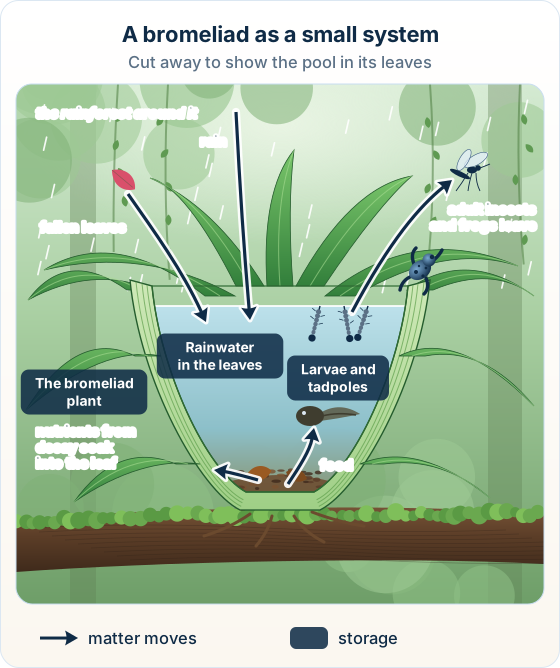
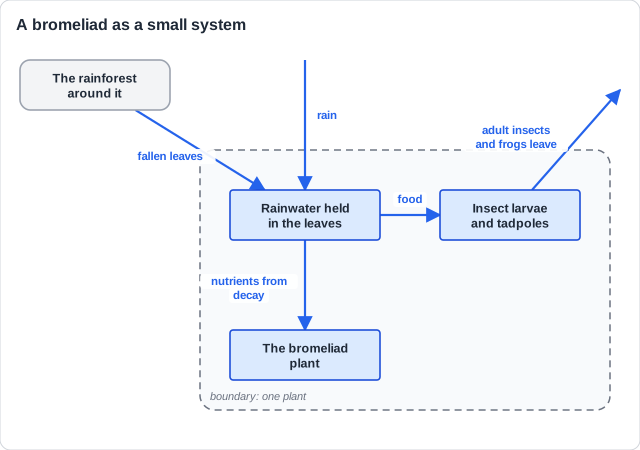
Bromeliad pool Components: the plant, stored rainwater, dead leaves, larvae and tadpoles. Interactions and processes: organisms feed; microbes break down dead leaves and release nutrients. Inputs: rain and fallen leaves enter. Outputs: water evaporates; adult insects and frogs leave. Its connected parts make a small system within the rainforest.
Earth Components: life, water, ice, rocks, air and people. Interactions and flows: water evaporates into the air; rain returns it to land and oceans. Inputs and outputs: sunlight enters; heat leaves. Very little matter crosses Earth’s boundary, so Earth is approximately closed. Feedback: warming melts ice → less sunlight reflected → more warming. Changes in one part affect the others.
Negative feedback
NEGATIVE = COUNTERACTS CHANGE. Prey ↑ → predators ↑ → more prey eaten → prey ↓.
More hares support more lynx; more predation then reduces hare numbers.
Interactive diagram
Explore the labelled diagram, charts and maps for this topic in study mode.
Meaning Negative feedback counteracts change. The response reduces the original change, helping the system stay stable.
Predator–prey loop More prey → more predators → more prey eaten → fewer prey. The response counteracts the original increase in prey.
Limited food More rabbits → less food per rabbit → slower population growth. The population may still grow, but more slowly.
Stable equilibrium
Disturbance → response → return towards the previous equilibrium. Steady state: flows continue, but inputs balance outputs over time.
Stable does not mean motionless A lake can keep a similar water level while water enters and leaves. Populations can fluctuate around an average. Static equilibrium: no ongoing change or flows. Stable equilibrium can also develop over time, such as during succession. Negative feedback maintains stability; diversity, complex food webs, large storages and populations can support it.
Why balance matters for sustainability If a resource is removed faster than it is replaced, its storage falls. Keeping use within regeneration helps maintain natural capital over time. A temporary balance alone does not prove that every part of a system is sustainable.
Positive feedback
POSITIVE = AMPLIFIES CHANGE. Warming → ice melts → less sunlight reflected → more heat absorbed → more warming.
The last step strengthens the first: more warming.
Interactive diagram
Explore the labelled diagram, charts and maps for this topic in study mode.
Meaning Positive feedback amplifies change. The response strengthens the original change and can move the system away from its earlier equilibrium.
Positive vs negative Positive: reinforces change. Negative: counteracts change. These names do not mean good or bad. Positive feedback can also support growth.
Tipping points
Tipping point = threshold beyond which a small further change can cause a large shift.
Explore how adding nutrients can push a clear lake into a murky state.
Interactive diagram
Explore the labelled diagram, charts and maps for this topic in study mode.
Crossing the threshold A system can cope with disturbance up to a limit. Crossing the tipping point can cause a major change.
Resilience Closer to the tipping point: a smaller disturbance may trigger change. Further away: the system can generally withstand a larger disturbance.
Recovery Removing the original pressure may not bring the old state back. Recovery can be difficult after the system has changed.
Regime shifts
Regime shift = a large, persistent move from one stable state to another. Example: a clear, plant-rich lake becomes murky and algae-dominated.
One lake can have two different stable states.
Interactive diagram
Explore the labelled diagram, charts and maps for this topic in study mode.
1. Algae block light Extra nutrients → more algae → less light underwater → plants die.
2. Oxygen falls Microbes break down dead material → oxygen is used → fish may die.
3. Positive feedback Decomposition releases nutrients → more algae grow → more material dies and decomposes. This loop can keep the lake murky.
4. Recovery is difficult Phosphate stored in lake mud can keep feeding algae, even after nutrient runoff is reduced.
Models
Model = simplified representation of reality. Words, diagrams, graphs, equations and simulations help explain systems and predict change.
The same system can be represented in different forms.
Interactive diagram
Explore the labelled diagram, charts and maps for this topic in study mode.
Food webs Show feeding links and how a change in one species can affect others. Help identify keystone species.
System and feedback diagrams Show storages, flows and how a system responds to change.
Population models Explore population growth and predator–prey interactions. Help predict whether a population can survive.
Energy-flow and nutrient-cycle models Show how energy and nutrients move through a system. Help assess resource use and sustainability.
Diversity and biotic indices Compare biodiversity or environmental quality using numerical measures.
Microcosms Small, controlled systems used to test ideas. Their results can help guide conservation.
Model limitations
Simplification leaves out detail. Data + assumptions affect predictions.
Benefit A food web makes feeding links easy to see. It helps predict what may happen if a species is lost.
Limitation A simple food web leaves out changing population sizes and other influences. Its predictions may be incomplete.
Judgement Useful for understanding feeding links. Combine it with real observations and other models when making decisions.
Why predictions differ Models use different data, assumptions and processes. Predictions show possible outcomes, not certainty.
Emergent properties
Emergent property = a pattern produced by interactions between parts. Predator–prey interactions can create repeating population cycles.
Population cycle More prey → more predators → fewer prey. Fewer prey → less food for predators → fewer predators → prey can increase again.
Why it’s emergent The population cycle comes from interactions between predators and prey. One species alone cannot produce this predator–prey cycle.
Indirect effects More foxes → fewer rabbits → less grass eaten → more grass grows. Foxes affect the grass indirectly through rabbits.
Resilience
Resilience = ability to resist disturbance, recover or adapt while avoiding a lasting shift to a different state.
Greater resilience: a larger disturbance is needed to tip the system.
Interactive diagram
Explore the labelled diagram, charts and maps for this topic in study mode.
Withstanding disturbance A resilient system can absorb more disturbance before crossing a tipping point. Recovery may still be slow: resilience is not simply how quickly a system recovers.
The valley model Deeper valley → larger push needed to move the ball out. The ball represents the system’s state; the push represents a disturbance.
What supports resilience?
Diversity + complex food webs + LARGE storages/populations + negative feedback can support resilience.
| Factor | How it helps |
|---|---|
| High biodiversity | Other species can maintain a function if one is lost. |
| Genetic diversity | Some individuals may tolerate disease or changing conditions. |
| Complex food webs | Alternative foods reduce the effect of losing one feeding link. |
| Large storages | Reserves buffer shortages of water, nutrients or energy. |
| Large populations | Local extinction is less likely. |
| High productivity | Biomass can regrow faster after damage. |
| Negative feedback | Counteracts disturbances and helps maintain stability. |
| Tipping point further away | A larger disturbance is needed to trigger a major change. |
| Mature communities | Developed soils, nutrient cycling and species interactions can support recovery. |
| Balanced inputs and outputs | Help maintain storages over time. |
Prairie diversity A {{prairie|a large grassland with few trees, mainly in North America}} has many plant species. If some fail in a drought, others may survive. A one-crop field has fewer alternatives.
Lake vs puddle A lake stores more water than a puddle, so it usually takes longer to dry out. Larger reserves can buffer a shortage.
Time lag A delay between a change and its effect. Stored water can delay the effect of less rainfall. Large storage alone does not guarantee resilience.
Humans and resilience
People can make a system less or more able to cope with disturbance and recover.
Reduce resilience
Make it harder for the system to cope and recover.
Deforestation Trees cleared → species and biomass lost → recovery becomes harder.
Overfishing Too many fish caught → smaller populations → less ability to recover.
Pollution Sensitive species lost → lower diversity → resilience may fall.
Climate change Heat or drought damages species and storages → resilience may fall.
Increase resilience
Help the system cope and recover by protecting or rebuilding diversity and storages.
Protected areas Habitats and species protected → diversity maintained → resilience supported.
Fishing quotas Enough fish remain to breed → populations rebuild → greater ability to recover.
Pollution controls Less pollution → less damage to species → recovery is supported.
Soil conservation Protect soil → retain water and nutrients → support plant growth and recovery.
Habitat restoration Repair damaged habitats → species return → diversity and recovery are supported.
Reforestation Grow trees again where forest was lost → rebuild biomass and habitats → recovery is supported. A mix of native species can also restore diversity.