Two kinds of flow: Every flow is a transfer or a transformation.
The points to remember
- A transfer changes only where matter or energy is.
- A transformation changes what it is: its chemical nature, its state or its energy form.
- Say why each flow is a transfer or a transformation.
Remember it as: Transfer = it moves. Transformation = it changes.
Transfer
- It only changes location.
- Water flowing down a river; a rabbit eating grass.
- Heat carried by ocean currents.
- Sunlight reaching the Earth; heat radiated back to space.
Transformation
- It changes chemical nature, state or energy.
- Photosynthesis; water evaporating.
- Sulfur oxides and water forming acid rain.
Chemical nature
- Photosynthesis, respiration, decomposition, burning.
State
- Evaporation, condensation, melting, freezing.
Energy
- Light to chemical in photosynthesis; chemical to heat in respiration.
In the air: clouds reflecting sunlight, dust scattering it and wind carrying heat in water vapour are transfers; ozone breaking down is a transformation.
Free preview
This is the free notes preview
You're reading the free notes. Aimnova Pro unlocks the full study experience — and you can try it with your first topic free to keep:
- FlashcardsLock in vocabulary and key terms with spaced repetition.
- Practice questionsAnswer exam-style questions and get instant AI marking.
- Mock exams & past-paper vaultSit full mocks and see exactly how examiners award marks.
- Personalised study planA daily plan built around your exam date and weak areas.
The water cycle is the favourite test. Learn which flow is which.
The points to remember
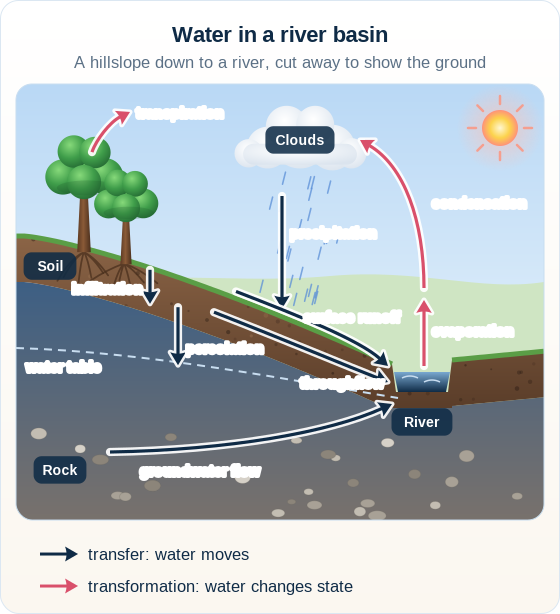
- Transfers: precipitation, runoff, infiltration, percolation, groundwater flow, plant uptake, advection.
- Transformations: evaporation, transpiration, condensation, melting, freezing, sublimation.
- Pick flows shown in the figure.
| Process | Transfer or transformation | Why |
|---|---|---|
| Precipitation | Transfer | Water falls from clouds to the ground |
| Runoff, infiltration, percolation | Transfer | Water moves over or into the ground |
| Groundwater flow, plant uptake | Transfer | Water moves to a new place |
| Evaporation, transpiration | Transformation | Liquid water becomes vapour |
| Condensation | Transformation | Vapour becomes liquid |
| Snowmelt, freezing | Transformation | Ice becomes liquid, or liquid becomes ice |
| Advection | Transfer | Wind moves water vapour |
| Sublimation | Transformation | Ice becomes vapour directly |
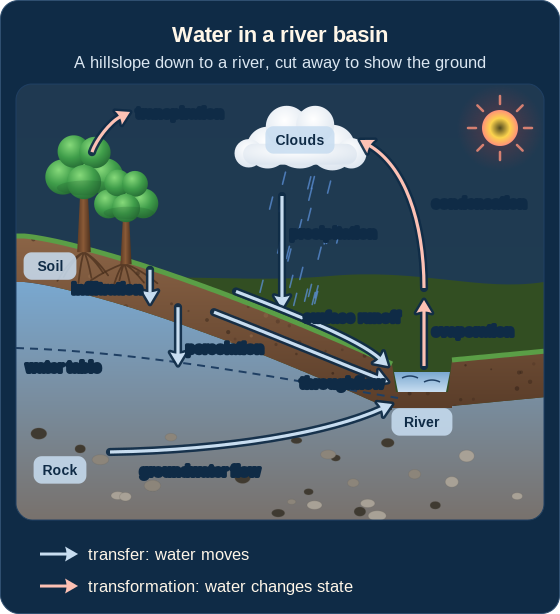
Choose a flow: navy arrows transfer water; pink arrows transform its state.
Interactive diagram
Explore the labelled diagram, charts and maps for this topic in full study mode.
In the exam you draw the same cycle as boxes and arrows: a box for each storage, a labelled arrow for each flow.
See it drawn, step by step
In My Learning, handwritten diagrams build one step at a time. Play, pause and replay each explanation until it clicks. Create your free account to try it.
Exam tip: questions with a figure: A question may show a diagram and ask: "Identify one transfer shown in Figure 1." Look at the figure and pick a process you can see on it, such as runoff. A process that is not drawn there gets no mark. Write only one answer: if you write two, only the first one counts.
Know your predicted grade
Take timed mock exams and get detailed feedback on every answer. See exactly where you're losing marks.
In an ecosystem, matter and energy flow through the producers and on along the food chain.
See it drawn, step by step
In My Learning, handwritten diagrams build one step at a time. Play, pause and replay each explanation until it clicks. Create your free account to try it.
Remember it as: Matter goes round and round; energy goes through once and leaves as heat.
See it drawn, step by step
In My Learning, handwritten diagrams build one step at a time. Play, pause and replay each explanation until it clicks. Create your free account to try it.
Why does every living thing lose heat?: Every living thing needs energy to stay alive, and respiration always lets some of that energy escape as heat.
From food to heat
- Trees, rabbits and decomposers (worms, fungi, bacteria) all need energy to grow, move and repair themselves.
- They get it by respiration: breaking down sugars to release the chemical energy stored in them.
- Respiration is never perfect, so some of that energy always escapes as heat.
- That is why every box on the diagram has a heat arrow.
- It is also why energy flows through the ecosystem once and is never recycled.
Asked to draw this for 7 marks? Up to 2 for the energy stores, up to 4 for each process named, and 1 for a clear diagram.
Reflected light does not count: Light that bounces off a leaf never enters the plant, so it is not a transfer into it.
How this comes up: Identify transfers and transformations in a figure, or outline them for a named system.
Outline two transfers and two transformations of water in the water cycle of a river basin.
Model answer plan
See the answer broken into clear points, with guidance on how each point earns marks.
Matter or energy?: If the question says matter, do not give energy flows, and the other way round.