A model keeps the important features and leaves out extra detail.
We use models to explain how a system works and explore what could happen if it changes.
Interactive diagram
Explore the labelled diagram, charts and maps for this topic in full study mode.
Free preview
This is the free notes preview
You're reading the free notes. Aimnova Pro unlocks the full study experience — and you can try it with your first topic free to keep:
- FlashcardsLock in vocabulary and key terms with spaced repetition.
- Practice questionsAnswer exam-style questions and get instant AI marking.
- Mock exams & past-paper vaultSit full mocks and see exactly how examiners award marks.
- Personalised study planA daily plan built around your exam date and weak areas.
Models do two jobs.
Understand
- How the system works now.
- A food web shows which species others depend on.
Predict
- What will happen if something changes.
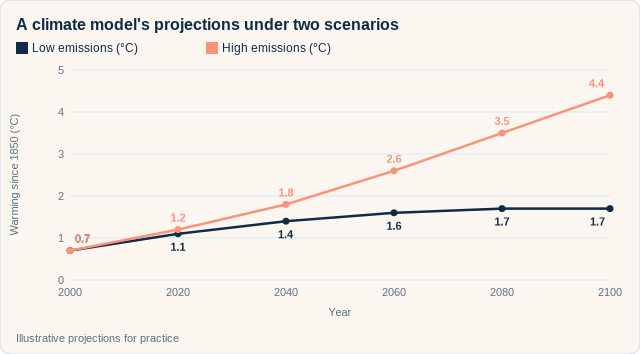
- A climate model shows warming for each level of emissions.
Interactive diagram
Explore the labelled diagram, charts and maps for this topic in full study mode.
Memorize terms 3x faster
Smart flashcards show you cards right before you forget them. Perfect for definitions and key concepts.
You meet models in every topic. Name the model and say what it shows.
| Model | Where | What it shows |
|---|---|---|
| Systems diagram | 1.2 | Storages and flows |
| Feedback loop | 1.2 | How a change is held or amplified |
| Food web, pyramids | 2.2 | Feeding links; energy lost at each level |
| S and J curves | 2.1 | How a population grows |
| Predator-prey graph | 2.1 | Two populations rising and falling |
| r and K strategies | 2.5 | How species breed: many young or few |
| Diversity index | 3.1 | How varied a community is |
| Biotic index | 4.4 | Water quality from the species living there |
| Demographic transition model | 8.1 | How a population changes as a country develops |
| Energy flow and nutrient cycle models | 2.2, 2.3 | Inputs v outputs of a farm; they miss soil erosion, transport and pesticides |
Models help protect species because we cannot experiment on a whole ecosystem.
Models at work
- A food web shows who depends on whom, keystone species and possible trophic cascades.
- A systems diagram shows the key storages and flows to protect, and the habitat area needed.
- A population model gives the chance of extinction or recovery.
- Diversity indices show whether protection works; genetic diversity guides breeding plans.
- Physical models (a zoo, an aquarium, a microcosm) show a species' needs and test disturbance safely.
- Models work best with field observations, not instead of them.
- Models show the whole ecosystem at once, not just one species.
Know your predicted grade
Take timed mock exams and get detailed feedback on every answer. See exactly where you're losing marks.
How this comes up: To what extent are models useful [9], or how can models help conservation [7]. In the [7], naming models earns at most [2]; the rest is how they help.
To what extent are different models useful in the study of ecosystems?
Model answer plan
See the answer broken into clear points, with guidance on how each point earns marks.
If asked about conservation: Explain how the model helps a decision: estimate the habitat a species needs, use diversity measures to check whether protection is working, or explore which conditions a species needs in an aquarium. Genetic diversity can also guide breeding programmes.
Check model predictions against observations from the real ecosystem.