aimnova.
DashboardMy LearningPaper MasteryStudy Plan

Aimnova site navigation

Stay in the loop

Get the latest study resources and updates

New features, study tips and exam insights — straight to your inbox.

IB Diploma

  • IB Past Papers
  • IB Study Notes
  • IB Question Bank
  • IB Mock Exams
  • IB Revision

IB Subjects

  • IB Math AA
  • IB Math AI
  • IB Economics
  • IB Business Management
  • IB Physics
  • IB Biology
  • View all IB subjects→

IB Past Papers

  • IB Math AA HL Past Papers
  • IB Math AA SL Past Papers
  • IB Math AI HL Past Papers
  • IB Math AI SL Past Papers
  • IB Economics HL Past Papers
  • IB Economics SL Past Papers
  • IB ESS Past Papers
  • View all past papers→

Study Resources

  • Study Notes
  • Question Bank
  • Mock Exams
  • Flashcards
  • Revision Guide
  • Exam Skills
  • Command Terms
  • Grade Calculator
  • Exam Timetable 2026

Aimnova

  • Features
  • Pricing
  • For Teachers
  • For Schools
  • For Parents
  • About Us
  • Blog
  • Contact
aimnova.

AI-powered study platform for smarter revision, past-paper analysis and examiner-style feedback.

TermsPrivacyCookies·© 2026 Aimnova. All rights reserved.fe11773

Aimnova is not affiliated with or endorsed by the International Baccalaureate Organization (IB).

NotesESSTopic 1.2Positive feedback
Back to ESS Topics
1.2.103 min read

Positive feedback

IB Environmental Systems and Societies • Unit 1

AI-powered feedback

Stop guessing — know where you lost marks

Get instant, examiner-style feedback on every answer. See exactly how to improve and what the markscheme expects.

Try It Free

Contents

  • Positive feedback
  • Growth or decline
  • Climate loops
  • Positive feedback in human systems
  • Exam-style question
A change that feeds itself: In positive feedback, the result of a change makes the change bigger. It pushes a system away from equilibrium.
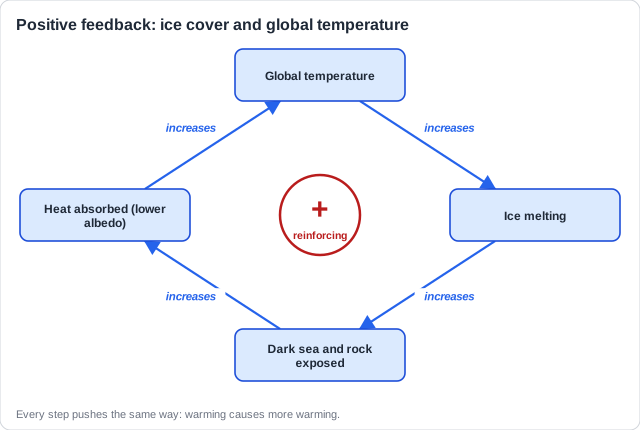
Positive feedback loop: warming, ice melting, dark surfaces exposed, more heat absorbed, more warming
Warming melts ice, which leads to more warming.

Negative feedback (1.2.8)

  • The result counteracts the change.
  • Stabilising.

Positive feedback

  • The result amplifies the change.
  • Destabilising: away from equilibrium.

Free preview

This is the free notes preview

You're reading the free notes. Aimnova Pro unlocks the full study experience — and you can try it with your first topic free to keep:

  • FlashcardsLock in vocabulary and key terms with spaced repetition.
  • Practice questionsAnswer exam-style questions and get instant AI marking.
  • Mock exams & past-paper vaultSit full mocks and see exactly how examiners award marks.
  • Personalised study planA daily plan built around your exam date and weak areas.
Start Studying Free Full access to Aimnova Pro · cancel anytime

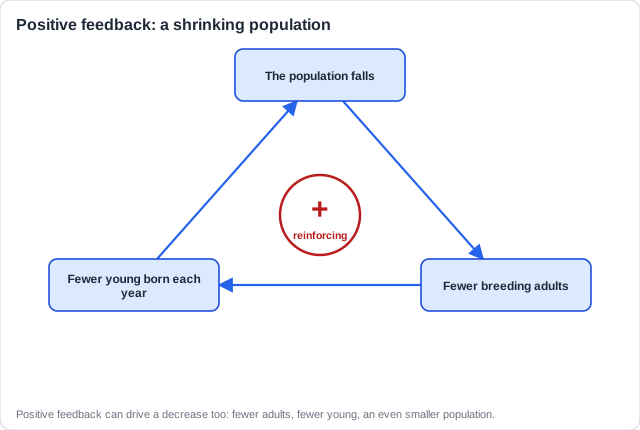
Positive feedback can drive a component up or down. What matters is that the change grows.

Growth

  • More people, more parents, more births.
  • The population grows faster and faster.

Decline

  • Fewer adults, fewer young born.
  • A small population shrinks faster.
Positive feedback loop: the population falls, fewer breeding adults, fewer young born
A falling population can fall further: still positive feedback.

See how examiners mark answers

Access past paper questions with model answers. Learn exactly what earns marks and what doesn't.

Try Exam Vault FreeYour first topic is free to keep • No credit card required

Many climate loops are positive. Each amplifies warming.

LoopThe steps
Ice and albedoWarming melts ice; dark sea and rock absorb more heat; more warming
PermafrostWarming thaws permafrost; methane is released; more warming
WildfiresHotter, drier forests burn; soot and CO₂ warm the climate; more fires
Forest diebackFewer trees, less water returned to the air; less rain; more trees die
Match the loop to the question: Albedo belongs to ice and snow. For permafrost, the step is methane, not albedo.

Try it: tap each loop to follow it round.

R marks a reinforcing (positive) loop, B a balancing (negative) loop.

Interactive diagram

Explore the labelled diagram, charts and maps for this topic in full study mode.

Claim your free topic

Positive feedback works in human systems too. Papers give a model like this one and ask how it shows positive feedback.
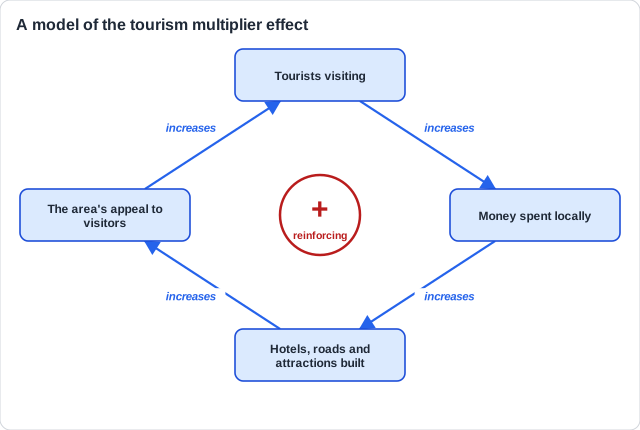
Model of the tourism multiplier: more tourists, more money spent, more hotels and roads built, more appeal, more tourists
The tourism multiplier effect.

Reading a model

  • Follow the arrows round from any box.
  • Say what increases at each step.
  • Show that the last step returns to increase the first: the change is amplified.

Study smarter, not longer

Most students waste 40% of study time on topics they already know. Our AI tracks your progress and optimizes every minute.

Try Smart Study FreeYour first topic is free to keep • No credit card required
How this comes up: Describe a positive loop for [2] or [3], or construct a feedback loop diagram for [4].
IB-style questionConstruct[4 marks]

Construct a feedback loop diagram showing the impact of rising global temperatures on ice cover.

Model answer plan

See the mark-by-mark plan — for / against / judgement, with marking guidance — in study mode.

Claim your free topic
Model answer: the ice and albedo positive feedback loop
One model answer: every step labelled, the loop closed.

Try an IB Exam Question — Free AI Feedback

Test yourself on Positive feedback. Write your answer and get instant AI feedback — just like a real IB examiner.

two human activities that can trigger positive feedback loops in environmental systems. [2 marks]

Key Terms

Dynamic equilibrium
A system in which changes occur but the system remains balanced overall.
Static equilibrium
A system in which there is no change over time.
Steady-state equilibrium
A system in which changes occur but the system returns to its original state.

Related ESS Topics

Continue learning with these related topics from the same unit:

1.1.1Perspectives
1.1.2What shapes a perspective
1.1.3Values
1.1.4Where values show
View all ESS topics

Practice with flashcards

Spaced repetition flashcards for Positive feedback

Improve your exam technique

Command terms, paper structure, and mark-scheme tips for ESS

Previous
1.2.9Stable equilibrium
Next
Tipping points1.2.11

26 exam-style questions ready for you

Students who practice on Aimnova improve their scores by 15% on average. Get instant feedback that shows exactly how to improve your answers.

Practice Now — FreeView All ESS Topics