One Earth, six spheres: The Earth is a single integrated system made of six spheres that constantly exchange energy and matter.
The points to remember
- The Earth is one integrated system.
- It has six spheres: bio-, hydro-, cryo-, geo-, atmo- and anthroposphere.
- The spheres exchange energy and matter all the time.
- A change in one sphere spreads to the others.
| Sphere | What it is | Example |
|---|---|---|
| Biosphere | All living things | Forests, plankton, people |
| Hydrosphere | All liquid water and water vapour | Oceans, rivers, groundwater |
| Cryosphere | All frozen water | Ice sheets, glaciers, permafrost |
| Geosphere | Rocks, soil and the Earth's interior | Mountains, volcanoes |
| Atmosphere | The layer of gases | The air |
| Anthroposphere | The parts of the Earth made or changed by people | Cities, farms, roads |
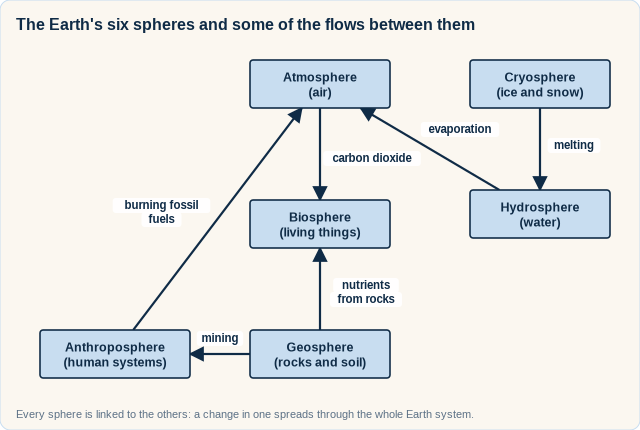
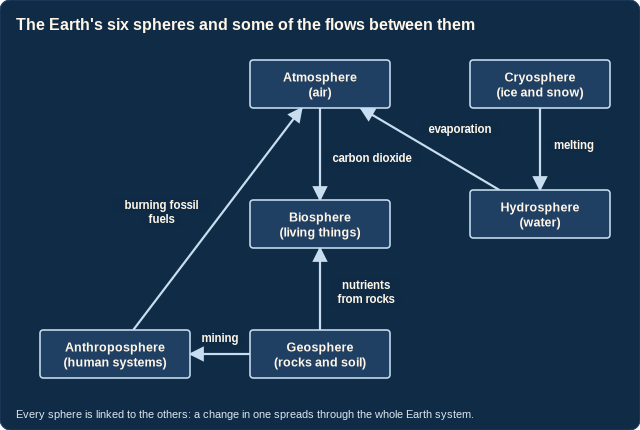
Remember it as: Life, water, ice, rock, air, people: the six spheres.
Free preview
This is the free notes preview
You're reading the free notes. Aimnova Pro unlocks the full study experience — and you can try it with your first topic free to keep:
- FlashcardsLock in vocabulary and key terms with spaced repetition.
- Practice questionsAnswer exam-style questions and get instant AI marking.
- Mock exams & past-paper vaultSit full mocks and see exactly how examiners award marks.
- Personalised study planA daily plan built around your exam date and weak areas.
Start Studying Free Full access to Aimnova Pro · cancel anytime
A model of a living planet: The Gaia hypothesis sees the Earth as one system that keeps its own temperature and air suitable for life.
The points to remember
- The Gaia hypothesis is a model of the Earth as one self-regulating system.
- It was proposed by James Lovelock; he and Lynn Margulis developed many versions.
- It explains how the gases in the air and the temperature are linked.
- The link works through feedback, with life as part of the loop.
- It gave people a holistic view: the whole Earth, not separate parts.
Lovelock proposed it in the 1970s. One example: the Sun has brightened, yet the Earth has not overheated.
An example of the feedback
- The Sun is about 30% brighter than 4 billion years ago.
- A warmer Earth speeds up plant growth and the weathering of rocks.
- Both take carbon dioxide out of the air.
- Less greenhouse gas cools the Earth, so it stays suitable for life.
A model, not a law: Gaia is a hypothesis: a simplified way to see how life and its surroundings affect each other.
Feeling unprepared for exams?
Get a clear study plan, practice with real questions, and know exactly where you stand before exam day. No more guessing.
Get Exam Ready FreeYour first topic is free to keep • No credit card required
Like every model, Gaia helps and has limits.
Strengths
- It links all six spheres in one system.
- It explains long-lasting conditions for life.
- It led to new research, such as the algae and cloud link.
Limits
- It can sound as if the Earth has a purpose.
- It is hard to test on a whole planet.
- Ice ages and mass extinctions show conditions do change.
How this comes up: A named event: show how it spread through several spheres.
IB-style questionOutline[4 marks]
With reference to a named wildfire, outline how it affected four different spheres of the Earth system.
Model answer plan
See the answer broken into clear points, with guidance on how each point earns marks.
Name the sphere: Use the sphere's name in each point: it shows you know the Earth is one linked system.