The points to remember
- An ecosystem is an open system: energy and matter flow in and out.
- Steady-state equilibrium: inputs and outputs flow at the same rate, so storage stays about the same.
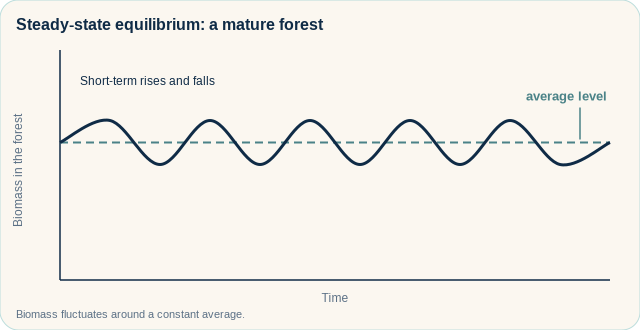
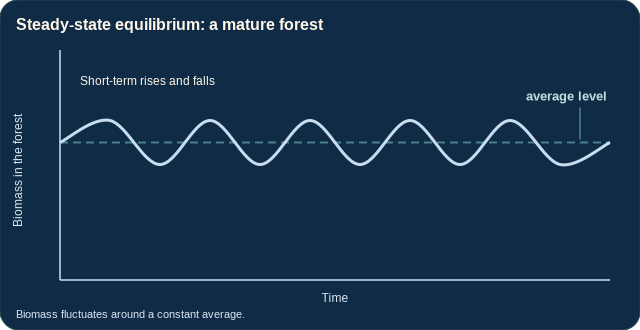
- Short-term ups and downs, but long-term stability around an average.
- It is kept steady by negative feedback loops.
- Sustainable use keeps the steady state: take no more than regrows, as with fish or timber.
Remember it as: A bath with the tap on and the plug out: water flows, the level stays put.
In a mature forest, old trees die and young trees grow, so the forest's biomass stays about the same.
When inflow equals outflow the water level stays the same, although water keeps moving: a steady state.
Interactive diagram
Explore the labelled diagram, charts and maps for this topic in full study mode.
Free preview
This is the free notes preview
You're reading the free notes. Aimnova Pro unlocks the full study experience — and you can try it with your first topic free to keep:
- FlashcardsLock in vocabulary and key terms with spaced repetition.
- Practice questionsAnswer exam-style questions and get instant AI marking.
- Mock exams & past-paper vaultSit full mocks and see exactly how examiners award marks.
- Personalised study planA daily plan built around your exam date and weak areas.
The points to remember
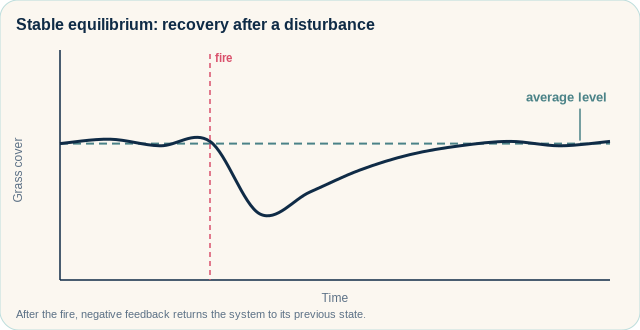
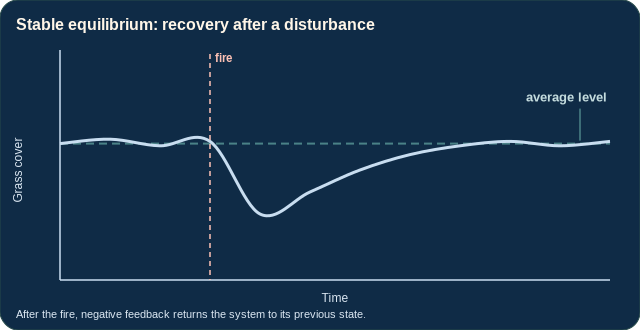
- stable equilibrium: after a disturbance, a system tends to return to where it was.
- Negative feedback counteracts the change, bringing the system back towards its previous state.
Remember it as: A ball in a bowl: push it and it rolls back to the bottom.
How it returns
- A fire burns the grassland.
- Light and nutrients are freed up for new growth.
- Plants regrow until they again compete for space.
- Negative feedback brings the system back to its previous state.
Stop wasting time on topics you know
Our AI identifies your weak areas and focuses your study time where it matters. No more overstudying easy topics.
Some equilibria develop over time. During succession, an ecosystem changes step by step, then settles.
The points to remember
- Some equilibria develop over time, as in succession.
- Each stage changes the conditions, so the next stage can grow.
- Over time, the ecosystem settles into a stable state.
- Succession also restores an ecosystem after damage.
During succession, plant biomass increases, then settles around a stable average.
Interactive diagram
Explore the labelled diagram, charts and maps for this topic in full study mode.
An example: An abandoned field becomes grassland, then shrubs, then woodland. Each stage changes the soil so the next can grow.
Several factors help keep an ecosystem in a steady state. Each works through negative feedback or by buffering change.
The factors to remember
- Species diversity: another species can replace one that is lost; keystone species or engineer species help.
- Complex food webs: many feeding links, so less extreme population swings.
- Large populations rarely die out; large storages of water and nutrients buffer shortages.
- Stable abiotic conditions: steady temperature and rainfall limit change.
- High productivity: faster recovery after a disturbance.
- Negative feedback (predator and prey) and little human disturbance.
Name the factor, then say why: A factor on its own is not enough. Link it to how it keeps the system near balance.
See how examiners mark answers
Answer exam-style questions with model answers. Learn exactly what earns marks and what doesn't.
How this comes up: May 2024, TZ2, Paper 2, Q5(a) [4 marks]: outline four factors that maintain steady-state equilibrium in an ecosystem. Name four different factors and explain how each helps keep it stable.
Outline how four named factors contribute to a steady-state equilibrium in a temperate forest.
Model answer plan
See the answer broken into clear points, with guidance on how each point earns marks.
Four different factors: Species, habitat and genetic diversity are three different factors. Two examples of the same factor count once.
A [9] on steady state and sustainability
- Terms: inputs balance outputs; short-term ups and downs, long-term stability.
- Named systems: one natural (a forest) and one managed (a fishery at maximum sustainable yield).
- Balance: where the idea helps, and where it misleads (time lags, tipping points).
- Conclusion: short-term swings are fine; long-term stability of the stock is the key.
- In a [7] on feedback and equilibrium, give examples: none caps it at [5], one at [6].