aımnova
DashboardMy LearningCrash CoursesStudy Plan

Aimnova site navigation

Stay in the loop

Get the latest study resources and updates

New features, study tips and exam insights — straight to your inbox.

IB Diploma

  • IB Past Papers
  • IB Study Notes
  • IB Question Bank
  • IB Mock Exams
  • IB Revision

IB Subjects

  • IB Math AA
  • IB Math AI
  • IB Economics
  • IB Business Management
  • IB Physics
  • IB Biology
  • View all IB subjects→

IB Past Papers

  • IB Math AA HL Past Papers
  • IB Math AA SL Past Papers
  • IB Math AI HL Past Papers
  • IB Math AI SL Past Papers
  • IB Economics HL Past Papers
  • IB Economics SL Past Papers
  • IB ESS Past Papers
  • View all past papers→

Study Resources

  • Study Notes
  • Question Bank
  • Mock Exams
  • Crash Courses
  • Flashcards
  • Revision Guide
  • Exam Skills
  • Command Terms
  • Grade Calculator
  • Exam Timetable 2027

Aimnova

  • Features
  • Pricing
  • For Teachers
  • For Schools
  • For Parents
  • About Us
  • Blog
  • Contact
aımnova

IB study, practice and feedback built around the real exam.

TermsPrivacyCookies·© 2026 Aimnova. All rights reserved.d9e1c61

Aimnova is not affiliated with or endorsed by the International Baccalaureate Organization (IB).

NotesESSTopic 1.2Systems at different scales
Back to ESS Topics
1.2.76 min read

Systems at different scales

IB Environmental Systems and Societies · Unit 1

Exam preparation

Practice the questions examiners actually ask

Our question bank mirrors real IB exam papers. Practice under timed conditions and track your progress across topics.

Start Practicing

Contents

  1. 1Systems at every scale
  2. 2A small system
  3. 3A global system
  4. 4Exam-style question
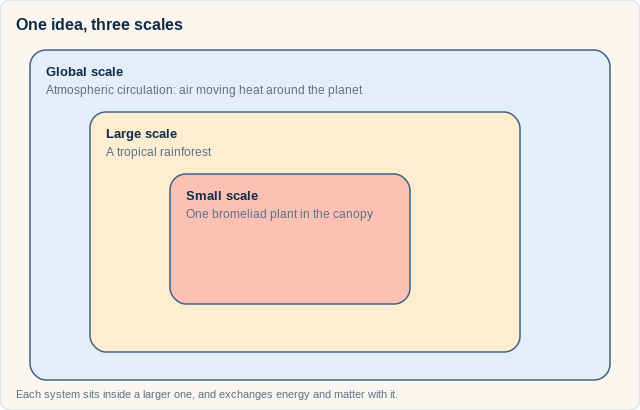
Small, large, global: The idea of a system works at any scale: one plant, a whole forest, or the whole planet.

The points to remember

  • The idea of a system works at any scale.
  • Small: a local ecosystem, such as a bromeliad in a rainforest.
  • Large: a whole ecosystem, such as a rainforest.
  • Global: atmospheric circulation, or the Earth in the Gaia hypothesis.
  • Each has storages, flows and a boundary, and sits inside a larger system.

Small scale

  • A bromeliad in the rainforest canopy.

Large scale

  • A tropical rainforest.

Global scale

  • Atmospheric circulation, or Gaia.
Three nested systems: a small system inside a large one inside a global oneThree nested systems: a small system inside a large one inside a global one
Each system sits inside a larger one.
Remember it as: Plant, forest, planet: one idea, three sizes.

Free preview

This is the free notes preview

You're reading the free notes. Aimnova Pro unlocks the full study experience — and you can try it with your first topic free to keep:

  • FlashcardsLock in vocabulary and key terms with spaced repetition.
  • Practice questionsAnswer exam-style questions and get instant AI marking.
  • Mock exams & past-paper vaultSit full mocks and see exactly how examiners award marks.
  • Personalised study planA daily plan built around your exam date and weak areas.
Start Studying Free Full access to Aimnova Pro · cancel anytime

A bromeliad is a rainforest plant whose leaves form a cup that holds rainwater. That tiny pool is a whole system.
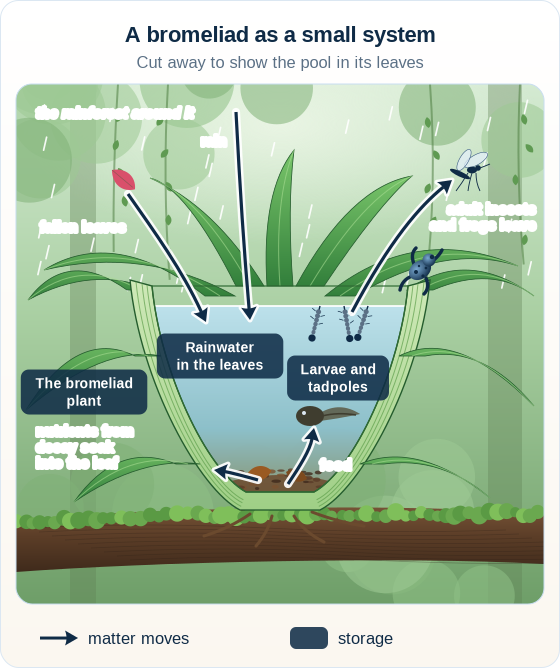
A tank bromeliad on a mossy rainforest branch, cut away to show the pool in its leaves: rain and a fallen leaf enter, mosquito larvae and a tadpole live in the water, decaying leaves at the bottom feed nutrients to the leaf bases, and an adult mosquito and a frog leave
One plant, a whole system. Find its storages and flows before you read how it works.

The same system as an exam diagram: each storage a box, each flow an arrow. Watch it drawn step by step.

See it drawn, step by step

In My Learning, handwritten diagrams build one step at a time. Play, pause and replay each explanation until it clicks. Create your free account to try it.

Claim your free topic
Linked to the larger system: Leaves fall in from the forest and adult insects fly out: the small system exchanges matter with the rainforest around it.

Study smarter, not longer

Most students waste 40% of study time on topics they already know. Our AI tracks your progress and optimizes every minute.

Try Smart Study FreeYour first topic is free to keep • No credit card required

At the global scale, the whole atmosphere is one system. Air carries heat from the hot equator towards the poles.

How the circulation works

  • Strong sunlight heats the air at the equator; it rises.
  • High up, it flows north and south, carrying heat.
  • Near 30° it has cooled and sinks.
  • It returns to the equator as the trade winds.
Another global system: The Gaia hypothesis (1.2.6) treats the whole Earth as one system too.
How this comes up: Apply the idea of a system at a named scale, or at several scales.
IB-style questionExplain[3 marks]

Explain how a single bromeliad can be seen as a system within the larger rainforest system.

Model answer plan

See the answer broken into clear points, with guidance on how each point earns marks.

Claim your free topic

Try an IB Exam Question — Free AI Feedback

Test yourself on Systems at different scales. Write your answer and get instant AI feedback — just like a real IB examiner.

A class studies a school pond instead of a large lake. one advantage and one disadvantage of studying a system at this small scale. [2 marks]

Related ESS Topics

Continue learning with these related topics from the same unit:

1.1.1Perspectives1.1.2What shapes a perspective1.1.3Values1.1.4Where values show
View all ESS topics
Practice with flashcardsSpaced repetition flashcards for Systems at different scalesImprove your exam techniqueCommand terms, paper structure, and mark-scheme tips for ESS
Previous1.2.6The Earth as a systemNextNegative feedback1.2.8

4 exam-style questions ready for you

Students who practice on Aimnova improve their scores by 15% on average. Get instant feedback that shows exactly how to improve your answers.

Practice Now — FreeView All ESS Topics