A planetary human signal at Higher Level: This statement is Higher Level only. It is about the evidence: the traces people are leaving in mud, ice and rock worldwide, and whether they show an epoch separate from the Holocene.
Practise this as you read
- Name at least four kinds of evidence, each with a real example.
- Weigh the evidence for and against.
Free preview
This is the free notes preview
You're reading the free notes. Aimnova Pro unlocks the full study experience — and you can try it with your first topic free to keep:
- FlashcardsLock in vocabulary and key terms with spaced repetition.
- Practice questionsAnswer exam-style questions and get instant AI marking.
- Mock exams & past-paper vaultSit full mocks and see exactly how examiners award marks.
- Personalised study planA daily plan built around your exam date and weak areas.
Traces that will outlast us: Geologists read Earth's history from its strata. People are now leaving traces in those layers across the whole planet, which future geologists will be able to read.
The points to remember
- Human impacts are now planetary: their traces reach the deepest oceans and polar ice.
- Many traces are building up in layers of mud, ice and rock that will last for millions of years.
- So future geologists could detect our time in the geological record, like any other epoch.
- Most signals rise sharply from about 1950: the Great Acceleration.
- These changes support calling the Anthropocene an epoch separate from the Holocene.
Remember it as: Everywhere, from about 1950, and built to last.
Real example: in 2018 scientists reported a plastic bag lying 10,898 m down in the Mariana Trench, the deepest piece of plastic litter ever found.
See how examiners mark answers
Answer exam-style questions with model answers. Learn exactly what earns marks and what doesn't.
Two of the clearest signals are chemical. Pollutants and radioactive atoms settle out of the air and water and are buried, layer by layer, in lake mud, sea mud and ice.
Chemical and nuclear signals
- Chemical pollution builds up in layers: lead from petrol, pesticides such as DDT, PCBs.
- Fertilisers leave extra nitrogen and phosphorus in lake and sea mud.
- Ice cores record carbon dioxide and methane rising far above anything in 800,000 years.
- Nuclear tests (over 500 in the air, 1945-1980) spread plutonium and carbon-14 worldwide.
- Plutonium-239 takes 24,100 years to halve, so it will be traceable for a very long time.
Remember it as: Lead, fertiliser, carbon dioxide, plutonium: a chemical diary in the mud.

Real example: the mud of Crawford Lake, Canada, has one thin layer for each year. Plutonium from bomb tests appears in the layer for 1950 and peaks in the early 1960s, so the layers can be read like a calendar.
People also make new solid things that will become part of the rock: new minerals and new materials.
New minerals and materials
- About 200 minerals are known only, or mostly, from human activity: in mines, slag and old metal.
- Humans make materials nature rarely does: concrete, pure aluminium, plastics.
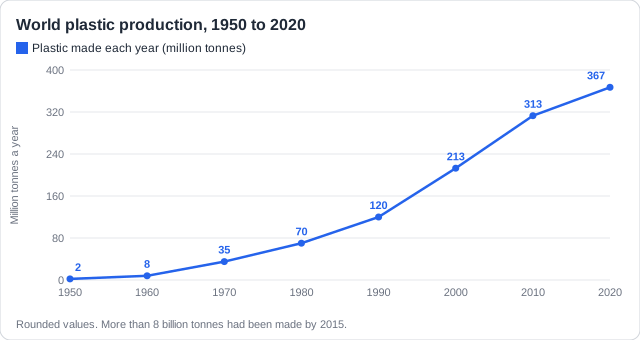
- More than 8 billion tonnes of plastic had been made by 2015; most still exists.
- Burning coal and oil makes tiny round fly ash particles, found in lakes on every continent.
- Future fossils of our objects are called technofossils.
Human-made minerals
- Crystals that grow on old mine walls and slag heaps.
- Formed as metal objects corrode over years.
- About 200 kinds known.
Human-made materials
- Concrete in cities and roads.
- Pure aluminium, almost never found in nature.
- Plastics, now in sediments worldwide.
Real example: on Kamilo Beach, Hawaii, scientists in 2014 described plastiglomerate, formed when plastic litter melted in campfires. It may one day be part of the rock record.
Study smarter, not longer
Most students waste 40% of study time on topics they already know. Our AI tracks your progress and optimizes every minute.
The last two signals come from living things and from the ground itself. People move species around the world and move vast amounts of soil and sediment.
Species and sediment
- People move species around the world, so native and non-native species now mix in the fossil record.
- The broiler chicken is the most common bird on Earth; its bones fill landfills on every continent.
- People change sediment: dams trap it, farming and building wash soil away, trawlers churn the sea floor.
- Each year people move more rock and soil than all the world's rivers carry to the sea.
- Rivers starved of sediment have shrinking deltas, which will show in the rock as a sharp change.
Remember it as: Chickens everywhere, rivers without mud.
Mixing of species
- Chicken bones: over 70 billion birds a year.
- Rats taken to islands worldwide.
- Pacific oysters now in European seas.
Changed sediment
- Large dams trap sediment.
- Soil washed off farms and building sites.
- Trawlers stir up the sea floor.
Real example: since the Aswan High Dam trapped the Nile's mud, the delta gets almost no new sediment, and parts of its coast are being worn away.
Does all this evidence show a new epoch? A good answer gives both sides, because the evidence is strong but geologists have not accepted the epoch.
Weighing the evidence
- For: the signals are global, start at about the same time (about 1950) and will last.
- For: carbon dioxide is far outside the Holocene's stable range, and it matches industrialisation.
- Against: Earth has always had natural warming and cooling cycles, which also change the record.
- Against: the layers are thin, may be eroded, and human impact began at different times.
- Against: in 2024 geologists voted against a formal epoch; it stays a proposed one.
Real example: Antarctic ice cores show carbon dioxide rising and falling with the ice ages, between about 180 and 300 ppm, for 800,000 years. Today it is over 420 ppm, and it kept rising even after the Kyoto Protocol. Natural cycles happen, but a change this fast, matching industrialisation, points to people.
Discuss means both sides: List evidence for a new epoch, then evidence against, then decide. One-sided answers, however detailed, cannot reach full marks.
Practice with exam-style questions
Answer exam-style questions and get AI feedback that shows you exactly what examiners want to see in a full-marks response.
How this comes up: Paper 2, Section B (c) [9]: discuss the evidence for a new geological epoch (2024 specimen). Or (a) [4] on types of evidence, or a Section A question on a sediment core.
Discuss the evidence suggesting human activity has given rise to what may be considered a new geological epoch.
Model answer plan
See the mark-by-mark plan — for / against / judgement, with marking guidance — in study mode.