The Anthropocene at Higher Level: This statement is Higher Level only. It asks what the proposed Anthropocene epoch is, when it might have begun, which golden spikes could mark it, and why geologists voted against it in 2024.
Practise this as you read
- Pair each proposed start date with its evidence.
- Weigh the case for and against a new epoch.
Free preview
This is the free notes preview
You're reading the free notes. Aimnova Pro unlocks the full study experience — and you can try it with your first topic free to keep:
- FlashcardsLock in vocabulary and key terms with spaced repetition.
- Practice questionsAnswer exam-style questions and get instant AI marking.
- Mock exams & past-paper vaultSit full mocks and see exactly how examiners award marks.
- Personalised study planA daily plan built around your exam date and weak areas.
Big picture: The Anthropocene is a proposed new unit of Earth's history: the time when people became the main force changing the planet.
The points to remember
- The Anthropocene is a proposed geological epoch: the age of humans ('anthropos' is Greek for human).
- It is marked by rapid environmental change and species extinction caused by human activity.
- The idea: humans are now the dominant force shaping Earth's rocks, ecosystems and climate.
- Change sped up sharply from the 1950s: the Great Acceleration in population, resource use and pollution.
- It is not official: we still live in the Holocene epoch, which began 11,700 years ago.
Remember it as: Anthropo-cene: the age of humans, proposed but not official.
The Great Acceleration is the heart of the idea. The world's population rose from 2.5 billion in 1950 to 8 billion in 2022.
Signs of the Anthropocene
- Carbon dioxide rose from about 280 ppm before industry to over 420 ppm today.
- Plastics and radioactive atoms from nuclear tests (from 1945) now lie in sediments worldwide.
- New materials such as concrete and pure aluminium are spread across the planet.
- Farming and cities have changed how sediment is worn away and laid down.
- Species are dying out far faster than normal: a possible sixth mass extinction.
Real example: where the name came from: In 2000 the Nobel Prize-winning chemist Paul Crutzen, who helped explain the ozone hole, said at a conference that we no longer live in the Holocene but in the Anthropocene. The word spread fast.
Never wonder what to study next
Get a personalized daily plan based on your exam date, progress, and weak areas. We'll tell you exactly what to review each day.
If there is an Anthropocene, when did it start? Every proposed date has evidence behind it, and each has problems.
Proposed start dates
- There is debate about whether the Anthropocene exists, and when it began.
- An epoch needs a start that shows up worldwide, at about the same time, in the rock.
- Early farming, about 10,000 years ago: forests cleared; but it began at different times in different places.
- The Industrial Revolution, from about 1750-1800: coal burning and rising carbon dioxide.
- The 1950s: the Great Acceleration and nuclear tests; the choice of most scientists who studied it.
Remember it as: Farms, 1610, factories, the 1950s: four starts, one debate.
Farming
- From about 10,000 years ago, forests were cleared for farms; later, flooded rice fields in Asia released methane. But farming spread slowly, so there is no single date.
1610
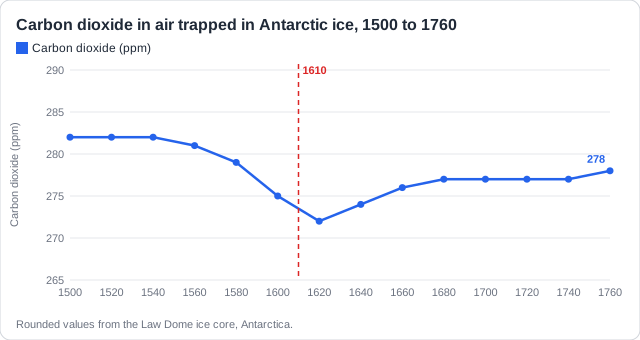
- After Europeans reached the Americas, disease and war killed tens of millions of Indigenous people. Their fields grew back into forest, and carbon dioxide dipped.
About 1800
- James Watt's steam engine (1784) and coal burning began the Industrial Revolution; carbon dioxide in ice cores starts to rise. Crutzen chose this date.
1950s
- Nuclear tests, fly ash, plastics and the Great Acceleration leave a sharp, worldwide signal. Most of the scientists studying the question chose this date.
In an answer, give a date AND its evidence: 'The 1950s, because nuclear tests left plutonium in sediments worldwide' is a point. 'The 1950s' on its own is not.
Geologists mark the start of every unit of time with one golden spike. The guide names three candidates for the Anthropocene.
Three candidate golden spikes
- A golden spike is a marker in the rock, ice or mud that shows where an epoch begins.
- 1610: a dip in carbon dioxide after Europeans arrived in the Americas.
- 1950: tiny round fly ash particles from burning coal and oil appear in lake mud worldwide.
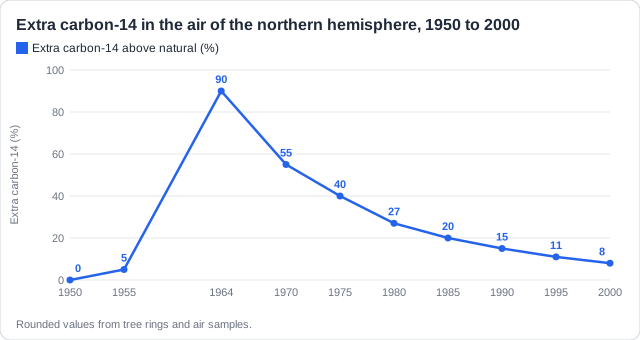
- 1964: a peak of carbon-14 from nuclear bomb tests, in tree rings, corals and sediment.
- A good spike is global, sharp and will last in the rock for millions of years.
| Spike | What caused it | Where it is found |
|---|---|---|
| 1610 carbon dioxide dip | Forest regrowth after millions of deaths in the Americas | Air bubbles in Antarctic ice |
| 1950 fly ash | Burning coal and oil at high heat in power stations | Lake mud around the world |
| 1964 carbon-14 peak | Nuclear bomb tests in the air, stopped by a 1963 treaty | Tree rings, corals, sediment |
Real example: in 2023 the scientists studying the Anthropocene chose the mud of Crawford Lake, Ontario, Canada, as their golden spike. Its layers, one for each year, show plutonium from bomb tests rising sharply from 1950.
Stop wasting time on topics you know
Our AI identifies your weak areas and focuses your study time where it matters. No more overstudying easy topics.
So is the Anthropocene a real epoch? Geologists have argued about it for over 20 years, and the answer so far is no, at least not officially.
The debate
- For: human signals are global, sharp, lasting, and unlike anything in the Holocene.
- Against: about 75 years is very short for an epoch; the Holocene has lasted 11,700 years.
- Against: human impact began at different times in different places, so no single start date fits.
- Against: the layers are only a few centimetres thick, and the choice may be political, not geological.
- In March 2024 geologists voted 12 to 4 against making it a formal epoch; the decision was upheld.
Useful for science
- Links the study of rocks, climate and living things.
- Measures how far people have changed Earth.
- But as a formal epoch, rejected in 2024.
Useful for policy
- A powerful word that shows how urgent change is.
- Makes people ask who is responsible.
- But 'humans' hides that rich countries caused far more.
Real example: in March 2024 a panel of the International Union of Geological Sciences voted 12 to 4 against adding the Anthropocene to the timescale, and the Union upheld the vote. It said the word stays useful to describe human impact, as an informal term.
How this comes up: Paper 2, Section B: (a) [4] on proposed golden spikes, (b) [7] on the debate, or (c) [9] on how useful the Anthropocene idea is.
In 2024 geologists rejected the Anthropocene as a formal epoch, yet the term is widely used by scientists and governments.
Explain why there is debate about the existence and the beginning of the Anthropocene epoch.
Model answer plan
See the mark-by-mark plan — for / against / judgement, with marking guidance — in study mode.