Biodiversity and its three levels at Higher Level: The same three levels as SL, with different examples: Borneo, Mount Kinabalu and Yunnan. At HL, expect to outline how the levels are linked, and to explain why some regions are far richer than others.
Practise this as you read
- Link the levels: say which one causes which.
- Quote the figure's facts when you explain a region's diversity.
Free preview
This is the free notes preview
You're reading the free notes. Aimnova Pro unlocks the full study experience — and you can try it with your first topic free to keep:
- FlashcardsLock in vocabulary and key terms with spaced repetition.
- Practice questionsAnswer exam-style questions and get instant AI marking.
- Mock exams & past-paper vaultSit full mocks and see exactly how examiners award marks.
- Personalised study planA daily plan built around your exam date and weak areas.
Life at three sizes: Biodiversity is the total diversity of living systems. It exists at three levels: the places things live, the kinds of living things, and the genes inside each kind.
The points to remember
- Biodiversity is the total diversity of living systems in an area.
- It exists at three levels: habitat diversity, species diversity and genetic diversity.
- Habitat diversity: the range of different habitats in an area.
- Species diversity: how many species there are and how evenly they are spread.
- Genetic diversity: the range of genes within one species or population.
- It can also be given as the amount of biological diversity per unit area.
Remember it as: Three sizes of variety: places, kinds, genes.
Habitat diversity
- Mangroves, peat swamp, lowland rainforest and mountain forest
- Like a park with ponds, woods and meadows
Species diversity
- About 15,000 kinds of flowering plant
- Orangutans, hornbills, pitcher plants
Genetic diversity
- Orangutans on each side of big rivers differ
- Like the many breeds of one species, the dog
Real example: the island of Borneo shows all three levels: habitats from mangroves to mountain forest, about 15,000 kinds of flowering plant, and orangutan groups whose genes differ.
Richness is not a level: Asked for 'another level of biodiversity', write genetic or habitat diversity. Richness and evenness are parts of species diversity, not separate levels.
Stop wasting time on topics you know
Our AI identifies your weak areas and focuses your study time where it matters. No more overstudying easy topics.
Species diversity and habitat diversity are the two levels you can see. Each has its own parts.
The points to remember
- Species diversity has two parts: richness (how many species) and evenness (how equal their numbers).
- Habitat diversity is the range of habitats in an ecosystem or biome.
- Habitats change along gradients: altitude, latitude, wet to dry, salty to fresh.
- Disturbances such as volcanoes, landslides or floods add new, different habitats.
- More habitats give more niches, food, nursery grounds and shelter from predators, so more species live there.
Species diversity
- Richness: the number of species
- Evenness: how similar their numbers are
- High when many species are all fairly common
Habitat diversity
- The range of habitats in an area
- Set by altitude, latitude and conditions
- Renewed by disturbances such as floods
Real example: in Borneo, the tide-flooded mangroves, the waterlogged peat swamp, the lowland rainforest and the cool mountain forest are different habitats, each with its own species.
Say both parts: When you describe species diversity, mention richness AND evenness: ten species where one covers almost everything is less diverse than ten species in equal numbers.
Genetic diversity is the level inside a species: individuals of one species carry slightly different versions of their genes.
The points to remember
- Genetic diversity is the range of genes in a population or species.
- It shows as variety: breeds of dog, kinds of apple or potato.
- It rises through mutation, sexual reproduction and natural selection in different places.
- Populations cut off from each other build up different genes over time.
- Small populations lose genetic diversity.
Remember it as: Same species, different genes: every dog is a dog.
Real example: Bornean orangutans are one species, but groups separated by Borneo's wide rivers have built up different genes, so scientists split them into three subspecies.
Genes, not species: Genetic diversity is about variety WITHIN one species. 'Many kinds of bird' is species diversity, not genetic diversity.
See how examiners mark answers
Answer exam-style questions with model answers. Learn exactly what earns marks and what doesn't.
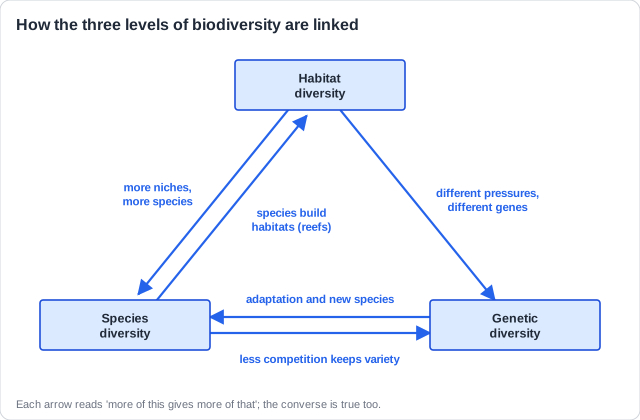
The three levels are not separate boxes: each one feeds the others. Questions ask you to outline these links.
The points to remember
- More habitats give more niches, so species diversity rises.
- Different habitats set different selection pressures, so genetic diversity rises.
- More genetic diversity helps species survive, adapt and even split into new species.
- Many species build habitats for others (corals build reefs, trees make forest layers).
- Many species share out resources, so each population keeps its variety of genes.
- The converse is true too: lose one level and the others fall.
Real example: Mount Kinabalu in Borneo rises from rainforest to bare rock at 4,095 m. Each height has its own habitat and niches, and more than 5,000 kinds of plant grow on the mountain, many adapted to one zone only.
Outline the links: Define each level for up to two points, then give links: 'more habitats, so more niches, so more species'. Say which level causes which.
Some places hold far more species than others. Data questions ask you to find the reasons in a fact file or a table.
The points to remember
- A range of habitats (mountains to coast) gives many niches.
- Big changes in altitude make zones of different habitat.
- A range of climates in one place: wet and dry, warm and cold.
- Isolation (an island, a mountain range) keeps out competitors and lets new species form.
- Warm, wet, sunny places near the equator are productive, and large protected areas keep species safe.
- Volcanic activity and succession keep making new habitats.
- Comparing two places: habitat loss (clearing for farms) or more surveys can explain a difference.
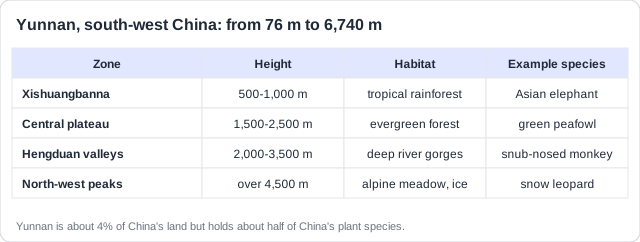
Real example: Yunnan, China, is about 4% of China's land but holds about half of China's plant species: it runs from 76 m to 6,740 m, from rainforest to glaciers.
Traps: For plant diversity, 'high rainfall' alone is not enough: say 'a RANGE of climates'. 'Conservation efforts' or 'a large area' do not explain diversity, and nor does 'more resources' alone. Human impacts explain why one place has lost species, but never count as factors that ADD biodiversity. When comparing two places, name the one with more.
Study smarter, not longer
Most students waste 40% of study time on topics they already know. Our AI tracks your progress and optimizes every minute.
Three short data skills come up again and again: telling two places apart, working out a percentage, and saying why a place matters.
The points to remember
- Distinguish = say which one has more, and of what: richness, evenness, habitats.
- Found only here = endemic.
- A percentage: part / total x 100, then round correctly.
- It matters for conservation if it has endemic species, many habitats, high biodiversity or little disturbance.
- Other reasons: legal protection, ecosystem services, cultural value, ecotourism.
- Use the figure's own facts: only the first two answers count.
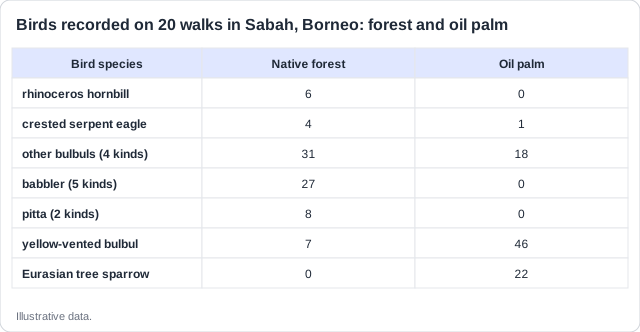
Distinguish: the native forest has greater richness and evenness; in oil palm two birds make up most records. Real example: Madagascar has about 11,000 native plants and about 9,000 grow nowhere else: 9,000 / 11,000 x 100 = 81.8%.
Round as asked: Give the number of decimal places the question asks for, and round the last one correctly: 68.888 is 68.9, not 68.8.
How this comes up: Paper 2, Section B (a): outline how the levels of biodiversity are linked, using an example [4].
Mount Kinabalu in Borneo rises from lowland rainforest at the coast to bare granite peaks at 4,095 m.
Outline how the habitat diversity of the mountain can increase its species diversity and its genetic diversity.
Model answer plan
See the mark-by-mark plan — for / against / judgement, with marking guidance — in study mode.