Biodiversity and evolution at Higher Level: The same statement as SL, with different real cases: Croatia's wall lizards, the tree of life, Lake Victoria's cichlids and coral reefs. At HL, later statements build on this one: mutation, isolation and deep time.
Practise this as you read
- Define evolution in the guide's words: cumulative, heritable, population.
- Explain how one ancestor becomes many species, with a named example.
Free preview
This is the free notes preview
You're reading the free notes. Aimnova Pro unlocks the full study experience — and you can try it with your first topic free to keep:
- FlashcardsLock in vocabulary and key terms with spaced repetition.
- Practice questionsAnswer exam-style questions and get instant AI marking.
- Mock exams & past-paper vaultSit full mocks and see exactly how examiners award marks.
- Personalised study planA daily plan built around your exam date and weak areas.
Life changes over time: Biodiversity exists because life evolves. Evolution slowly builds new features, and in time new species.
The points to remember
- Evolution is cumulative change in the heritable characteristics of a population or species.
- Heritable: passed from parents to offspring in their genes, e.g. the shape of a beak.
- Cumulative: small changes add up over many generations.
- Populations evolve, not single animals: an individual cannot change its genes.
- A change gained in one lifetime (big muscles, a scar) is not heritable, so it is not evolution.
Remember it as: Heritable, cumulative, population: evolution in three words.
Real example: in 1971 scientists moved five pairs of Italian wall lizards from one small Croatian island to a nearby one, Pod Mrcaru. By 2008 their descendants had bigger heads, a stronger bite and new folds in the gut for digesting plants: heritable changes built up over about 30 generations.
Not evolution: A horse that gets fitter with training, or a plant that grows taller with fertiliser, has not evolved. The change is not in its genes, so it is not passed on.
Get feedback like a real examiner
Submit your answers and get instant feedback — what you did well, what's missing, and exactly what to write to score full marks.
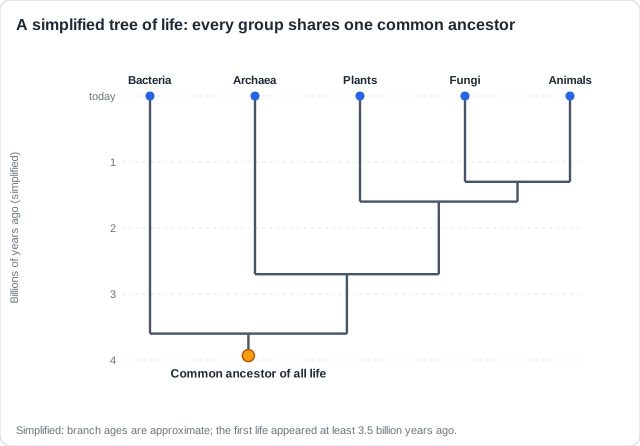
Over millions of years, evolution splits one species into many. Every living thing shares one common ancestor.
The points to remember
- Over long periods, evolution produces new species: this is where biodiversity comes from.
- All living things share one common ancestor, from at least 3.5 billion years ago.
- One species reaching a place with empty niches can split into many: adaptive radiation.
- Each new species suits a different food or habitat, so species diversity rises.
- Species also go extinct: today's biodiversity is new species formed minus species lost.
Real example: Lake Victoria in East Africa holds more than 500 species of cichlid fish, almost all found nowhere else. The lake was almost dry about 15,000 years ago, so many of them evolved very fast, each eating a different food: adaptive radiation.
Link evolution to biodiversity: Say the link in full: 'evolution produces new species, so species diversity increases'.
Evolution adds to all three levels of biodiversity: genetic, species and habitat.
The points to remember
- Genetic diversity is the raw material: evolution needs differences between individuals.
- Evolution turns those differences into new species: species diversity.
- Living things build and change habitats (reefs, forests), adding habitat diversity.
- More biodiversity gives more ways to cope with change: higher resilience.
Remember it as: Genes vary, species split, habitats grow, systems cope.
Genetic
- Corals of one species differ in how much heat they tolerate.
Species
- About 600 coral species on the Great Barrier Reef.
Habitat
- Corals built the reef itself, a habitat for thousands of fish species.
Real example: reef-building corals have evolved for over 200 million years. The reefs they built now hold about a quarter of all marine species, though they cover under 1% of the sea floor.
From evolution to resilience: For a longer answer, carry the chain on: evolution creates species, speciation raises biodiversity, and higher biodiversity makes ecosystems more resilient.
Learn what examiners really want
See exactly what to write to score full marks. Our AI shows you model answers and the key phrases examiners look for.
How this comes up: Paper 2, Section B (b): explain how evolution gives rise to biodiversity, with named examples [7].
Lake Victoria, Hawaii and the Galapagos Islands are famous for large numbers of closely related species.
Explain how evolutionary processes give rise to biodiversity.
Model answer plan
See the mark-by-mark plan — for / against / judgement, with marking guidance — in study mode.