Diversity and resilience at Higher Level: The same ideas as SL, with different evidence: a drought experiment at Cedar Creek, the lost Gros Michel banana, Isle Royale's wolves and push-pull farming in Kenya. At HL, expect longer answers that weigh diversity against the pull of monocultures.
Practise this as you read
- Link each component of diversity to resilience in so many words.
- Weigh gains against costs with named examples.
Free preview
This is the free notes preview
You're reading the free notes. Aimnova Pro unlocks the full study experience — and you can try it with your first topic free to keep:
- FlashcardsLock in vocabulary and key terms with spaced repetition.
- Practice questionsAnswer exam-style questions and get instant AI marking.
- Mock exams & past-paper vaultSit full mocks and see exactly how examiners award marks.
- Personalised study planA daily plan built around your exam date and weak areas.
Variety is a safety net: Every level of biodiversity adds to an ecosystem's resilience. With more species, an ecosystem keeps working when one species is lost, like a team with lots of substitutes.
The points to remember
- More species usually means more resilience.
- Redundancy: several species do the same job, so if one is lost another takes over its niche.
- More food chains and pathways: energy and nutrients can flow another way.
- A variety of species is more likely to include some that resist the change.
- Lose species and the web gets simpler, so one disturbance hits harder and can pass a tipping point.
Remember it as: More threads in the web: cut one and it still holds.
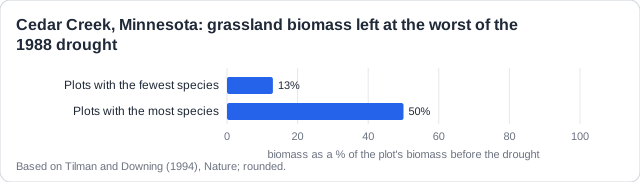
Real example: at Cedar Creek, Minnesota, scientists had grown grassland plots with different numbers of species. In the 1988 drought the species-rich plots kept far more of their growth, and recovered faster, because some of their species could cope with dry soil.
Say the word 'resilience': Link every point to resilience in so many words: 'so it recovers after the disturbance'. A point about species that never says why the system is more resilient is not complete.
Practice with exam-style questions
Answer exam-style questions and get AI feedback that shows you exactly what examiners want to see in a full-marks response.
The second component is genetic diversity. It decides whether a species can survive something new, such as a disease or a drier climate: some plants survive drought better than others of the same kind.
The points to remember
- Genetic diversity means some individuals survive a new disease, pest or climate.
- The survivors breed, so the population recovers and adapts.
- Low genetic diversity: every individual is equally at risk, so one disease can wipe out the lot.
- Crops grown as one variety (or clones) have almost no genetic diversity.
Remember it as: Same genes, same fate.
Real example: the Gros Michel banana was grown as identical clones. Panama disease wiped it out as an export crop by the 1960s. Its replacement, the Cavendish, is a clone too, and a new strain of the disease is now spreading.
Genes, then survival, then recovery: Write the chain: more genetic diversity, so some individuals resist the change, so they survive and breed, so the population recovers.
Size matters too. A large population is a big storage; a small one can vanish after a single bad event.
The points to remember
- Large populations hold bigger storages and more genetic diversity, so they last through bad years.
- Small populations can die out after one disturbance, or just by chance.
- Cut off in a small area: inbreeding, a small gene pool, less disease resistance.
- Crowded together: disease spreads fast, competition rises, one fire can kill most of them.
- Home ranges outside the protected area: animals there are hunted or killed by accident.
- Many small populations of different species beat one huge population of one dominant species.
- Big populations of foundation species (corals, kelp) add resilience; big invasive populations reduce it.
Remember it as: Few, crowded and cut off: one blow can finish them.
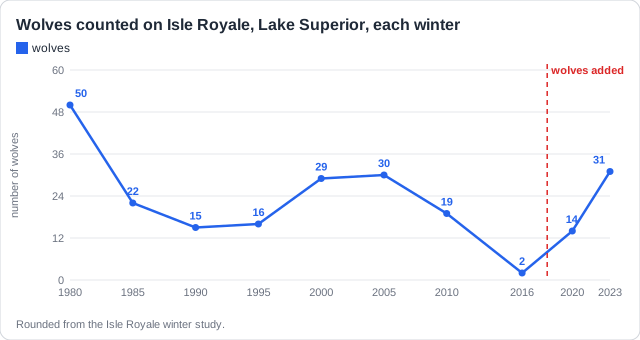
Real example: wolves reached Isle Royale, an island in Lake Superior, over the ice in the 1940s. In the early 1980s a dog virus cut them from 50 to 14. With no new wolves arriving, inbreeding caused bone deformities, and by 2016 only two were left. From 2018, wolves were brought in from the mainland.
Cover both, when asked for both: A question on species diversity AND population size needs points on each. Answers about only one of them cannot get full marks.
Feeling unprepared for exams?
Get a clear study plan, practice with real questions, and know exactly where you stand before exam day. No more guessing.
The third component is habitat diversity. A natural forest with many habitats is compared with a plantation monoculture.
The points to remember
- A mix of habitats gives refuges: species survive a disturbance in one patch and recolonise the rest.
- Natural forest: many tree species of every age, complex food webs, deep leaf litter.
- Plantation monoculture: one tree species, same age, often the same genes.
- So plantations suffer more from pests, disease, storms, fire and drought.
- Fewer habitats and niches mean fewer species in the plantation, so it is less resilient.
- Plant cover shields soil from erosion and keeps it moist; plantations can also exhaust the soil.
Real example: in Portugal, eucalyptus plantations now cover about a quarter of the forest. In June 2017 the Pedrogao Grande fire spread through them and killed 66 people.
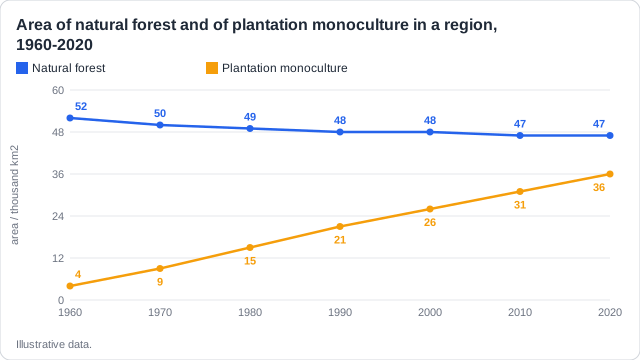
Reading two trends: To distinguish two trends, compare their rates: 'plantation rises faster than natural forest falls'. 'One is higher than the other' does not describe the trends.
Farms and fisheries are ecosystems too. Diversity at every level helps food production keep going year after year, which makes it more sustainable.
The points to remember
- Genetic diversity: many crop varieties and wild relatives hold genes for resisting disease and drought.
- Species diversity: polyculture, pollinators and natural pest enemies keep yields steady.
- Habitat diversity: hedges, ponds and buffer strips shelter pollinators and pest-eaters.
- Monocultures give big, cheap harvests but are fragile: one pest or disease can ruin them.
- Diversity can also be protected in seed banks, or added by breeding and genetic modification.
- Crop rotation, organic farming and biological pest control use diversity instead of chemicals.
Diversity helps
- Mixed crops: one failure is not a disaster
- Wild pest-eaters cut pesticide use
- Varied genes resist new diseases
But
- Monocultures feed more people cheaply
- Machines and markets suit one crop
- Farmed salmon escape and dilute wild genes
Real example: in Kenya, push-pull farming plants desmodium between maize rows and Napier grass around the edge, which lures the pests out. Maize yields rise with no pesticide. Crop genes are also stored in the Svalbard Global Seed Vault, Norway, which holds over a million seed samples.
Name a farm for every point: In a long answer, tie each point to a named system and place, then weigh it against the big yields of monocultures before you conclude.
Memorize terms 3x faster
Smart flashcards show you cards right before you forget them. Perfect for definitions and key concepts.
How this comes up: Paper 2, Section B (b): explain, with a named species, why small populations are less resilient [7].
Many rare species now survive only as small populations in protected areas.
With reference to a named species, explain why small, isolated populations are less resilient than large ones.
Model answer plan
See the mark-by-mark plan — for / against / judgement, with marking guidance — in study mode.