Natural selection at Higher Level: The same statement as SL, with different real cases: rock pocket mice, Acanthostega, whales, eucalyptus and the Florida panther. At HL this mechanism returns in human-driven selection, artificial selection and deep time.
Practise this as you read
- Link every change to a selection pressure in the environment.
- Give each factor that changes genetic diversity its effect: up or down, and why.
Free preview
This is the free notes preview
You're reading the free notes. Aimnova Pro unlocks the full study experience — and you can try it with your first topic free to keep:
- FlashcardsLock in vocabulary and key terms with spaced repetition.
- Practice questionsAnswer exam-style questions and get instant AI marking.
- Mock exams & past-paper vaultSit full mocks and see exactly how examiners award marks.
- Personalised study planA daily plan built around your exam date and weak areas.
The environment chooses: Natural selection is the mechanism that drives evolution. A selection pressure filters each generation: what fits, passes.
The points to remember
- Natural selection is the mechanism that drives evolutionary change.
- A selection pressure (a predator, drought, disease, cold) decides who survives.
- Individuals better adapted survive and reproduce more, so their genes become more common.
- It is not deliberate: nothing plans it; the environment keeps what works there.
- 'Fittest' means best suited to that environment, not the strongest.
Remember it as: The environment is the filter: what fits passes through.
Real example: in the deserts of Arizona and New Mexico most rock pocket mice are sandy-coloured, but on black lava flows most are dark. Owls catch the mice that stand out, so each rock colour selects the fur colour that matches it.
Nobody chooses: Do not write that animals 'try to adapt' or 'decide to change'. The variation is already there; the selection pressure decides which individuals survive to breed.
Feeling unprepared for exams?
Get a clear study plan, practice with real questions, and know exactly where you stand before exam day. No more guessing.
Natural selection never stops, and it has had a very long time to work.
The points to remember
- Natural selection works continuously: in every generation, in every population.
- It can act over billions of years: life has evolved for at least 3.5 billion years.
- Environments keep changing (a drought kills food plants, the climate shifts), so the 'best' trait changes too.
- Adapting takes many generations; if change is too fast, a species can go extinct.
- Small changes add up until whole new body parts (lungs, legs) appear: the biodiversity of life.
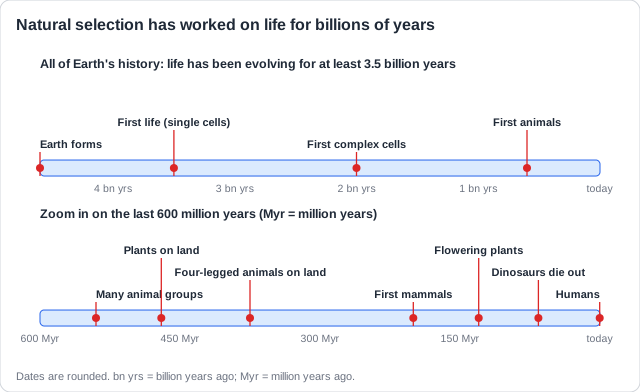
Real example: Acanthostega lived about 365 million years ago. It had legs with eight fingers, yet still had gills and lived mostly in water: legs evolved before animals left the water.
Too fast to adapt: Selection needs many generations. If the environment changes faster than that, for example a warming climate or a new predator, a species may die out instead of adapting.
One favourite exam question: how could a land animal evolve from an ancestor that lived in water? The answer is natural selection, step by step.
Water to land, step by step
- The ancestors had genetic variation, from mutations built up over many years.
- Some features gave an advantage on land: sturdy fins, simple lungs.
- Individuals with them could colonise land, with less competition and new food.
- They were more likely to survive and reproduce (natural selection).
- Their offspring inherited the features, which became more common each generation.
- In time the land group could not breed with the water group: a new species.
Variation
- About 50 million years ago, small land mammals such as Pakicetus varied in how well they swam.
Advantage
- In shallow seas rich in fish, good swimmers found more food.
Colonise
- They spent more time in water, with little competition from other mammals.
Inherit
- Their young inherited streamlined bodies; legs shrank over generations.
New species
- After about 10 million years, fully sea-living whales, a new group of species.
Finish with the new species: The last mark is often for speciation: say the land group became unable to breed with the water group, so a new species formed.
Memorize terms 3x faster
Smart flashcards show you cards right before you forget them. Perfect for definitions and key concepts.
Why does natural selection increase the number of species? Because it can take groups of one species in different directions.
The points to remember
- Natural selection acts on existing genetic variation, made by mutations over long periods.
- It raises the survival of the fittest variations.
- These traits are heritable: selected individuals reproduce more and pass them on.
- Their share rises in later generations, so species adapt to different environments.
- With reproductive isolation this leads to speciation, so species diversity increases.
Remember it as: Variation in, fittest survive, traits spread, groups split, species multiply.
Real example: Australia has more than 700 species of eucalyptus. As the continent dried out, selection fitted different groups to different soils, rainfall and fire, and many became separate species.
Two marks, two linked points: For 'the role of natural selection in increasing species diversity', link selection to adaptation, then adaptation plus isolation to new species. Stopping at 'the fittest survive' is not enough.
A population's genetic diversity is not fixed: it goes up and down over time.
Can increase it
- Mutation makes new genotypes.
- Migration mixes populations and brings new genes.
- A changing climate can select new genotypes.
- Tectonic barriers split populations, which then diverge.
- Escaped farmed or bred animals add new genes to wild ones.
Can reduce it
- Natural selection removes less fit genotypes.
- Hunting, pollution, habitat loss, alien species shrink it to a bottleneck.
- Genetic drift: genes lost by chance in small populations.
- A changing climate can wipe out some genotypes.
Say how, not just what: 'Mutation' alone is only half an answer. Write the factor and its effect: 'mutation creates new genotypes, so genetic diversity increases'. Four bare factors get at most half the marks.
Real example: by the 1990s fewer than 30 Florida panthers were left, and inbreeding caused heart defects. In 1995 eight female pumas from Texas were released; migration brought new genes and the population grew to over 120.
Know your predicted grade
Take timed mock exams and get detailed feedback on every answer. See exactly where you're losing marks.
How this comes up: Paper 2, Section B (a): identify four reasons why a population's genetic diversity may change [4].
The Florida panther fell to fewer than 30 animals in the 1990s. Eight female pumas from Texas were released in 1995, and the population has since grown to over 120.
Identify four reasons why the genetic diversity of a population may change over time.
Model answer plan
See the mark-by-mark plan — for / against / judgement, with marking guidance — in study mode.