Deep time at Higher Level: This statement is Higher Level only. It asks you to picture Earth's 4.5-billion-year history, the slow processes that led to life as it is today, and how fossils show that story.
Practise this as you read
- Quote the key dates: 4.5 billion, 3.7 billion, 600 million years ago.
- Link each fossil clue to evolution.
Free preview
This is the free notes preview
You're reading the free notes. Aimnova Pro unlocks the full study experience — and you can try it with your first topic free to keep:
- FlashcardsLock in vocabulary and key terms with spaced repetition.
- Practice questionsAnswer exam-style questions and get instant AI marking.
- Mock exams & past-paper vaultSit full mocks and see exactly how examiners award marks.
- Personalised study planA daily plan built around your exam date and weak areas.
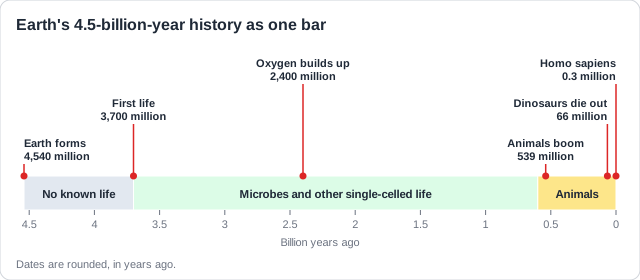
A history too long to picture: Earth has a history of about 4.5 billion years. Scientists call this huge span deep time.
The points to remember
- Earth is about 4.5 billion years old (4,540 million years).
- Its age comes from radiometric dating: radioactive atoms in rocks decay at a known, steady rate.
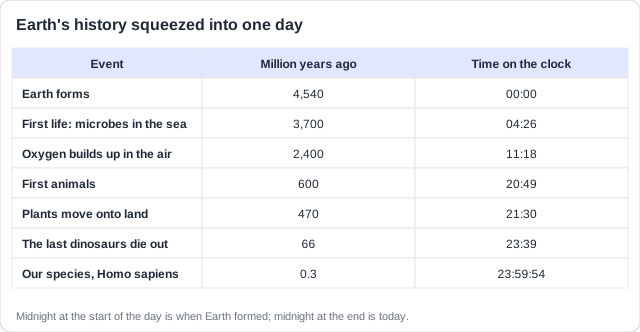
- Life appeared about 3.7 billion years ago, as microbes in the sea.
- For most of Earth's history, life was single-celled; animals appear only in the last 600 million years.
- Humans are very recent: squeeze Earth's history into one day and we arrive 6 seconds before midnight.
Remember it as: 4.5 billion years: microbes for most of it, animals at the end, humans in the last seconds.
Real example: tiny crystals of zircon from the Jack Hills of Western Australia are 4.4 billion years old, the oldest pieces of Earth known.
Feeling unprepared for exams?
Get a clear study plan, practice with real questions, and know exactly where you stand before exam day. No more guessing.
Some changes are too slow to see in a lifetime, but over deep time they shaped every living thing. The key one is the build-up of oxygen.
Slow processes that shaped life
- Evolution by natural selection needs many generations, so big changes take millions of years.
- Oxygen built up slowly: microbes made it for hundreds of millions of years before it filled the air.
- Oxygen allowed complex life that respires aerobically, and an ozone layer that shields the land.
- Plate tectonics moves continents a few centimetres a year, joining and splitting habitats.
- Climate and sea level change over thousands to millions of years, changing selection pressures.
Remember it as: Slow air, slow rocks, slow selection: life needed all of deep time.
3.5 billion
- Cyanobacteria build mats called stromatolites. Living ones still grow at Shark Bay, Australia.
2.4 billion
- After hundreds of millions of years, their oxygen fills the air: the Great Oxidation Event. Rusted iron layers at Karijini, Australia, record it.
600 million
- With more oxygen, larger cells and the first animals can respire aerobically and grow.
470 million
- An ozone layer from the oxygen blocks harmful ultraviolet light, so plants can live on land.
Real example: seeing deep time in rock: In 1788 the geologist James Hutton stood at Siccar Point, Scotland, and saw tilted grey rock under flat red sandstone. Laying down, tilting and wearing away rock takes vast time, so he realised Earth must be far older than people thought.
How do we know how life changed? Mostly from fossils, read layer by layer.
What fossils tell us
- A fossil is the preserved remains or trace of an organism, usually in sedimentary rock.
- Rock layers build up in order: deeper layers are older, so fossils show the order of life.
- Radiometric dating of volcanic layers gives the age of the fossils between them.
- The record shows life changing from simple to complex, and groups appearing in a sequence.
- Transitional fossils link groups: Tiktaalik (fish to land animal), Archaeopteryx (dinosaur to bird).
- The record is incomplete: soft bodies rarely fossilise, and many rocks are eroded or unexplored.
Remember it as: Deeper is older; fossils show the order; dating gives the age.
Grand Canyon, lower layers
- About 500 million years old.
- Trilobites and other simple sea animals.
- No land animals.
Grand Canyon, upper layers
- About 270 million years old.
- Footprints of reptiles and early land animals.
- Fossil ferns and land plants.
Real example: in 2004 scientists searched 375-million-year-old rock on Ellesmere Island, Canada, for a fish-to-land-animal link, and found Tiktaalik: a fish with gills and scales, but a neck and leg-like fins. The order of the layers told them where to dig.
The record has gaps: Most organisms rot before they fossilise, soft bodies (worms, jellyfish) are rarely kept, and many rocks are eroded or buried. Say the record is incomplete, not that it is wrong.
Memorize terms 3x faster
Smart flashcards show you cards right before you forget them. Perfect for definitions and key concepts.
How this comes up: Paper 2, Section B (a) [4] or (b) [7] on fossils and deep time, or a Section A question on a timeline of when groups first appear.
The oldest known fossils are about 3.5 billion years old; the first fossils of land animals are about 370 million years old.
Outline how fossils help to explain the evolution of life over the geological timescale.
Model answer plan
See the mark-by-mark plan — for / against / judgement, with marking guidance — in study mode.