Artificial selection at Higher Level: An HL-only statement. Every banana, cow and ear of wheat you meet was shaped by people choosing which plants and animals should breed. That choice gave us more food, and a hidden weakness.
Practise this as you read
- Distinguish natural from artificial selection.
- Explain how artificial selection lowers genetic diversity and resilience, and evaluate the value of genetic diversity.
Free preview
This is the free notes preview
You're reading the free notes. Aimnova Pro unlocks the full study experience — and you can try it with your first topic free to keep:
- FlashcardsLock in vocabulary and key terms with spaced repetition.
- Practice questionsAnswer exam-style questions and get instant AI marking.
- Mock exams & past-paper vaultSit full mocks and see exactly how examiners award marks.
- Personalised study planA daily plan built around your exam date and weak areas.
Deliberate breeding, less diversity: Artificial selection reduces genetic diversity and, consequently, species resilience. Unlike natural selection, it is deliberate: people choose which individuals breed.
The points to remember
- Natural selection is not deliberate: the environment decides which individuals survive and breed.
- Artificial selection (selective breeding) is deliberate: people choose which plants or animals breed.
- Breeders choose traits useful to people: high yield, fast growth, taste, a calm temper.
- Repeated over many generations, it changes a species fast: all our crops and livestock.
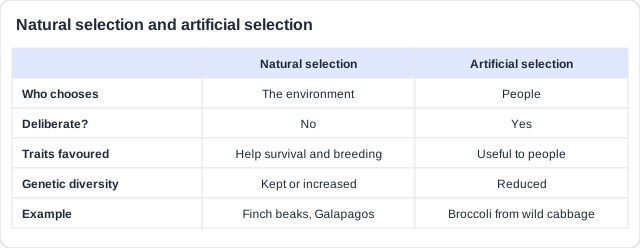
Real example: cabbage, kale, broccoli, cauliflower, Brussels sprouts and kohlrabi are all one species, bred from wild cabbage by choosing plants with big leaves, buds or flower heads. Maize was bred from teosinte about 9,000 years ago. Today's livestock breeds grow faster and more efficiently than their ancestors.
Study smarter, not longer
Most students waste 40% of study time on topics they already know. Our AI tracks your progress and optimizes every minute.
Every breeding choice keeps a few alleles and throws the rest away.
Why artificial selection reduces genetic diversity
- Only a few chosen parents breed, so most alleles of the wild population are left behind.
- Breeders want uniform crops and animals, so they breed close relatives together.
- Many crops are clones, grown from cuttings or tubers: every plant is genetically identical.
- A few high-yield breeds and varieties replace thousands of local ones.
- Wild relatives of crops are lost as their habitats become farmland.
Real example: the Holstein is the world's most common dairy cow. There are millions of them, but artificial insemination means a few top bulls father most calves. Their genetic diversity is like that of fewer than 100 animals: a genetic bottleneck. Modern wheat, too, carries far less diversity than its wild ancestors.
The cost to the animals: Breeding for output has trade-offs. Broiler chickens reach slaughter weight in about six weeks, but many have leg and heart problems; very high-yield dairy cows are more often lame and less fertile, and intensive herds need more feed and produce more waste.
Low genetic diversity leaves a crop or breed with no back-up when something new arrives.
Low diversity, low resilience
- With little genetic diversity, few or no individuals can resist a new disease, pest or climate.
- One disease can wipe out a whole crop or herd: the species has low resilience.
- In a monoculture of one variety, a pest spreads easily from plant to plant.
- Farmers then need more pesticides and fungicides, which cost money and pollute.
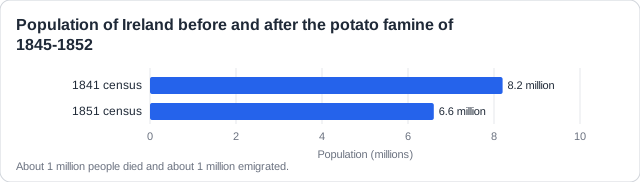
Real example: most poor Irish families grew one potato variety, the Lumper, planted from tubers, so every plant was a clone. When potato blight arrived in 1845, no plant could resist it. Bananas repeat the story: the Gros Michel banana was wiped out by Panama disease in the 1950s, and its clone replacement, the Cavendish, is now threatened by a new strain.
Remember it as: Clones share one weakness.
Practice with exam-style questions
Answer exam-style questions and get AI feedback that shows you exactly what examiners want to see in a full-marks response.
Why keep genetic diversity? The reasons are both economic and environmental.
The value of genetic diversity
- Economic: old varieties and wild relatives hold alleles for disease resistance and drought or heat tolerance.
- Economic: diverse crops and herds mean fewer crop failures and lower costs.
- Environmental: diverse populations can adapt to climate change and new diseases: resilience.
- Environmental: resistant, varied crops need fewer chemicals, so less pollution and healthier ecosystems.
- Seed banks and protected habitats of wild relatives keep this diversity for the future.
Real example: in the 1970s grassy stunt virus destroyed rice crops across Asia. Scientists tested thousands of rice samples and found resistance in one population of wild rice from India; it was bred into new varieties within a few years. The Svalbard Global Seed Vault now keeps more than a million seed samples.
Economic perspective
- Genes for future breeding
- Fewer crop failures
- Lower pesticide costs
Environmental perspective
- Adapt to climate change
- Fewer chemicals, less pollution
- Keep wild relatives' habitats
How this comes up: Expect a Section B (a) [4] on how breeding lowers resilience, with a named crop or breed, or a (b) [7] or (c) [9] weighing the value of genetic diversity. Name the example: [3 max] without one.
Almost every banana sold in shops around the world is a Cavendish, grown from shoots cut from other banana plants.
Outline how artificial selection has reduced the resilience of the Cavendish banana.
Model answer plan
See the mark-by-mark plan — for / against / judgement, with marking guidance — in study mode.
Close the chain: Deliberate choice, then less genetic diversity, then less resilience: name all three links.