Geological epochs at Higher Level: This statement is Higher Level only. It shows how Earth's history is divided into eons, eras, periods and epochs, and why each boundary sits where the fossils change.
Practise this as you read
- Order the four ranks from largest to smallest.
- Explain a boundary with fossils and the environment.
Free preview
This is the free notes preview
You're reading the free notes. Aimnova Pro unlocks the full study experience — and you can try it with your first topic free to keep:
- FlashcardsLock in vocabulary and key terms with spaced repetition.
- Practice questionsAnswer exam-style questions and get instant AI marking.
- Mock exams & past-paper vaultSit full mocks and see exactly how examiners award marks.
- Personalised study planA daily plan built around your exam date and weak areas.
A calendar for deep time: To talk about 4.5 billion years, geologists split Earth's history into named units, like a calendar with years, months and days. This is the geological timescale.
The points to remember
- Earth's history is divided into eons, then eras, then periods, then epochs.
- Each unit sits inside the one above it: an epoch is part of a period, a period part of an era.
- We live in the Phanerozoic eon, the Cenozoic era, the Quaternary period and the Holocene epoch.
- The Holocene began 11,700 years ago, at the end of the last ice age (the Pleistocene epoch).
- The scale is agreed worldwide by the International Commission on Stratigraphy.
Remember it as: Eons hold eras, eras hold periods, periods hold epochs.
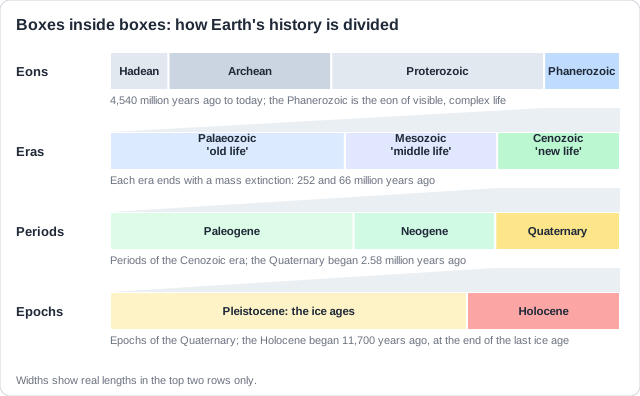
Real example: the names tell the fossil story. Palaeozoic means 'old life', Mesozoic 'middle life' and Cenozoic 'new life': each era has its own kind of animals and plants.
Learn what examiners really want
See exactly what to write to score full marks. Our AI shows you model answers and the key phrases examiners look for.
Where does one unit end and the next begin? Where the fossils change sharply, because the environment changed and many species died out.
How a boundary is chosen
- A boundary is placed where the fossils change a lot: many species vanish, new ones appear.
- Such a change shows a big environmental change that caused many extinctions.
- After it, new species evolve to fill the places left empty.
- The largest changes end eras; smaller ones end periods and epochs.
- Boundaries also match geological events: an impact layer, volcanic rock, a change in climate.
Remember it as: Fossils change sharply: old species out, new species in, new time unit.
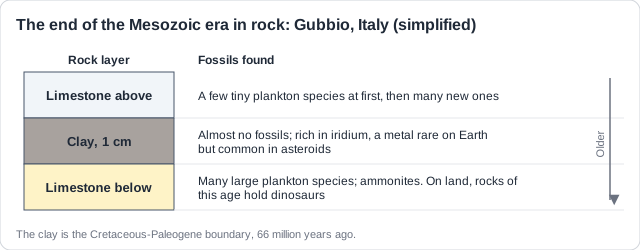
Real example: in 1980 Luis and Walter Alvarez found that the clay at Gubbio is rich in iridium. An asteroid hit Earth 66 million years ago; the dinosaurs and ammonites vanish below the clay, and mammals spread after it.
Real example: a boundary between two epochs: About 34 million years ago the Eocene epoch gave way to the Oligocene. The climate cooled, ice spread over Antarctica, many warm-water plankton died out, and in Europe many old mammal groups vanished as new ones arrived from Asia.
To use the timescale, geologists must know which layers in different places are the same age. Fossils do this, together with radiometric dating.
Reading the fossil record
- Rocks and fossils of the same age are matched around the world using index fossils.
- An index fossil was common, widespread and lived for a short time: it dates the rock it is in.
- Ammonites date Mesozoic rocks; trilobites date Palaeozoic rocks.
- Each boundary has one golden spike: a marker at one place in the rock where the unit officially starts.
- Pollen in lake mud and ice cores shows the change from ice age to Holocene.
Remember it as: Common, widespread, short-lived: a good index fossil.
Trilobites
- Sea animals with a jointed shell.
- Found in rocks 521 to 252 million years old.
- Their rocks are Palaeozoic.
Ammonites
- Sea animals with a coiled shell.
- The true ammonites lived 201 to 66 million years ago.
- Their rocks are Mesozoic.
Real example: the Holocene's golden spike is a layer in the NorthGRIP ice core from Greenland. Dust and chemical changes in the ice show a sudden warming 11,700 years ago.
Never wonder what to study next
Get a personalized daily plan based on your exam date, progress, and weak areas. We'll tell you exactly what to review each day.
How this comes up: Paper 2, Section B (a) [4] on how Earth's history is divided, or a Section A question on a drawing of rock layers and the fossils in each.
Geologists say we live in the Holocene epoch, which began 11,700 years ago.
Outline how the fossil record is used to divide Earth's history into geological epochs.
Model answer plan
See the mark-by-mark plan — for / against / judgement, with marking guidance — in study mode.