Human impacts on selective forces at Higher Level: An HL-only statement. Elephants born without tusks, moths that changed colour, bacteria no antibiotic can kill: people are now one of the strongest forces of natural selection on Earth.
Practise this as you read
- Explain how hunting, chemicals, climate change and new habitats cause evolutionary change.
- Use named examples, with Gorongosa's tuskless elephants as the guide's own case.
Free preview
This is the free notes preview
You're reading the free notes. Aimnova Pro unlocks the full study experience — and you can try it with your first topic free to keep:
- FlashcardsLock in vocabulary and key terms with spaced repetition.
- Practice questionsAnswer exam-style questions and get instant AI marking.
- Mock exams & past-paper vaultSit full mocks and see exactly how examiners award marks.
- Personalised study planA daily plan built around your exam date and weak areas.
People now steer natural selection: Human activities have impacted the selective forces acting on species within ecosystems, resulting in evolutionary change in these species, often at a speed never seen before.
The points to remember
- People change which individuals survive and breed: they are now a major selective force.
- Individuals with a helpful trait survive and breed more; the trait is inherited.
- So the trait's allele frequency rises over generations: evolutionary change.
- It is the same mechanism as natural selection, but people are the selective agent: human-driven evolution.
- It can be fast: tens of years, not millions.
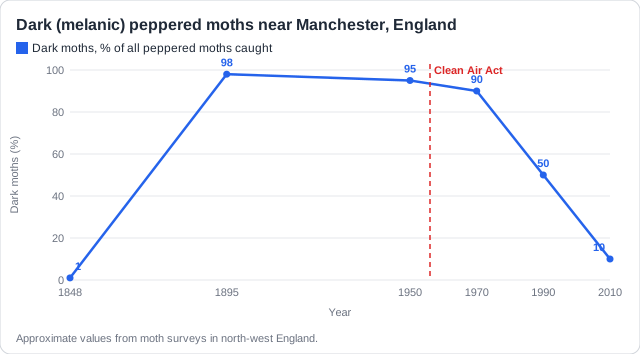
Real example: the peppered moth. In the Industrial Revolution, soot from burning coal blackened tree trunks and killed the pale lichens. Pale moths were easy for birds to see, so dark moths survived and bred: by 1895 about 98% near Manchester were dark. After the Clean Air Act, pale moths returned.
Never wonder what to study next
Get a personalized daily plan based on your exam date, progress, and weak areas. We'll tell you exactly what to review each day.
Hunting, poaching and harvesting remove individuals with a chosen trait, so the rest pass on theirs.
Hunting, poaching and fishing
- Hunters, poachers and fishers take the biggest individuals: large tusks, horns or fish.
- Individuals with no tusks, small horns or small bodies survive and breed more.
- The trait is inherited, so it becomes more common over generations.
- Heavily fished cod now breed younger and smaller: fisheries-induced evolution.
- Losing tusks or big fish changes the ecosystem and cuts genetic diversity.
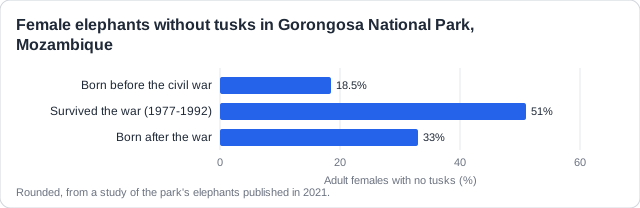
Real example: in Gorongosa, Mozambique, about 90% of elephants were killed for ivory to pay for the civil war. Tuskless females survived and passed on the trait, which is carried on the X chromosome, so it shows only in females. Without tusks, elephants dig for water and strip bark less, changing the park's vegetation.
The law and the money (HL lenses): Since 1989 CITES has banned the international ivory trade (Appendix I), but high black-market prices and legal domestic ivory markets in some countries still reward poaching.
The chemicals people use to kill bacteria, pests and rats are powerful selective forces.
Chemicals as selective forces
- An antibiotic or pesticide kills susceptible individuals; a few with a resistance allele survive.
- Survivors breed and pass on resistance; bacteria and insects breed fast, so it takes only years.
- Bacteria can also pass resistance genes directly to each other.
- Overuse speeds it up: antibiotics for minor illness or in farm animals, the same spray every year.
- Pollution selects too: killifish in polluted US harbours tolerate PCBs that kill other fish.
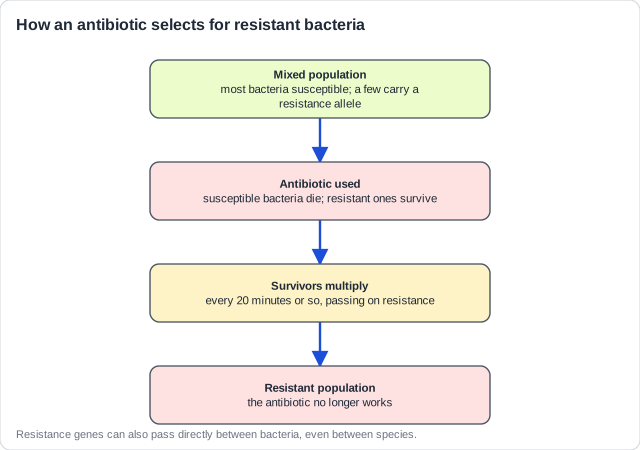
Real examples: MRSA spread through hospitals. The Colorado potato beetle now resists more than 50 insecticides. Rats resistant to the poison warfarin were first found in Scotland in 1958.
The chemical does not cause the resistance: The resistance allele was already there, by chance mutation. The chemical only kills the others.
Stop wasting time on topics you know
Our AI identifies your weak areas and focuses your study time where it matters. No more overstudying easy topics.
People also change whole environments, and species evolve to fit them.
Climate change and new habitats
- Burning fossil fuels warms the climate, changing which individuals survive.
- Traits suited to warmer conditions become more common.
- People create new habitats: cities, roads, farmland, tunnels.
- Urban noise: city birds sing at a higher pitch, above the low rumble of traffic.
- Roads: birds with shorter wings turn faster and are hit by cars less.
Remember it as: Hunt it, spray it, warm it, build on it: people select.
Real examples: in Finland, grey tawny owls survive snowy winters better than brown ones; as winters have warmed and snow has shortened, brown owls have become much more common. In cities, great tits sing higher than in forests. In Nebraska, USA, cliff swallows nesting under road bridges have evolved shorter wings over 30 years, and far fewer are killed by cars.
Name your examples: Answers need named examples: Gorongosa's elephants, the peppered moth and antibiotic resistance are the best known. Say which human activity is the selective force each time.
How this comes up: Expect data on a trait that changed under a human pressure, then: explain how the activity caused evolutionary change [2]-[4], or a Section B (a) [4] / (b) [7] with named examples.
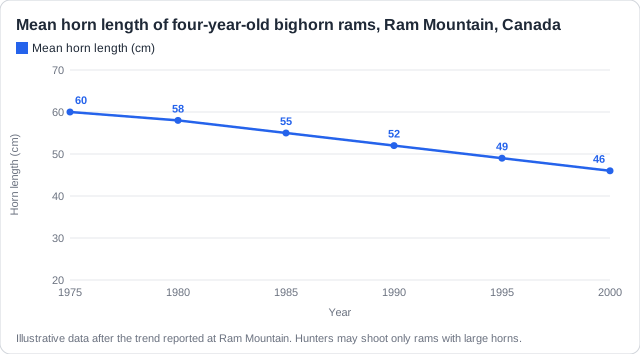
At Ram Mountain, in Alberta, Canada, trophy hunters were allowed to shoot bighorn rams whose horns had grown large. The graph in this section shows the mean horn length of four-year-old rams there.
With reference to the graph, explain how trophy hunting has caused this evolutionary change.
Model answer plan
See the mark-by-mark plan — for / against / judgement, with marking guidance — in study mode.
Not 'natural selection' alone: Name the human activity as the selective agent, and include inheritance and a change over generations.