Where biodiversity is concentrated at Higher Level: An HL-only statement. Half of the world's plant species live only in regions that cover about 2% of the land. Where are they, why are they so rich, and why does it help to name them?
Practise this as you read
- Explain the latitudinal gradient and the factors that make a region rich in species.
- Outline what a biodiversity hotspot is and the value of identifying one.
Free preview
This is the free notes preview
You're reading the free notes. Aimnova Pro unlocks the full study experience — and you can try it with your first topic free to keep:
- FlashcardsLock in vocabulary and key terms with spaced repetition.
- Practice questionsAnswer exam-style questions and get instant AI marking.
- Mock exams & past-paper vaultSit full mocks and see exactly how examiners award marks.
- Personalised study planA daily plan built around your exam date and weak areas.
Uneven, and richest in the tropics: Biodiversity is spread unevenly across the planet, and certain areas contain a particularly large proportion of species, especially species that are rare and endangered.
The points to remember
- Species are not spread evenly: a few areas hold a large share of all species.
- Diversity is highest near the equator and falls towards the poles: the latitudinal gradient.
- The richest places are mostly tropical: rainforests on land, coral reefs in the sea.
- Rich areas also hold many rare, endemic and endangered species with small ranges.
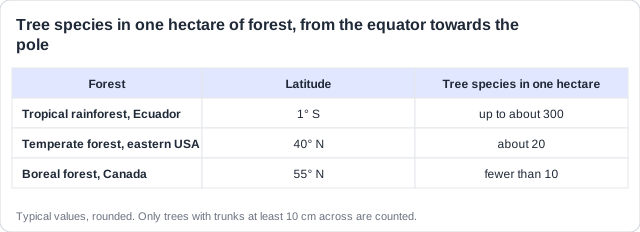
Real example: Ecuador and the United Kingdom are about the same size. About 1,600 bird species have been recorded in Ecuador, which lies on the equator; in the UK, about 630, and many of those are rare visitors.
Learn what examiners really want
See exactly what to write to score full marks. Our AI shows you model answers and the key phrases examiners look for.
Why do some places hold so many species? Several factors add up.
Why tropical places are so rich
- Sunlight and rain all year: high productivity, so more energy to support more species.
- A stable climate for millions of years, never covered by ice: a long time for speciation.
- Tall forests have many layers and niches, so many species can live side by side.
- Varied habitats close together: coasts, lowlands, mountains and altitude zones.
- Active plate tectonics: mountains and volcanoes make barriers and new land for speciation.
- Protected areas help keep that diversity.
Real example: in Ecuador, the land climbs from Amazon rainforest at about 300 m to glaciers on Chimborazo in less than 200 km. Each height has its own climate and its own species, so one small country holds rainforest, cloud forest, grassland and ice.
'It is hot and wet' is not enough: Link each factor to diversity: high rainfall and sunlight give high productivity, which supports more species. A climate named alone does not explain why there are many species.
Some regions are so rich, and so threatened, that they are given a special name.
Biodiversity hotspots
- A biodiversity hotspot has at least 1,500 endemic plant species and has lost at least 70% of its original habitat.
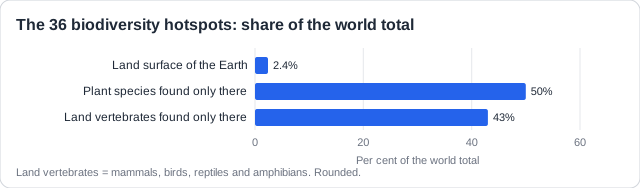
- There are 36 hotspots: about 2.4% of the land, yet half of all plant species live only there.
- Most are tropical: rainforests, islands and mountains.
- So hotspots are both very rich and under threat: many species are rare and endangered.
Real example: the Tropical Andes, from Venezuela to Bolivia, is the richest hotspot. It holds about 30,000 plant species, about half of them found nowhere else, but much of its forest has been cleared for farms, mines and roads.
Never wonder what to study next
Get a personalized daily plan based on your exam date, progress, and weak areas. We'll tell you exactly what to review each day.
Why does it help to name a region as a hotspot?
The value of identifying a hotspot
- It recognises that many endemic species are concentrated there and under threat.
- It focuses funding where it saves the most species.
- It raises international awareness of the region's value.
- It informs government decisions and laws.
- It drives scientific research into the region's species.
Remember it as: Recognise, fund, publicise, legislate, research.
Real example: some regions are also centres of diversity for crops. The Andes of Peru is the potato's: farmers there grow thousands of varieties, and a gene bank in Lima stores them so plant breeders can find genes for disease resistance.
How this comes up: A map of a rich country or region, then: identify three factors that could explain its high biodiversity [3]. The HL specimen asked the value of naming a region as a hotspot [2].
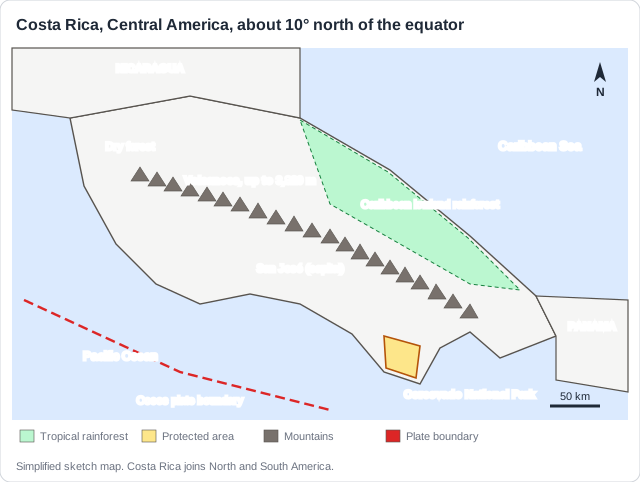
Costa Rica covers only 0.03% of the Earth's surface but holds about 5% of its known species. The sketch map of Costa Rica in this section shows its main features.
With reference to the map, identify three factors that could explain the high biodiversity of Costa Rica.
Model answer plan
See the mark-by-mark plan — for / against / judgement, with marking guidance — in study mode.
Use the map: Other factors the map could support: the active plate boundary building volcanoes and barriers, coasts on two seas, and protected areas such as Corcovado National Park.