Virtue ethics at Higher Level: This page looks at the environment through the lens of ethics. It explains virtue ethics, which judges the character of the person acting, through a philosopher's story about an avocado tree.
Practise this as you read
- Outline what virtue ethics focuses on and what it assumes.
- Apply respect, compassion and responsibility to a real choice.
- Evaluate virtue ethics as a guide to environmental decisions.
Free preview
This is the free notes preview
You're reading the free notes. Aimnova Pro unlocks the full study experience — and you can try it with your first topic free to keep:
- FlashcardsLock in vocabulary and key terms with spaced repetition.
- Practice questionsAnswer exam-style questions and get instant AI marking.
- Mock exams & past-paper vaultSit full mocks and see exactly how examiners award marks.
- Personalised study planA daily plan built around your exam date and weak areas.
Judge the person, not just the act: Virtue ethics asks what kind of person you are. A good character shows itself in good actions. Each virtue leads to caring actions; each vice to harmful ones.
Virtue ethics in six points
- Virtue ethics judges the character of the person doing the action.
- It assumes good people do good actions and bad people do bad actions.
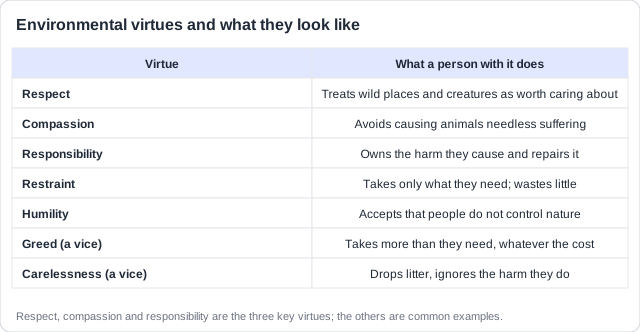
- Virtues are good traits: respect, compassion and responsibility towards nature.
- Vices are bad traits: greed, cruelty, carelessness.
- Virtues are built by habit: we become caring by acting with care (Aristotle).
- Its question is 'What would a good person do?', not 'What is the rule?'
Remember it as: Be a good person, and good actions follow.
Practice with exam-style questions
Answer exam-style questions and get AI feedback that shows you exactly what examiners want to see in a full-marks response.
In 1983 the philosopher Thomas Hill told a short story to show what virtue ethics adds.
The avocado tree: A rich man buys a house with a huge, healthy old avocado tree. He cuts it down and covers the whole garden with asphalt. It is his land, it breaks no law, and no one is clearly harmed.
What the story shows
- No rule is broken and no one is clearly harmed.
- Yet the act still feels wrong.
- Virtue ethics explains why: it shows insensitivity, a lack of respect and humility.
- So virtue ethics can judge acts that rules and results miss.
Hill's question was not 'Which rule did he break?' or 'Who was harmed?' but 'What kind of person would do that?' That is the virtue ethics question.
Most green choices are not covered by any law. Virtue ethics says they come from character.
Character in everyday choices
- Character guides everyday choices where no law applies: food, travel, waste.
- Respect: treat wild places and creatures as worth caring about.
- Compassion: avoid causing animals needless suffering.
- Responsibility: own the harm you cause and repair it.
- Integrity: act on your values even when it costs you.
Greta Thunberg's trip, August 2019: Invited to speak at the UN in New York, she refused to fly and crossed the Atlantic on a racing yacht in 15 days. No law asked her to; it showed integrity. In Sweden, many people began to feel 'flight shame' and chose trains.
A virtuous traveller
- Takes the train when one exists
- Leaves no litter on the trail
- Does not touch or feed wild animals
A careless traveller
- Flies for a weekend trip
- Drops rubbish where no one sees
- Chases animals for a photo
Feeling unprepared for exams?
Get a clear study plan, practice with real questions, and know exactly where you stand before exam day. No more guessing.
Virtue ethics is popular for personal choices, but it has clear limits for big decisions.
Strengths and limits
- Strength: guides choices where no law exists and no one is watching.
- Strength: builds lasting habits and personal motivation.
- Limit: it is vague: it rarely says exactly what to do about a dam or a cull.
- Limit: virtues can conflict: compassion for one animal, responsibility for many.
- Limit: good people can do harm by mistake, so its main assumption can fail.
- Limit: cultures disagree about which traits count as virtues.
Virtues in conflict: Australia's feral cats
Feral cats kill about 1.5 billion native animals a year in Australia. Compassion for the cats says do not cull them; responsibility for native wildlife says do. Virtue ethics alone cannot settle it.
Good people, bad results: pet goldfish
Kind owners release unwanted goldfish into lakes. In 2021 Burnsville, Minnesota, found huge goldfish in Keller Lake, an invasive species that stirs up mud and harms water quality.
The assumption can fail: Virtue ethics assumes that good people do good actions. The goldfish owners meant well, so always add knowledge: a virtuous person also tries to understand the results of what they do.
How it is asked: Expect virtue ethics in a Paper 1 'Through the lens of ethics' question, or as one side of an essay. An Evaluate [7] needs both strengths and limits, each with a real case, then a conclusion.
Some people argue that protecting the environment depends more on the character of individuals than on rules.
Evaluate virtue ethics as a guide to environmental decisions.
Model answer plan
See the mark-by-mark plan — for / against / judgement, with marking guidance — in study mode.