Three approaches to ethics at Higher Level: This page looks at the environment through the lens of ethics. It sets out the three major approaches of traditional ethics and uses them on one real decision: Kenya's ivory burn of 2016.
Practise this as you read
- Outline the three approaches and what each one looks at.
- Apply two approaches to the same issue and compare them.
- Discuss why the approaches can lead to different decisions.
Free preview
This is the free notes preview
You're reading the free notes. Aimnova Pro unlocks the full study experience — and you can try it with your first topic free to keep:
- FlashcardsLock in vocabulary and key terms with spaced repetition.
- Practice questionsAnswer exam-style questions and get instant AI marking.
- Mock exams & past-paper vaultSit full mocks and see exactly how examiners award marks.
- Personalised study planA daily plan built around your exam date and weak areas.
Three questions to ask about any action: ethics asks what we ought to do. Traditional ethics gives three main ways to judge an action: by the person's character, by its results, or by the rights it respects.
The three approaches
- Ethics asks what is right and wrong, and why.
- Traditional ethics has three major approaches: virtue, consequentialist and rights-based.
- Virtue ethics looks at the character of the person acting.
- Consequentialist ethics looks at the consequences (results) of the action.
- Rights-based (deontological) ethics looks at the rights of those involved.
- The same action can be judged right by one approach and wrong by another.
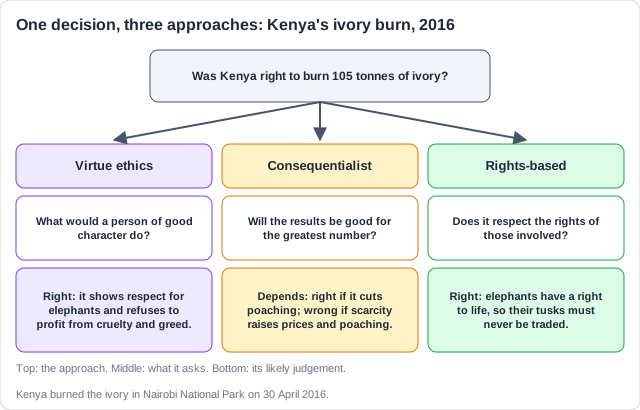
Real example: on 30 April 2016 Kenya burned a stockpile of about 105 tonnes of ivory taken from more than 6,000 elephants, most killed by poaching. It could have sold it for over US$100 million. Each approach judges that choice in its own way.
Remember it as: Who you are, what happens, whose rights.
Know your predicted grade
Take timed mock exams and get detailed feedback on every answer. See exactly where you're losing marks.
Each approach is centuries old. virtue ethics goes back to Aristotle; consequentialist ethics to Bentham and Mill; rights-based ethics to Kant. The utilitarian view is the best-known consequentialist one.
What each approach looks at
- Virtue: 'Would a good person do this?' Respect, compassion, responsibility (Aristotle).
- Consequentialist: 'What will happen?' Good results = good action; the greatest good for the greatest number (Bentham, Mill).
- Rights-based: 'Whose rights are at stake?' Some actions are wrong whatever the results (Kant).
- Intentions matter to virtue ethics; only outcomes matter to consequentialists.
- Rights and duties can forbid an action even when it would bring great benefits.
| Virtue ethics | Consequentialist | Rights-based | |
|---|---|---|---|
| Looks at | The person's character | The results of the action | The rights involved |
| Key question | Would a good person do it? | Does it bring the most good? | Does it break anyone's rights? |
| Good action | Shows respect, compassion, responsibility | Greatest good for the greatest number | Keeps duties; respects rights |
| Kenya's ivory | Refuse to profit from greed | Right only if poaching falls | Elephants' right to life comes first |
Do not mix them up: 'It will create jobs' is a consequence. 'It breaks their right to clean water' is a right. 'A caring person would not do it' is a virtue. Rights-based ethics is also called deontological ethics.
The skill the exam rewards is to apply the approaches to the same issue and compare how each would justify or reject it. Here are three real issues.
How to compare the approaches
- Apply all three to one issue, then compare them.
- Name what each approach looks at: character, results or rights.
- Show where they agree and where they disagree.
- They can reach the same verdict for different reasons.
A large dam
Consequentialist: build it if the energy, water and jobs outweigh the losses. Rights-based: the people and river species it displaces have rights that cannot be traded away. Virtue: would a responsible, humble steward drown a valley?
Genetically modified crops
Consequentialist: support genetically modified (GM) crops if they cut hunger and pesticide use. Virtue: do they show humility and responsibility towards natural systems? Rights-based: do farmers keep the right to save their own seed?
Cutting greenhouse gases
Rights-based: we have a duty to protect future generations, whatever it costs now. Consequentialist: cut emissions as far as the benefits outweigh the costs. Virtue: restraint and responsibility mean using less energy ourselves.
Same verdict, different reasons: All three approaches backed Kenya's burn, but for different reasons: the elephants' right to life, a hoped-for fall in poaching, and a refusal to profit from greed.
Get feedback like a real examiner
Submit your answers and get instant feedback — what you did well, what's missing, and exactly what to write to score full marks.
Real environmental policy is hard because good values pull in different directions. These are the tensions the approaches help you discuss.
Ethical tensions in environmental policy
- Present v future: today's needs against the rights of future generations.
- Local v global: jobs and growth here against harm everywhere.
- Indigenous rights v national development: whose land, whose decision?
- Individual freedom v collective duty: my car, our clean air.
- Rich v developing nations: past emissions against the right to develop.
- No single approach settles these: use two or more and weigh them.
Present v future: intergenerational equity: intergenerational equity says people alive now must leave future generations able to meet their needs. discounting works against it: a high discount rate makes harm 50 years away look small, so it is easy to ignore.
Strengths of using the approaches
- They show why sensible people disagree
- They give clear questions to ask
- Comparing two of them makes a decision fairer
Limits
- They often give different answers
- Results and rights are hard to measure
- They rarely end a real conflict on their own
How it is asked: Ethics questions on HL papers come as a short Discuss [3] on a figure, a Paper 1 'Through the lens of ethics, suggest how...' [6], or a Section B essay [9]. In every shape, name the approach, apply it to the case, and compare.
In 2016 Kenya burned its ivory stockpile, while some southern African countries argued that selling ivory could pay for conservation.
To what extent do the three approaches of traditional ethics lead to different decisions about wildlife conservation?
Model answer plan
See the mark-by-mark plan — for / against / judgement, with marking guidance — in study mode.