What environmental law covers at Higher Level: This statement is Higher Level only. It sets out the ground environmental law covers: resources, pollution, biodiversity and new development. May 2026 Paper 1 asked students to find these principles in one country's mining rules.
Practise this as you read
- Outline how a country's rules demonstrate principles of environmental law.
- Give a real law for each area: resources, pollution, biodiversity, EIAs.
- Explain how a law supports social as well as ecological sustainability.
Free preview
This is the free notes preview
You're reading the free notes. Aimnova Pro unlocks the full study experience — and you can try it with your first topic free to keep:
- FlashcardsLock in vocabulary and key terms with spaced repetition.
- Practice questionsAnswer exam-style questions and get instant AI marking.
- Mock exams & past-paper vaultSit full mocks and see exactly how examiners award marks.
- Personalised study planA daily plan built around your exam date and weak areas.
Rules for using nature: Environmental law is the part of the law about how people use and affect natural resources. It aims to improve social sustainability and ecological sustainability.
The points to remember
- Environmental law = rules on how people use and affect natural resources.
- Its aim: better social and ecological sustainability.
- Area 1: natural resources: forests, minerals, fisheries.
- Area 2: pollution: air, soils, water.
- Area 3: biodiversity: wildlife and habitats.
- Area 4: construction and development: an EIA before building.
Remember it as: Resources, pollution, wildlife, building.
Resources
- Costa Rica, 1996: forest may not be turned into farmland or pasture.
Pollution
- EU, 2000: every river, lake and groundwater must reach 'good status'.
Wildlife
- USA, 1973: killing or trading a listed endangered species is a crime.
Building
- Australia, 2023: a coal mine 10 km from the Great Barrier Reef was refused after its assessment.
See how examiners mark answers
Answer exam-style questions with model answers. Learn exactly what earns marks and what doesn't.
Natural resources such as forests, minerals and fish are used by many people. Without rules, each user takes as much as possible, and the resource runs out.
Managing natural resources
- Laws stop resources being used faster than they can recover (overexploitation).
- Forests: bans on clearing, protected forest, replanting rules.
- Minerals: licences, mining bans in sensitive places, rules on mine waste (tailings).
- Fisheries: quotas, closed seasons, minimum net mesh sizes, no-take zones.
Forests: Costa Rica
Its 1996 Forestry Law banned turning forest into farmland or pasture. Forest cover rose from about a fifth of the land in the late 1980s to more than half today.
Minerals: Costa Rica
A 2010 law banned new open-pit mines for gold and other metals, to protect forests and rivers from mine waste.
Fisheries: the European Union
Each December EU ministers set a quota for each fish stock for the next year, so no more fish are caught than the stock can replace.
Pollution laws protect air, soils and water by setting limits on what may be released, and on how clean the environment must be.
Managing pollution
- Laws set limits: how much of a pollutant may be released or may be in the air or water.
- Air: emission limits for factories, vehicles and power stations.
- Water: water-quality standards; permits for what may be discharged into rivers.
- Soils: testing and cleaning up contaminated land; limits on pesticides and waste.
- Pollution often crosses borders, so some limits are agreed between countries.
| Area | Real law | What it does |
|---|---|---|
| Air | China's Air Pollution Action Plan, 2013 | Limits on coal and factories: Beijing's PM2.5 fell from 89.5 to 58 by 2017 |
| Water | EU Water Framework Directive, 2000 | Every river, lake and groundwater must reach good status |
| Soil | Japan's Soil Contamination Act, 2002 | Land is tested when a factory using toxic chemicals closes; polluted land is cleaned |
Name the medium: Say which part of the environment a pollution law protects (air, soil or water) and what limit it sets.
Study smarter, not longer
Most students waste 40% of study time on topics they already know. Our AI tracks your progress and optimizes every minute.
Biodiversity laws protect species directly, and protect the habitat they need to survive.
Protecting biodiversity
- Laws list threatened species and make it illegal to kill, catch or trade them.
- Laws protect habitats: national parks, reserves, marine protected areas.
- Listing a species can also protect the habitat it needs.
- Laws ban the cause of decline, e.g. a toxic pesticide.
Real example: the bald eagle, the USA's national bird, fell to about 417 nesting pairs in 1963, poisoned by the pesticide DDT. DDT was banned in 1972, and the 1973 Endangered Species Act made it illegal to harm the eagles or their nests. By 2007 there were about 9,800 pairs, and the eagle was taken off the list.
Habitats: Natura 2000: EU law protects a network of sites called Natura 2000, about 18% of the EU's land, chosen for rare habitats and species. Activities there must not harm what the site protects.
Mines, dams, roads, ports and housing estates change land for decades. Many countries' laws require an EIA before such a project is allowed.
Construction and development: the EIA
- An EIA is required by law before a project such as a mine, dam, road or port is allowed.
- It studies the site first (baseline), then predicts the impacts.
- It plans how to avoid or reduce harm (mitigation).
- It consults local people, so social impacts count too.
- The government then approves, sets conditions, or refuses the project.
Real example: the Central Queensland Coal project planned an open-cut coal mine about 10 km from the Great Barrier Reef. Under Australia's 1999 EPBC Act it needed a federal assessment, which found that water pollution from the mine could harm the reef. In February 2023 the government refused it: the first coal mine ever refused under that law.
An EIA advises; it does not decide: An EIA predicts impacts and suggests ways to reduce them. The government still decides, and many projects with serious impacts are approved with conditions.
Practice with exam-style questions
Answer exam-style questions and get AI feedback that shows you exactly what examiners want to see in a full-marks response.
Environmental law aims at both kinds of sustainability, and it rarely works alone. It also has gaps.
The aims of environmental law, and its gaps
- Ecological: keep ecosystems healthy and stop resources running out.
- Social: protect people's health and treat communities fairly (environmental justice).
- Law often works with economic tools: taxes, royalties, the polluter-pays principle.
- Gaps: some activities are not covered, or permits still allow harm.
- Law can manage the use of a non-renewable resource, but extraction is never fully sustainable.
Real example: in England in 2023, water companies' storm overflows released sewage into rivers and the sea about 464,000 times. Their permits allowed spills in heavy rain, so the law itself left a gap: rivers were polluted without a rule being broken.
Social as well as ecological: When a law protects people's health, or makes a project consult local communities, say that it supports social sustainability and environmental justice, not only the ecosystem.
How this is asked: May 2026 HL Paper 1 asked students to outline how one country's mining rules, given in a fact file, demonstrate principles of environmental law [6]. Each mark is one rule linked to what it does: who made it, what it protects, and whether it helps people too. A gap in the rules also scores.
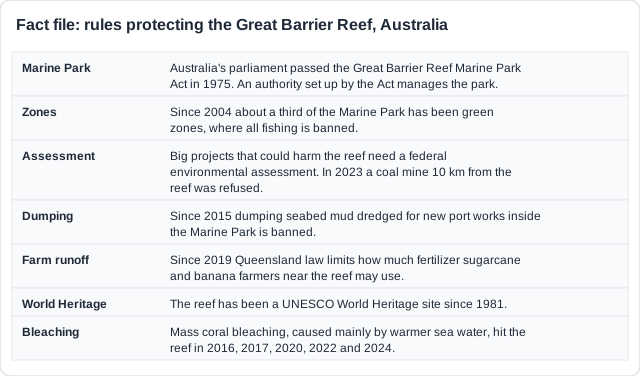
Figure 1 is a fact file on the rules protecting the Great Barrier Reef in Australia.
Outline how the rules protecting the Great Barrier Reef demonstrate principles of environmental law.
Model answer plan
See the mark-by-mark plan — for / against / judgement, with marking guidance — in study mode.