What laws are at Higher Level: This statement is Higher Level only. It opens the environmental law lens: before asking what environmental law does, you need to know what makes any rule a law. The answer is who makes it and whether it can be enforced.
Practise this as you read
- State the features of a law.
- Outline how a named law is made and enforced.
- Distinguish a law from a guideline or a voluntary pledge.
Free preview
This is the free notes preview
You're reading the free notes. Aimnova Pro unlocks the full study experience — and you can try it with your first topic free to keep:
- FlashcardsLock in vocabulary and key terms with spaced repetition.
- Practice questionsAnswer exam-style questions and get instant AI marking.
- Mock exams & past-paper vaultSit full mocks and see exactly how examiners award marks.
- Personalised study planA daily plan built around your exam date and weak areas.
Rules with teeth: A law is a rule that governs human behaviour. It is made and enforced by a social or governmental authority. Environmental law is one kind of law.
The points to remember
- A law is a rule: it says what people must or must not do.
- It governs human behaviour: what people make, use, sell or throw away.
- It is made by an authority: a government, or a community's own leaders.
- It is enforced: someone checks, and breaking it brings a penalty.
Remember it as: Rule, behaviour, authority, enforced.
Rule
- No one may make, import, sell or use plastic bags.
Behaviour
- Shoppers and shops switch to paper, cloth and woven bags.
Authority
- Rwanda's parliament passed the law in 2008.
Enforced
- Bags are taken at the border and airport; shops that sell them are fined.
Feeling unprepared for exams?
Get a clear study plan, practice with real questions, and know exactly where you stand before exam day. No more guessing.
Most laws come from a government. A parliament passes an Act, and ministers or agencies add each regulation. But a community can also make and enforce rules: customary law.
Two kinds of authority
- Governmental authority: a parliament passes Acts; ministers and agencies make regulations.
- Social authority: a community's leaders make and enforce customary law.
- Both make real laws, because both can enforce them.
- Government laws cover a whole country; social laws cover one community or place.
Governmental: the UK
- Parliament passed the Environment Act 2021
- It sets legal targets for air, water, wildlife and waste
- The Environment Agency checks rivers and can fine polluters
Social: a village in Fiji
- The chief declares a tabu: no fishing on one reef for a set time
- Village fish wardens watch the reef
- Rule breakers are shamed or must pay the village a fine
Name the authority: When you describe a law, say who made it and who enforces it: a parliament and an agency, or a chief and the village.
Not every rule is a law. A guideline or a promise only says what should happen. A law can be enforced, so people must obey it.
Law or guideline?
- A guideline or pledge says what should happen, but nobody is punished for ignoring it.
- A law is binding: everyone it covers must obey it.
- A guideline often becomes a law later, when a government adopts it.
- So ask two questions: who made it, and can it be enforced?
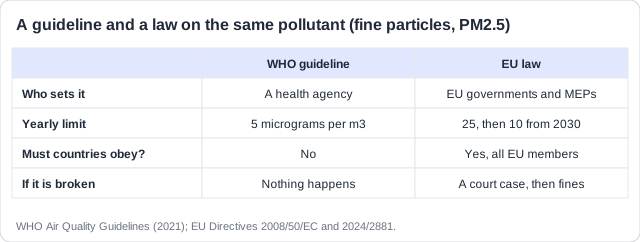
Real example: the WHO says yearly fine-particle pollution should stay below 5 micrograms per cubic metre, but no country is punished for going over. The EU made a binding limit of 25, falling to 10 from 2030. The European Commission can take a country that breaks it to the EU Court of Justice.
Memorize terms 3x faster
Smart flashcards show you cards right before you forget them. Perfect for definitions and key concepts.
A rule only changes behaviour if it is enforced. To enforce a law, an authority checks that it is kept and applies a sanction when it is broken.
How laws are enforced
- Monitoring: inspectors, police, wardens or cameras check that the rule is kept.
- Fines and prison for those who break it.
- Losing a licence, or goods taken away (confiscation).
- Courts decide disputes and set the punishment.
- Social penalties: public shame or exclusion from the community.
Real example: in Singapore, dropping litter can bring a fine of up to S$2,000 for a first offence. Since 1992 courts can also give a Corrective Work Order: offenders clean streets and parks in bright vests, so the public sees them. That is a legal penalty and a social one at once.
A law nobody enforces: A law with no checks and no penalties changes little. Writing a rule down is not enough: it needs people, money and courts to make it work.
How this could come up: No paper has asked this statement on its own yet. It sits inside other questions: May 2026 credited 'the rules are set by the government' as a principle of environmental law. Likely shapes: a Paper 1 part on a fact file [1-3], or Paper 2 Section B (a) [4].
Since 1992 Singapore has banned the import and sale of chewing gum, to stop gum being stuck on pavements, buses and train doors. Since 2004 gum with a health benefit may be sold by pharmacists.
Outline how Singapore's chewing gum ban shows the features of a law.
Model answer plan
See the mark-by-mark plan — for / against / judgement, with marking guidance — in study mode.