Consequentialist ethics at Higher Level: This page looks at the environment through the lens of ethics. It explains consequentialist ethics, which judges actions only by their results, through China's Three Gorges Dam and Australia's cane toads.
Practise this as you read
- Outline how consequentialist ethics decides whether an action is right.
- Explain why intentions do not change the verdict.
- Evaluate a consequentialist approach to a large project.
Free preview
This is the free notes preview
You're reading the free notes. Aimnova Pro unlocks the full study experience — and you can try it with your first topic free to keep:
- FlashcardsLock in vocabulary and key terms with spaced repetition.
- Practice questionsAnswer exam-style questions and get instant AI marking.
- Mock exams & past-paper vaultSit full mocks and see exactly how examiners award marks.
- Personalised study planA daily plan built around your exam date and weak areas.
Judge an action by its results: Consequentialist ethics says the consequences of an action make it right or wrong. The best action is the one with the best results for the most people.
Consequentialist ethics in five points
- The consequences (results) of an action decide whether it is right or wrong.
- Good consequences = a good action; bad consequences = a bad action.
- The best action brings the greatest common good: the most good for the most people.
- The intention does not matter: only the outcome counts.
- The best-known form is utilitarianism (Bentham, Mill).
In 1789 Jeremy Bentham wrote that the measure of right and wrong is 'the greatest happiness of the greatest number'. This is utilitarianism.
Remember it as: Ends, not intentions: judge it by what happens.
See how examiners mark answers
Answer exam-style questions with model answers. Learn exactly what earns marks and what doesn't.
Governments use this approach when they weigh a big project with cost-benefit analysis. The Three Gorges Dam on China's Yangtze River is a classic case.
How a consequentialist decides
- List all the outcomes, good and bad, for everyone affected.
- Weigh them: often in money, as a cost-benefit analysis.
- If the good outweighs the bad, the action is right.
- Each person's wellbeing counts equally; some add animals' suffering too (Singer).
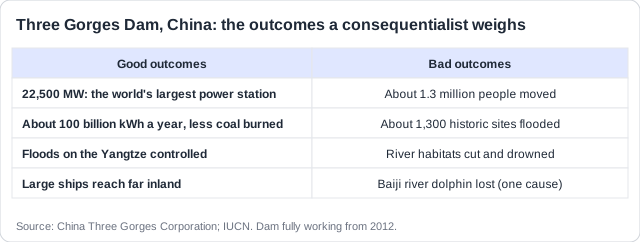
The verdict: With 22,500 MW of clean power for hundreds of millions of people, China judged the benefits larger. Critics counted 1.3 million people moved and the baiji lost, and reached the opposite verdict with the same method.
For a consequentialist, intentions do not change the verdict. Only the outcome does.
Outcomes, not intentions
- A good intention with bad results = a bad action.
- A selfish motive with good results = a good action.
- So consequentialists ask 'What actually happened, or will happen?'
- Cane toads: meant to save the sugar crop; the results made it wrong.
Cane toads, Queensland, 1935: About 100 toads were brought from Hawaii to eat beetles destroying the sugar cane. They ignored the beetles, spread across northern Australia to more than 200 million, and poisoned quolls and other predators.
Intention
- Protect the sugar crop
- Save farmers' jobs
- Use nature, not chemicals
Outcome
- Beetles not controlled
- Native predators poisoned
- A pest across a continent
Study smarter, not longer
Most students waste 40% of study time on topics they already know. Our AI tracks your progress and optimizes every minute.
Consequentialist thinking is powerful and widely used, but it has well-known weaknesses.
Strengths and limits
- Strength: practical: it is how governments decide, with cost-benefit analysis.
- Strength: counts everyone's welfare equally, not just the powerful.
- Limit: results are hard to predict (cane toads).
- Limit: some things are hard to measure or compare: a dolphin against electricity.
- Limit: a minority can be sacrificed for the majority's good.
- Limit: whose results count? Animals? Future generations?
Do future people count? The discount rate: A discount rate decides how much future harm counts today. The UK's Stern Review (2006) used a very low rate, so climate damage in 2100 counted almost as much as damage now, and it called for strong action immediately.
A common mistake: consequentialist is not the same as 'anything goes'. It demands the best total result for everyone affected, and that can mean costly action now to protect the future.
How it is asked: Consequentialist ethics fits questions about big projects: dams, mines, culls, climate policy. An Evaluate [7] needs strengths and limits, each tied to a real case, then a conclusion.
The Three Gorges Dam on the Yangtze River produces more electricity than any other power station, but about 1.3 million people had to leave their homes.
Evaluate the use of a consequentialist approach to decide whether to build a large dam.
Model answer plan
See the mark-by-mark plan — for / against / judgement, with marking guidance — in study mode.