Environmental law, justice and lobbying at Higher Level: This statement is Higher Level only. It asks why environmental laws matter, protecting the common good and poorer communities, and why they are hard to pass when powerful companies lobby against them.
Practise this as you read
- Explain how laws prevent overexploitation for the short-term gain of a few.
- Explain how laws support environmental justice.
- Suggest how lobbying could delay or weaken a named law.
Free preview
This is the free notes preview
You're reading the free notes. Aimnova Pro unlocks the full study experience — and you can try it with your first topic free to keep:
- FlashcardsLock in vocabulary and key terms with spaced repetition.
- Practice questionsAnswer exam-style questions and get instant AI marking.
- Mock exams & past-paper vaultSit full mocks and see exactly how examiners award marks.
- Personalised study planA daily plan built around your exam date and weak areas.
The many against the few: Environmental laws try to stop overexploitation and damage that serve the short-term interests of a few people, at the cost of the long-term common good.
The points to remember
- Without rules, a few users can overexploit or degrade a shared resource for short-term profit.
- The costs fall on everyone, now and in the future: the common good.
- Laws set limits: quotas, bans, protected areas, permits.
- So a law puts the long-term interests of the many above the short-term interests of a few.
Remember it as: A few gain now; everyone pays later. The law says no.
Short-term
- Big trawlers caught as much cod as they could for decades.
Weak limits
- Quotas were set too high, above what the stock could replace.
Collapse
- In 1992 Canada declared a moratorium on cod fishing.
Common good lost
- About 30,000 people lost their jobs; the stock has still not fully recovered.
Practice with exam-style questions
Answer exam-style questions and get AI feedback that shows you exactly what examiners want to see in a full-marks response.
Laws can support environmental justice. Without them, harmful sites tend to go where people have the least power to object.
Laws and environmental justice
- Pollution and waste often end up near poorer or minority communities.
- Laws can require that their health and views are considered before decisions.
- Courts let communities make polluters pay and clean up.
- So laws support environmental justice: a fair share of harms and benefits.
Warren County, USA, 1982
The state chose a poor, mostly Black county for a landfill of soil polluted with PCBs. Protests started the environmental justice movement. In 1994 a presidential order told federal agencies to consider the effects of their decisions on low-income and minority communities.
Farmers against Shell, Nigeria
Oil spills ruined farmland and fish ponds in Oruma and Goi. In 2021 a Dutch appeal court held Shell's Nigerian company responsible, and in 2022 Shell agreed to pay the farmers EUR 15 million.
Economic systems can give an incentive to harm the environment and people. A law can make ethical behaviour the rule for everyone.
When the economy rewards harm
- Markets can reward harm: polluting or overfishing is often the cheapest choice.
- Ethical companies then lose out to cheaper, harmful ones.
- A law makes the ethical choice compulsory for everyone, so no one gains by cheating.
- Penalties make harm cost more than doing the right thing.
Real example: cleaning diesel exhaust properly costs money. Volkswagen fitted software that switched on full pollution control only during official tests. On the road its cars released up to 40 times the legal limit of nitrogen oxides. Under the US Clean Air Act, VW agreed in 2016 to pay up to US$14.7 billion. The law turned cheating from the cheap option into the most costly one.
Feeling unprepared for exams?
Get a clear study plan, practice with real questions, and know exactly where you stand before exam day. No more guessing.
Environmental laws can be hard to approve. Economically powerful stakeholders use lobbying to stop or weaken laws that would cut their profits.
Lobbying against environmental law
- Lobbying: trying to influence lawmakers.
- Economically powerful stakeholders (fossil fuels, mining, farming, chemicals) lobby most.
- Methods: meetings with ministers, funding campaigns and adverts, donations, warnings about jobs.
- Effects: laws delayed, weakened or repealed, or never passed.
- They have money and access; the people harmed are often poorer and less organised.
Australia: a law repealed
- A carbon price started in July 2012
- Mining and energy companies campaigned against it
- It was repealed in July 2014
USA: a law never passed
- A cap on carbon emissions passed the House in 2009, by 219 votes to 212
- Fossil fuel interests lobbied heavily
- The Senate never voted on it
Lobbying is not only by big business, and it does not always win.
How laws still get passed
- Public pressure: protests, petitions and votes push lawmakers the other way.
- Environmental groups and scientists lobby too.
- Courts can force governments to act on laws they already have.
- But laws passed against strong lobbies are often weakened first.
Real example: the EU Nature Restoration Law asks countries to restore at least 20% of EU land and sea by 2030. Farm lobbies and some lawmakers fought it, and parts were weakened, but it was adopted in June 2024. In 2018, after campaigns by beekeepers and environmental groups, the EU also banned outdoor use of three neonicotinoid insecticides that harm bees.
Memorize terms 3x faster
Smart flashcards show you cards right before you forget them. Perfect for definitions and key concepts.
How this could come up: May 2026 HL Paper 1 used a lens question worth [6]: 'Through the lens of ..., suggest how ... could lead to ...'. Each mark is one step in a chain; without the legal link, [4] is the most. Lobbying also appears in Section B essays on laws.
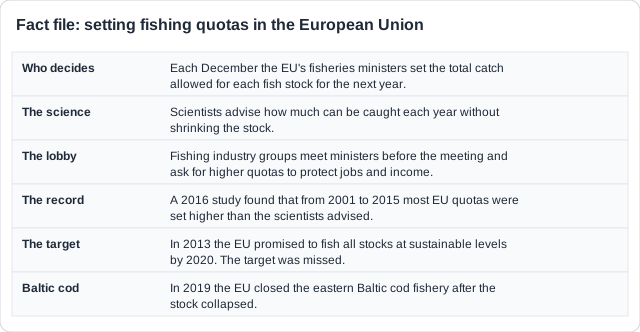
Figure 1 is a fact file on how fishing quotas are set in the European Union.
Through the lens of environmental law, suggest how lobbying by the fishing industry could lead to the overexploitation of fish stocks.
Model answer plan
See the mark-by-mark plan — for / against / judgement, with marking guidance — in study mode.