Making environmental law work at Higher Level: This statement is Higher Level only. It asks why a law works in one country and fails in another: enforcement, institutions, public acceptance and money. May 2026 asked about the limits of laws on coral bleaching and whether laws beat education.
Practise this as you read
- Outline limitations of environmental laws for a named problem.
- Explain why the same kind of law succeeds in one country and not another.
- Evaluate legislation against education, with real examples.
Free preview
This is the free notes preview
You're reading the free notes. Aimnova Pro unlocks the full study experience — and you can try it with your first topic free to keep:
- FlashcardsLock in vocabulary and key terms with spaced repetition.
- Practice questionsAnswer exam-style questions and get instant AI marking.
- Mock exams & past-paper vaultSit full mocks and see exactly how examiners award marks.
- Personalised study planA daily plan built around your exam date and weak areas.
A law needs a system behind it: Environmental law is built into each country's existing legal framework. Even the best law only works if it is properly enforced and monitored, so its success varies from country to country.
The points to remember
- Environmental law is built into each country's existing legal system.
- The constitution is at the top; Acts and regulations sit below it.
- Agencies apply the law: they issue permits, inspect and fine.
- Courts settle disputes and punish offenders.
- So a law is only as strong as the system that applies it.
Remember it as: Written down, enforced, accepted, paid for.
Constitution
- Brazil's 1988 constitution gives everyone the right to an ecologically balanced environment (Article 225).
Act
- The Forest Code makes Amazon farms keep 80% of their land as forest.
Agency
- IBAMA, the environment agency, raids illegal clearings and fines farmers.
Court
- Courts hear appeals against fines and can order land to be replanted.
See how examiners mark answers
Answer exam-style questions with model answers. Learn exactly what earns marks and what doesn't.
The guide names three things every environmental law needs. Behind them all sits political will.
What makes a law work
- Strong institutions: well-run agencies, enough inspectors, fair and independent courts.
- General acceptance by society: people and businesses see the law as fair and obey it.
- Adequate funding for monitoring, enforcement and the protection the law requires.
- Political will: the government wants the law to work.
- Weak governance or corruption undermines all of them.
Political will rises and falls. These are the forces that move it:
What affects political will
- Economic priorities often override environmental concerns.
- Election cycles create short-term thinking.
- Industry lobbying influences policy decisions.
- Public awareness and pressure from civil society push governments to act.
- International reputation and trade relationships.
Environmental governance: Good environmental governance means compliance is checked, funded, open to the public and accountable. Weak governance or corruption can undermine enforcement of any law.
Enforcement has two halves: finding out who breaks the law (monitoring), and making them stop (compliance tools).
Monitoring approaches
- Satellites and remote sensing for deforestation and pollution
- Air and water quality monitoring stations
- Biodiversity surveys and species counts
- Self-reporting by industries, with verification
- Citizen science and community monitoring
Compliance mechanisms
- Fines and other financial penalties
- Licence revocation: losing the right to operate
- Criminal prosecution for severe violations
- Naming and shaming through public disclosure
- Incentives and rewards for doing better than the standard
Real example: since 2004 Brazil's space agency has used remote sensing to send near real-time alerts of new forest clearing. IBAMA uses the alerts to send inspectors, fine farmers and seize equipment. Since 2008 banks may not lend to farms that clear illegally.
Citizens help too: In citizen science, local people report pollution or count species. It covers more places than inspectors can reach and builds acceptance of the law.
Study smarter, not longer
Most students waste 40% of study time on topics they already know. Our AI tracks your progress and optimizes every minute.
The same law can work well or badly depending on how hard it is enforced. Brazil's forest laws barely changed from 2012 to 2022, yet deforestation nearly tripled.
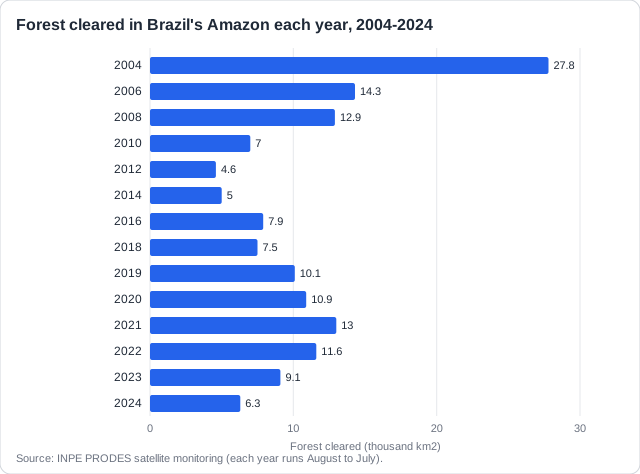
2004-2012: strong enforcement
Satellite alerts, raids, fines and limits on bank loans: clearing fell from 27.8 to 4.6 thousand km2 a year.
2019-2022: enforcement cut
Fewer inspections and fines, and talk of farming the forest: clearing rose to 13.0 thousand km2 in 2021.
2023-2024: enforcement restored
A new government funded IBAMA again: clearing fell to 6.3 thousand km2 in 2024.
Countries with similar laws can get very different results.
Why success varies
- The same kind of law can work in one country and fail in another.
- It works where institutions are strong, funding is enough and society accepts it.
- It fails where agencies are weak, poorly funded or corrupt, or many people ignore it.
- Success can also change over time in one country, as governments change.
USA: Clean Air Act, 1970
- A national agency (EPA) sets limits and inspects
- Emissions of six common air pollutants fell 78% from 1970 to 2020
- The economy grew at the same time
India: Air Act, 1981
- Pollution boards with too few staff and funds
- Many small, scattered sources: stoves, crop burning, old vehicles
- Delhi's air is among the most polluted of any capital city
Practice with exam-style questions
Answer exam-style questions and get AI feedback that shows you exactly what examiners want to see in a full-marks response.
When you evaluate environmental law, weigh real successes against real failures.
Success stories
- Montreal Protocol (1987): CFCs nearly eliminated; the ozone layer is recovering
- US Clean Air Act: about 78% less of the common air pollutants since 1970
- CITES: reduced illegal trade in many endangered species
- EU Habitats Directive: recovery of some European species
Ongoing failures
- Paris Agreement (2015): world emissions kept rising
- Aichi Biodiversity Targets: none of the 20 fully met by 2020
- Plastic pollution: talks on a global treaty failed to agree in 2024 and 2025
- Illegal logging and fishing continue despite regulations
Use both sides: Give named successes and failures, with data where you can. Then say why they differ: clear science, alternatives, enforcement and political will.
Some problems are hard for any law to solve, because of what causes them and where they happen.
Limits of environmental law
- Natural factors play a part and cannot be regulated (e.g. El Nino heat).
- Oceans are vast and cross boundaries: hard to monitor.
- Global causes (climate change) cannot be solved by national laws: they need global co-operation.
- Non-point sources such as farm runoff are hard to regulate.
- Enforcement is weak: conflicting interests, too few resources, little political will.
- Agreeing new rules can take years; local laws only limit harm.
- No global accountability: agreements can be ignored or never ratified.
Real example: the Florida Keys reefs have been a protected marine sanctuary since 1990, with rules on fishing, anchoring and discharges. Yet in July 2023 the sea at Manatee Bay reached about 38 C, and the reefs bleached badly. National rules could not stop global warming, or non-point source pollution from the land.
Feeling unprepared for exams?
Get a clear study plan, practice with real questions, and know exactly where you stand before exam day. No more guessing.
Laws need general acceptance by society, and education is one way to build it. Many essays ask which works better, for example in achieving water security.
Legislation and education
- Laws control big users at once (industry, farms) and set binding standards.
- Education changes attitudes, so people accept and keep the rules: general acceptance.
- Laws without acceptance are ignored; education without laws is often too slow.
- So the strongest approach combines both.
Real example: Singapore taxes water use (a water conservation tax), and since 2009 the law has required taps, toilets and washing machines to carry water-efficiency labels. Campaigns also teach families to save water. Household use fell from 165 litres per person per day in 2003 to 141 in 2019.
Do not take one side only: The best essays weigh both. Laws can be weakened by lobbying, and must be ratifyd or enforced to work; education is slow and voluntary but builds the acceptance laws need.
How this is asked: May 2026 HL Paper 2 asked for two limitations of environmental laws on coral bleaching [2], and a Section B essay on whether legislation works better than education [9]. The [9] is marked in bands: terms, breadth, named examples, balance and a supported conclusion.
Many countries try to cut plastic waste, some with bans and taxes, others with campaigns and lessons in schools.
To what extent is legislation more effective than education in reducing plastic waste?
Model answer plan
See the mark-by-mark plan — for / against / judgement, with marking guidance — in study mode.