Moral standing at Higher Level: Who, or what, counts when we decide how to act? This page follows the circle of moral standing outward: to animals, all living things, rivers and landscapes, and people not yet born.
Practise this as you read
- Define moral standing.
- Outline how ecocentrists extend moral standing beyond humans.
- Discuss whether rivers or future generations should have moral standing.
Free preview
This is the free notes preview
You're reading the free notes. Aimnova Pro unlocks the full study experience — and you can try it with your first topic free to keep:
- FlashcardsLock in vocabulary and key terms with spaced repetition.
- Practice questionsAnswer exam-style questions and get instant AI marking.
- Mock exams & past-paper vaultSit full mocks and see exactly how examiners award marks.
- Personalised study planA daily plan built around your exam date and weak areas.
Does it count?: To ask whether something has moral standing is to ask whether it should be taken into account when we decide how to act, and whether it can make a claim on us.
What moral standing is
- An entity has moral standing if it must be morally considered when we decide how to act.
- It must be taken into account by others: its interests count.
- It can make a claim on others: we may owe it something.
- Having standing does not mean having duties: a baby or a dog has standing but no duties.
- Debates are about where the line is drawn: who, or what, counts.
Real example: the UK's Animal Welfare (Sentience) Act 2022 says ministers must consider how their policies affect sentient animals. A review found that octopuses and decapods such as crabs and lobsters feel pain, so they were added alongside animals with backbones. In law, the circle of beings that count got wider.
Standing is not usefulness: A crab does not gain standing because it is useful to us. It has standing if its own pain or well-being counts when we decide what to do to it.
Memorize terms 3x faster
Smart flashcards show you cards right before you forget them. Perfect for definitions and key concepts.
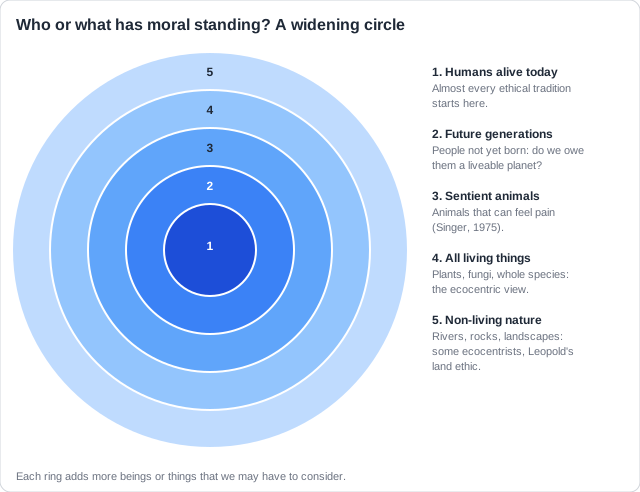
Views on moral standing can be pictured as a circle that grows outward.
How far does the circle go?
- Most traditions give standing to humans alive today.
- Many extend it to future generations and to sentient animals.
- Ecocentrists: all living things have moral standing, because they have intrinsic value.
- Some ecocentrists extend it to non-living nature: rivers, rocks, landscapes.
- Leopold's land ethic (1949): right is what keeps the integrity, stability and beauty of the biotic community.
Real example: in A Sand County Almanac (1949), Aldo Leopold argued that people are plain members of a biotic community, not its conquerors. An action is right when it tends to preserve the community's 'integrity, stability and beauty', and wrong when it does the opposite. So soils, waters, plants and animals all have standing.
The furthest step is to give standing to things that are not alive at all.
Rivers, forests and mountains
- If rivers or forests have moral standing, harming them can be wrong even when no person is hurt.
- In 1972 Christopher Stone asked: should trees have standing in a court of law?
- Some countries now give nature rights in law, a legal echo of moral standing.
- Ecuador (2008) put the rights of nature in its constitution.
- New Zealand's Whanganui River became a legal person in 2017.
- Critics ask who speaks for a river, and how its interests are known.
Whanganui River, New Zealand, 2017
After a 140-year campaign by the Whanganui iwi, the river became a legal person, with two guardians. A local saying runs 'I am the river, and the river is me'.
Ecuador, 2008
The constitution gives nature the right to exist and regenerate. In 2011 a court ruled for the Vilcabamba River, harmed by rubble dumped by a road project.
Bolivia, 2010
The Law of the Rights of Mother Earth lists nature's rights, such as the right to life and to clean water and air.
Colombia, 2016
The Constitutional Court declared the Atrato River, damaged by illegal gold mining, a subject of rights.
Remember it as: If it counts morally, harming it can be wrong even when no person is hurt.
Know your predicted grade
Take timed mock exams and get detailed feedback on every answer. See exactly where you're losing marks.
The guide also asks about people who do not exist yet.
Future generations
- Future generations do not exist yet, but our actions will affect them.
- The question: do we owe them anything, whatever the benefit to people today?
- If they have standing, today's choices on climate, soils and species must count their needs.
- The Brundtland definition of sustainable development rests on this idea.
- Against: they cannot speak, we do not know their needs, and they may have better technology.
An old idea
- The Haudenosaunee, in North America, weigh decisions by their effect seven generations ahead.
A definition
- The Brundtland Report (1987): meet today's needs without harming the future's.
In law today
- Wales has a Future Generations Commissioner (2015).
- In 2021 Germany's top court said its climate law put young people's future at risk.
Use the guide's phrase: Future generations count 'irrespective of benefits to humans of today': we may owe them a stable climate even if keeping it costs us more now.
How this comes up: Moral standing appears in Outline [4] parts (who or what counts), in lens questions on future generations, and in [9] essays on giving rights to nature. Name the entity, say why it counts, and give a real example.
Some environmental thinkers argue that moral concern should not stop at human beings.
Outline how ecocentrists extend moral standing beyond humans.
Model answer plan
See the mark-by-mark plan — for / against / judgement, with marking guidance — in study mode.
Move outward one ring per paragraph: living things, then why, then non-living nature, then the example.