Rights-based ethics at Higher Level: This page looks at the environment through the lens of ethics. It explains rights-based (deontological) ethics and uses it on the impacts of farming, the shape May 2026 HL Paper 2 used.
Practise this as you read
- Outline what rights-based ethics focuses on.
- Explain why there is debate about which rights exist.
- Discuss how a rights-based approach to an impact may be controversial.
Free preview
This is the free notes preview
You're reading the free notes. Aimnova Pro unlocks the full study experience — and you can try it with your first topic free to keep:
- FlashcardsLock in vocabulary and key terms with spaced repetition.
- Practice questionsAnswer exam-style questions and get instant AI marking.
- Mock exams & past-paper vaultSit full mocks and see exactly how examiners award marks.
- Personalised study planA daily plan built around your exam date and weak areas.
Some lines must not be crossed: Rights-based ethics judges the action itself: does it break someone's right? If it does, it is wrong, even if it brings good results. It is also called deontological ethics.
Rights-based ethics in six points
- Rights-based ethics looks at the action and asks whether it breaks the rights of others.
- Also called deontological: some actions are wrong whatever the results.
- Kant: treat people always as ends, never merely as a means.
- Rights can come from religious texts, laws or reason.
- If a holy text says killing animals is wrong, killing them for food breaks the animal's right.
- There is debate about what these rights are and who has them.
Where it comes from: the German philosopher Immanuel Kant (1724-1804) argued that some duties hold whatever the results, such as never using a person merely as a tool for someone else's gain.
Remember it as: Rights first: a good result cannot excuse a broken right.
Know your predicted grade
Take timed mock exams and get detailed feedback on every answer. See exactly where you're losing marks.
The hard part is the list of rights. People disagree about who has rights and which rights matter most.
Whose rights? The debate
- People: a right to life, food, water and a healthy environment (UN, 2022).
- Animals: a right not to be killed or made to suffer (Regan).
- Future generations: a right to a safe climate (Urgenda, Juliana).
- Ecosystems: a right to exist, because they have intrinsic value.
- Owners: property rights to use and improve their land.
People: a human right, 2022
On 28 July 2022 the UN General Assembly declared a clean, healthy and sustainable environment a human right: 161 votes for, none against, 8 abstentions.
Future generations: Urgenda, 2019
The Dutch Supreme Court ruled that climate change threatens the rights to life and family life, and ordered emissions cut at least 25% below 1990 by the end of 2020.
Future generations: Juliana, USA
In 2015, 21 young Americans sued for a right to a stable climate. A court accepted their harm was real but said judges could not order a climate plan.
Animals: Tom Regan, 1983
Regan argued that animals with a life of their own have rights, so farming and hunting them is wrong whatever the benefits.
Rights can point both ways: A farmer's property rights say 'my land, my choice'. A forest's intrinsic value says it has a right to exist. Both are rights-based arguments.
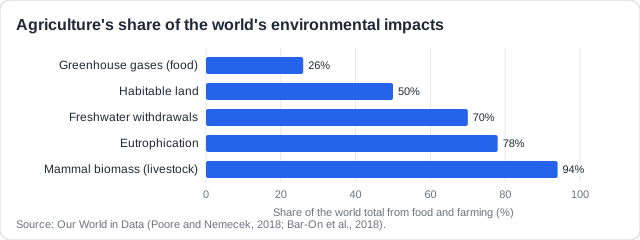
May 2026 HL Paper 2 set a figure of agriculture's impacts, from greenhouse gases to eutrophication, and asked how a rights-based approach to them may be controversial. Here is the same data.
Ethical and unethical, by rights
- Name an impact from the figure first (no mark on its own).
- Why it is ethical by rights: the right to food and basic needs; property rights to farm land.
- Why it is unethical by rights: people harmed by climate change; ecosystems' right to exist.
- Also unethical: others' right to be safe from floods, to clean water, to an indigenous way of life.
- One impact can be both, because rights conflict.
Land use: ethical, by rights
- People have a right to enough food
- Owners have property rights to farm their land
- Farmers have a right to earn a living
Land use: unethical, by rights
- Forests have a right to exist
- Indigenous people lose their way of life
- Downstream towns lose protection from floods
Get feedback like a real examiner
Submit your answers and get instant feedback — what you did well, what's missing, and exactly what to write to score full marks.
The question asks why the approach is controversial within society. The marks for that come from showing where the conflict lies.
Where the controversy lies
- Who pays? The people least responsible suffer most from climate change.
- Fairness: poorer countries asked to cut emissions and food output; richer ones buy permits.
- Consent: can an owner change land that affects others, future people and wildlife?
- Public land: what gives a government the right to decide an ecosystem's fate?
- So a rights-based answer is controversial: rights clash, and no list is agreed.
Greenhouse gases from farming: Ethical: food meets a basic human need. Unethical: warming breaks the rights of people who lose homes and harvests. Controversy: richer countries can buy carbon permits and keep producing, while the people least responsible suffer most.
Strengths of a rights-based approach
- Protects minorities from the majority
- Sets clear limits: some acts are never allowed
- Gives a voice to those who cannot speak
Limits
- Rights conflict: food against forests
- No agreed list of who has rights
- May forbid actions with large benefits
How it is asked: The real question was a Discuss [3] on a figure. There is no mark for defining the approach. Choose an impact from the figure, say why it is ethical and unethical by rights, then say where the controversy lies.
The figure above shows that agriculture accounts for 70% of the world's freshwater withdrawals and 78% of eutrophication.
Discuss how a rights-based ethical approach to the use of fresh water by agriculture may be controversial within society.
Model answer plan
See the mark-by-mark plan — for / against / judgement, with marking guidance — in study mode.