The appeal to nature at Higher Level: This page looks at the environment through the lens of ethics. It explains the appeal to nature fallacy, the belief that whatever is natural is good, through malaria mosquitoes and 'natural' pesticides.
Practise this as you read
- Outline what the appeal to nature is and why it is a fallacy.
- Apply it to a real claim about a 'natural' product.
- Discuss whether 'natural' is a reliable ethical guide.
Free preview
This is the free notes preview
You're reading the free notes. Aimnova Pro unlocks the full study experience — and you can try it with your first topic free to keep:
- FlashcardsLock in vocabulary and key terms with spaced repetition.
- Practice questionsAnswer exam-style questions and get instant AI marking.
- Mock exams & past-paper vaultSit full mocks and see exactly how examiners award marks.
- Personalised study planA daily plan built around your exam date and weak areas.
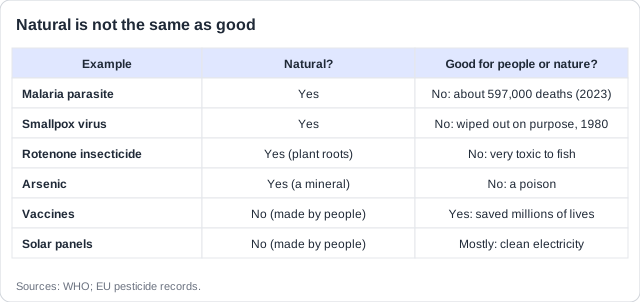
Natural does not mean good: Some people argue that whatever is natural must be right. This is a contentious position, called the appeal to nature fallacy: 'natural' tells you where something comes from, not whether it is good.
The appeal to nature in five points
- Some people hold that whatever is natural is correct or good.
- This is the appeal to nature fallacy: 'it is natural, so it is good'.
- It works the other way too: 'it is unnatural, so it is bad'.
- It is contentious: many natural things are harmful, such as diseases and poisons.
- 'Natural' describes where something comes from; 'good' is a judgement that needs reasons.
Remember it as: Natural is a fact; good is a judgement that needs reasons.
Feeling unprepared for exams?
Get a clear study plan, practice with real questions, and know exactly where you stand before exam day. No more guessing.
The classic test case asks: is it right to protect mosquitoes, even though they spread disease?
The mosquito question
- Malaria is natural: spread by mosquitoes, it killed about 597,000 people in 2023.
- If natural meant good, we should protect the mosquitoes and the parasite.
- Most people judge that saving children's lives comes first: natural is not a reliable guide.
- Smallpox, a natural virus, was wiped out on purpose in 1980.
- There are good reasons for caution, but they are about results, not about being natural.
Gene-drive mosquitoes: Scientists in the Target Malaria project are developing a gene drive to stop malaria mosquitoes breeding. Critics say 'we should not interfere with nature'; supporters point out that smallpox was eradicated in 1980 and no one wants it back.
A weak argument against
- 'Mosquitoes are natural, so leave them alone'
- 'Changing genes is unnatural'
Stronger arguments for caution
- Some fish, birds and bats eat mosquitoes
- A gene drive cannot be recalled once released
Shops and advertisers use 'natural' because buyers trust the word. That trust is the appeal to nature at work.
'Natural' on labels and in farming
- 'Natural' on a food label has no strict legal meaning in many countries.
- Natural pesticides can be harmful: rotenone is very toxic to fish.
- Copper, a natural mineral, builds up in vineyard soil and harms earthworms.
- A synthetic product can be safer or greener than a natural one.
- So judge a product by its effects, not by the word 'natural'.
Rotenone: a natural insecticide
rotenone was long allowed in organic farming because it is natural. It is very toxic to fish, and the EU ended its approval in 2008.
Copper on organic vines
In organic farming copper is sprayed against mildew. It never breaks down, builds up in the soil and harms earthworms, so since 2019 the EU has limited it.
'All natural' on food
In the USA there is no formal legal definition of 'natural' on food. The word says nothing about the land cleared, the water used or the transport.
The trap: Writing 'it is better because it is natural' is the fallacy itself. Write what it does to soil, water, wildlife or people instead.
Memorize terms 3x faster
Smart flashcards show you cards right before you forget them. Perfect for definitions and key concepts.
Rejecting the fallacy does not mean nature has nothing to teach us. It means 'natural' is never enough on its own.
When nature is a useful guide
- The fallacy is treating 'natural' as proof that something is good.
- Nature can still be evidence: designs tested over millions of years (biomimicry).
- Natural ecosystems can be models: they recycle all their waste.
- Valuing wild nature is fine as a value, but it needs reasons (rights, results, character).
- In an answer, say why something is good or bad, never just that it is natural.
Nature as evidence, not proof: In 1941 George de Mestral saw burdock burrs cling to his dog's fur and copied their tiny hooks to invent Velcro: biomimicry. Nature gave useful evidence of a good design, which was then tested and judged by its results.
Natural as a guide: strengths
- Reminds us to be careful with changes we cannot undo
- Natural systems recycle waste and use sunlight
Limits
- Diseases, poisons and disasters are natural too
- 'Natural' has no agreed meaning
How it is asked: Expect the appeal to nature as a short Discuss or Outline on a case, or inside a Paper 1 'Through the lens of ethics' question. Name the claim, show why it fails with evidence, and give the better reasons.
Malaria, spread by mosquitoes, killed about 597,000 people in 2023. Some people oppose using gene drives against malaria mosquitoes because mosquitoes are part of nature.
Discuss whether protecting mosquitoes because they are natural is a reliable ethical position.
Model answer plan
See the mark-by-mark plan — for / against / judgement, with marking guidance — in study mode.