Ecological economics at Higher Level: This statement belongs to the HL lens on environmental economics. It sets out a different way of seeing the economy: not as the whole system, but as a small part of the biosphere that depends on it.
Practise this as you read
- Distinguish between environmental economics and ecological economics.
- Describe the flows of energy and matter between the biosphere and the economy.
- Explain why natural capital and the precautionary principle matter, using Grand Banks cod.
Free preview
This is the free notes preview
You're reading the free notes. Aimnova Pro unlocks the full study experience — and you can try it with your first topic free to keep:
- FlashcardsLock in vocabulary and key terms with spaced repetition.
- Practice questionsAnswer exam-style questions and get instant AI marking.
- Mock exams & past-paper vaultSit full mocks and see exactly how examiners award marks.
- Personalised study planA daily plan built around your exam date and weak areas.
The economy lives inside nature: Ecological economics differs from environmental economics: it sees the economy as a subsystem of the Earth's larger biosphere, and society as a part of ecology.
The points to remember
- Environmental economics: the environment is one part of the economy, to be priced.
- Ecological economics: the economy is a subsystem of the Earth's biosphere.
- The social system (society) is a sub-component of ecology.
- So the economy can never grow bigger than the biosphere that holds it.
- Technocentrics prefer environmental economics; more ecocentric views prefer ecological economics.
Remember it as: Economy inside society, society inside nature.
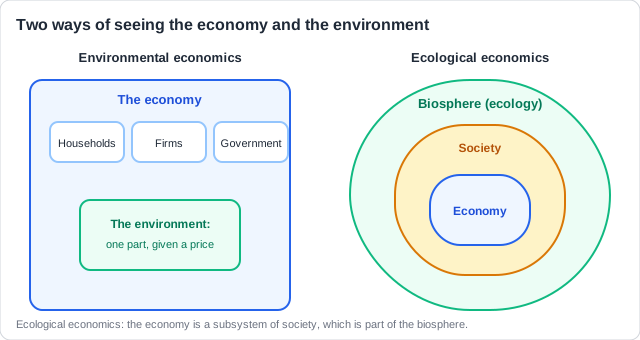
Link to perspectives: A technocentric view expects science to let environmental economics work within today's economy. A more ecocentric view prefers ecological economics.
Practice with exam-style questions
Answer exam-style questions and get AI feedback that shows you exactly what examiners want to see in a full-marks response.
The ecological economist draws the biosphere as a system, with energy flowing through it and matter cycling inside it.
Energy and matter through the system
- Input: solar energy enters the biosphere.
- It sustains natural energy and material resources (natural capital).
- These resources enter the economic subsystem, which makes goods and services.
- The economy produces wastes, which return to the biosphere.
- Energy finally leaves as low-grade heat: an overall loss from the biosphere.
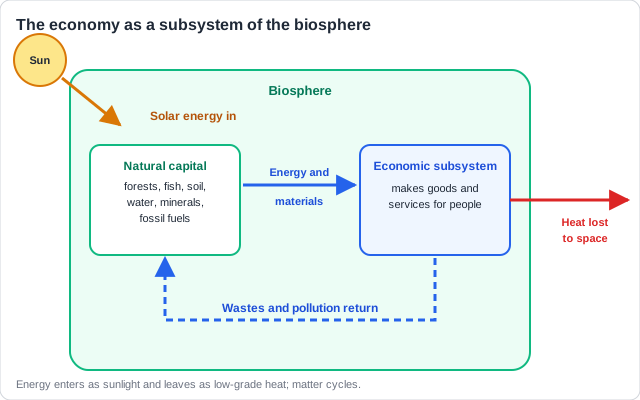
Every use of energy ends as low-grade thermal energy. So an economy that uses more energy and materials each year makes more waste and heat, and draws down natural capital faster.
Ecological economics emphasises the value of natural capital alongside the three other forms of capital an economy uses.
Four kinds of capital
- Natural capital: forests, fish, soil, water, minerals.
- Physical capital: machines, buildings, roads, boats.
- Human capital: people's skills, knowledge and health.
- Financial capital: money and savings.
- Ecological economics values natural capital alongside the other three; it cannot all be replaced by them.
Real example: Grand Banks cod, Canada: From the 1960s bigger trawlers with sonar (physical capital) and skilled crews (human capital) raised cod catches off Newfoundland. But they could not replace the fish. In July 1992 the stock collapsed, the fishery was closed and about 30,000 people lost their jobs.
Feeling unprepared for exams?
Get a clear study plan, practice with real questions, and know exactly where you stand before exam day. No more guessing.
Because the economy depends on natural capital, ecological economics asks us to live off natural income and to apply the precautionary principle.
Sustainable use and precaution
- Use natural capital sustainably: live off the natural income, keep the stock.
- Apply the precautionary principle when harm could be serious or irreversible.
- Aim: minimise environmental and social impacts, not only maximise output.
- The burden of proof shifts: show an activity is safe before it goes ahead.
Rio Declaration, 1992
Principle 15: where there is a threat of serious or irreversible damage, a lack of full scientific proof must not delay action to prevent it.
EU neonicotinoid ban, 2018
The EU banned outdoor use of three neonicotinoid insecticides that harm bees, protecting pollination before every effect was fully proven.
Grand Banks: precaution missing
Warnings in the 1980s that cod were falling did not cut quotas enough. Acting early would have kept the stock and the jobs.
Ecological economics grew from a few thinkers who put the limits of the planet into economics. The International Society for Ecological Economics was founded in 1989.
Where the ideas come from
- Kenneth Boulding (1966): Earth is a closed 'spaceship' with limited resources.
- Herman Daly: a steady-state economy that stays within the biosphere's limits.
- Robert Costanza (1997): nature's services worth about US$33 trillion a year.
- That was nearly twice the world's GNP at the time (about US$18 trillion).
Environmental economics
- Economy is the main system
- Fix problems with prices, taxes, permits
- Growth can continue with technology
- Natural capital can be replaced by other capital
Ecological economics
- Economy is a subsystem of the biosphere
- Respect limits, apply precaution
- Growth must stay within ecological limits
- Natural capital cannot all be replaced
Memorize terms 3x faster
Smart flashcards show you cards right before you forget them. Perfect for definitions and key concepts.
How this could come up: No paper has asked this statement yet. Likely shapes: Paper 2 Section B (a), outline [4]; Section A data on a model of the economy and biosphere [1-3]; an essay comparing economic approaches to sustainability [9].
In the 1980s Canada's Grand Banks cod fishery was managed to keep catches and jobs high. In 1992 the cod stock collapsed.
Outline the differences between environmental economics and ecological economics.
Model answer plan
See the mark-by-mark plan — for / against / judgement, with marking guidance — in study mode.