Use and non-use values at Higher Level: This statement belongs to the HL lens on environmental economics. Some of nature's value shows up when people use it; much of it does not. This page shows how both kinds are put into money, and why surveys are needed.
Practise this as you read
- Distinguish between use values and non-use values, with examples.
- Outline how willingness to pay and willingness to accept are measured.
- Evaluate valuation surveys, using the Exxon Valdez oil spill.
Free preview
This is the free notes preview
You're reading the free notes. Aimnova Pro unlocks the full study experience — and you can try it with your first topic free to keep:
- FlashcardsLock in vocabulary and key terms with spaced repetition.
- Practice questionsAnswer exam-style questions and get instant AI marking.
- Mock exams & past-paper vaultSit full mocks and see exactly how examiners award marks.
- Personalised study planA daily plan built around your exam date and weak areas.
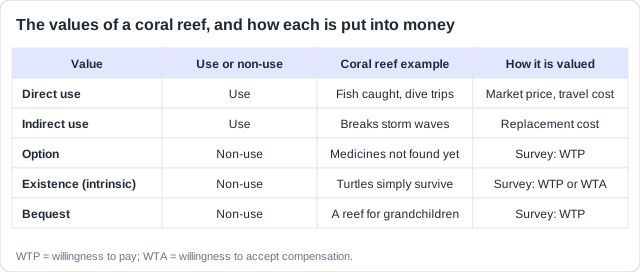
Used, or simply valued: A resource can have a use value and a non-use value. Use values can be put into money through use; non-use values cannot.
The points to remember
- Use values: from using the resource, e.g. fish caught, a dive trip, flood protection.
- Non-use values: valued even if never used.
- Non-use includes intrinsic (existence) value: a species has value in itself.
- Non-use includes future use (option value): e.g. medicines not yet found.
- Non-use includes value for future generations (bequest value).
Remember it as: Use it, or just know it is there.
Future use counts as non-use: Some books call the potential for future use (option value) a use value. Follow the guide: it is a non-use value, because no one is using it yet.
Memorize terms 3x faster
Smart flashcards show you cards right before you forget them. Perfect for definitions and key concepts.
When people pay for a resource, or spend money to use it, its use value can be read from what they spend.
Establishing use values
- Use values can be established by use: people buy, sell or travel for them.
- Market price: what timber, fish or crops sell for.
- Travel cost: what visitors spend to reach a park or reef.
- Replacement cost: what it would cost to do the same job artificially.
- Indirect use, such as clean water from a forest, is valued by what it saves.
Real example: New York City's water: In 1997 New York City chose to protect the forests and farms of its Catskill and Delaware watershed for about US$1.5 billion, instead of building a filtration plant costed at US$6-8 billion. The replacement cost showed what the land's clean water was worth.
Many people value a whale, a rainforest or a reef they will never see. This is a non-use value, and it includes the intrinsic value of a species.
Why non-use values are hard to price
- Non-use values have no market: no one buys or sells them.
- So they cannot be established by use; they must be estimated.
- Ignoring them makes nature look cheaper than people really think it is.
- They matter most for rare species and remote places few people visit.
Use value: a reef
- Fish sold at market
- Divers pay for trips
- Waves broken before the coast
Non-use value: the same reef
- Turtles survive, even if unseen
- Medicines may be found later
- The reef is left for grandchildren
Know your predicted grade
Take timed mock exams and get detailed feedback on every answer. See exactly where you're losing marks.
Non-use values are estimated by contingent valuation: asking people their willingness to pay for a common good, or their willingness to accept for its destruction.
Surveys: willingness to pay and to accept
- Surveys (contingent valuation) estimate non-use values.
- Willingness to pay (WTP): how much would you pay to protect this common good?
- Willingness to accept (WTA): how much compensation would you accept for its destruction?
- Answers are multiplied up for the whole population, giving a total value.
- The guide's example: the Exxon Valdez oil spill, Alaska, 1989.
Spill
- 24 March 1989: the tanker Exxon Valdez ran aground in Prince William Sound. About 41 million litres of oil spilled.
Use losses
- Fishing seasons were closed and fewer tourists came: losses with a market price.
Non-use losses
- About 250,000 seabirds and 2,800 sea otters died, in a place most Americans will never visit.
Survey
- In 1991 US households were asked what they would pay to prevent another such spill. Lost non-use value: about US$2.8 billion.
Surveys are the only way to put a number on non-use values, but the numbers are open to question.
Problems with valuation surveys
- The questions are hypothetical: people do not really pay.
- Answers depend on income: richer people can say more.
- WTA is usually much higher than WTP for the same thing.
- Some people refuse to put a price on nature at all (protest answers).
- Results depend on how the question is worded.
Real example: Deepwater Horizon, 2010: After the Deepwater Horizon rig exploded in the Gulf of Mexico in 2010, researchers asked 3,646 US households if they would vote for a one-time tax to prevent such harm. The average household would pay US$153, about US$17.2 billion for the whole country (published 2017).
Get feedback like a real examiner
Submit your answers and get instant feedback — what you did well, what's missing, and exactly what to write to score full marks.
How this could come up: No paper has asked this statement yet. Likely shapes: Paper 2 Section B (a), outline [4]; a Paper 1 lens question, 'Through the lens of economics, suggest...' [6]; Section A data on a valuation survey [1-3].
The Amazon rainforest supplies timber, Brazil nuts and medicines, and is home to jaguars and many species that few people will ever see.
Outline two use values and two non-use values of the Amazon rainforest.
Model answer plan
See the mark-by-mark plan — for / against / judgement, with marking guidance — in study mode.