Paying for ecosystem services at Higher Level: This statement belongs to the HL lens on environmental economics. It asks whether paying people, and whole countries, to keep their forests can protect nature, and why it can cause arguments between countries.
Practise this as you read
- Outline the values of a forest beyond its timber.
- Explain how payments work, using Costa Rica and the Amazon Fund.
- Evaluate payments between countries, including the failure of Yasuni-ITT.
Free preview
This is the free notes preview
You're reading the free notes. Aimnova Pro unlocks the full study experience — and you can try it with your first topic free to keep:
- FlashcardsLock in vocabulary and key terms with spaced repetition.
- Practice questionsAnswer exam-style questions and get instant AI marking.
- Mock exams & past-paper vaultSit full mocks and see exactly how examiners award marks.
- Personalised study planA daily plan built around your exam date and weak areas.
Paying to keep nature standing: Ecological economics puts great weight on the value of ecosystem services. So countries that have used up their own natural assets may make payments for ecosystem services to countries that still have them.
The points to remember
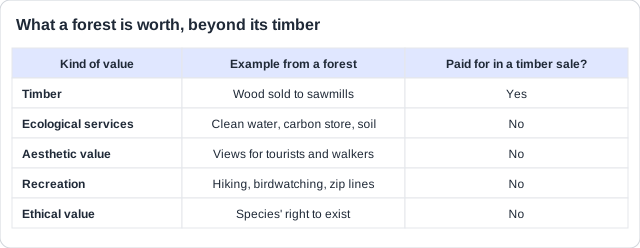
- Forests are worth more than their timber: ecological, aesthetic, recreation and ethical value.
- Ecological economics puts even greater emphasis on valuing these services.
- Resource-depleted countries pay resource-rich developing countries not to deplete them.
- This matters when a poor country might use up its forests to develop economically.
- Many paying countries cut their own forests in the past for economic gain.
Remember it as: Worth more standing than cut.
Study smarter, not longer
Most students waste 40% of study time on topics they already know. Our AI tracks your progress and optimizes every minute.
Costa Rica pays its own landowners for the services their forests give everyone. It is the best-known scheme of its kind.
Costa Rica's payments, since 1997
- Forestry Law 7575 (1996): forests give four services: carbon, water, biodiversity, scenery.
- Since 1997 landowners are paid per hectare to protect or replant forest.
- Money: 3.5% of a fuel tax, plus charges paid by water users.
- Forest cover: 21% in 1987, 52% in 2010, about 57% by 2017.
- Other help: falling beef prices and growing ecotourism.
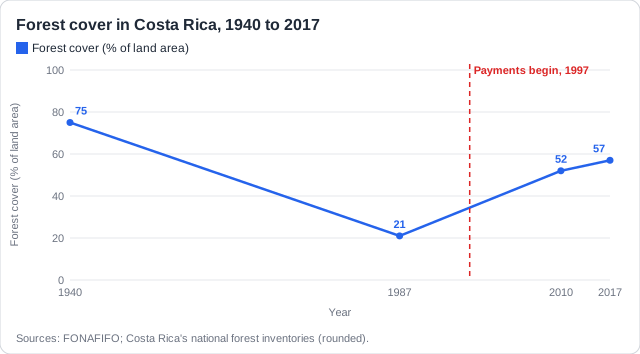
Not the only cause: Forests were already returning when payments began, as beef prices fell and pastures were abandoned. Payments helped, but they are not the whole story.
Between countries, the payments are often made through REDD+.
Rich countries paying forest countries
- Norway has paid forest countries to keep their forests standing.
- Amazon Fund (Brazil, 2008): Norway paid about US$1.2 billion by 2018.
- Indonesia (2010): Norway offered up to US$1 billion for proven cuts in deforestation.
- REDD+: the UN scheme that pays for proven cuts in forest loss.
- Payments are usually results-based: paid only after forest loss is shown to fall.
Brazil: the Amazon Fund
Set up in 2008. Norway paid about US$1.2 billion by 2018, and Germany also paid. The money funds forest monitoring, indigenous land rights and sustainable farming.
Indonesia: Norway's US$1 billion
A 2010 deal offered up to US$1 billion for proven cuts in deforestation. Indonesia ended it in 2021; a new deal in 2022 brought a first payment of US$56 million.
Norway: why it pays
Norway grew rich partly from North Sea oil. It uses some of that wealth to pay others to keep forests that store carbon for everyone.
Practice with exam-style questions
Answer exam-style questions and get AI feedback that shows you exactly what examiners want to see in a full-marks response.
The boldest offer came from Ecuador: a payment for leaving oil in the ground under a forest.
Yasuni-ITT, Ecuador, 2007-2013
- 2007: Ecuador offered to leave about 846 million barrels of oil under Yasuni National Park.
- In return it asked for US$3.6 billion, about half the oil's value, over 13 years.
- It would avoid about 410 million tonnes of carbon dioxide.
- By 2013 only about US$13 million had arrived; the plan was dropped and drilling began in 2016.
- In 2023 about 59% of voters chose to stop drilling in part of the park.
The economic problem: Yasuni's forest and stored carbon benefit the whole world, but nobody has to pay for them. The oil, by contrast, could be sold at once.
Why it failed
- Payments were voluntary: no country had to pay.
- Countries could be free riders: the climate benefit reaches everyone, payers or not.
- Donors had no guarantee a later government would not drill anyway.
- Leaving oil underground has no market price; the oil itself does.
- It was launched just before the 2008 financial crisis, when aid budgets were cut.
Who decides about a forest?: Paying another country not to use its resources can create tensions between countries, over sovereignty, fairness and trust. A free rider problem also weakens payments.
Sources of tension
- Sovereignty: 'our forest, our decision'.
- Fairness: rich countries cleared their own forests, now ask others not to.
- Conditions and late payments: Indonesia ended its deal with Norway in 2021.
- Politics changes: Norway froze Amazon Fund payments in 2019; they restarted in 2023.
- Dependence: a country may rely on payments that can stop.
Strengths
- Gives forests a value beyond timber
- Money reaches landowners and communities
- Results-based: pay only for proven cuts
- Costa Rica's forests recovered
Limits
- Voluntary: free riders
- Payments can stop when politics changes
- Feels unfair to forest countries
- Yasuni raised only US$13 million
Feeling unprepared for exams?
Get a clear study plan, practice with real questions, and know exactly where you stand before exam day. No more guessing.
How this could come up: No paper has asked this statement yet. Likely shapes: a Paper 1 lens question, 'Through the lens of economics, suggest...' [6], marked point by point, with at most 4 marks unless the answer uses economic ideas; Section A data on forest cover [1-3]; an essay [9].
Forest cover in Costa Rica fell from 75% of the land in the 1940s to 21% in 1987, then rose to about 57% by 2017.
Through the lens of economics, suggest why forest cover in Costa Rica recovered after 1987.
Model answer plan
See the mark-by-mark plan — for / against / judgement, with marking guidance — in study mode.