Environmental accounting at Higher Level: This statement belongs to the HL lens on environmental economics. It asks how countries can put an economic value on their natural resources and on what they use up, and why people rarely agree on that value.
Practise this as you read
- Outline what environmental accounting records that GDP leaves out.
- Explain how a cost-benefit analysis and a discount rate shape decisions.
- Evaluate green accounting, using Costa Rica and the Great Barrier Reef.
Free preview
This is the free notes preview
You're reading the free notes. Aimnova Pro unlocks the full study experience — and you can try it with your first topic free to keep:
- FlashcardsLock in vocabulary and key terms with spaced repetition.
- Practice questionsAnswer exam-style questions and get instant AI marking.
- Mock exams & past-paper vaultSit full mocks and see exactly how examiners award marks.
- Personalised study planA daily plan built around your exam date and weak areas.
Count the forest, not just the timber: Environmental accounting is the attempt to attach an economic value to natural capital and to its depletion.
The points to remember
- Environmental accounting attaches an economic value to natural resources.
- It also values their depletion: what is used up or damaged.
- Ordinary accounts (GDP) count the timber sold, not the forest lost.
- Green accounts record the stock (how much is left) and the change each year.
- Aim: make losses of natural capital visible to governments, so they plan for them.
Remember it as: Count the forest, not just the timber.
Ordinary accounts (GDP)
- Timber sold: counted as income
- Forest cut down: not counted
- Fish sold: counted as income
- Fish stock used up: not counted
Environmental accounts
- Timber sold: counted
- Forest lost: recorded as a loss of capital
- Fish sold: counted
- Fish stock left: recorded each year
Real example: a country that cuts down its forests can show fast growth in GDP for years, while its natural capital shrinks. Green accounts show both numbers side by side.
Know your predicted grade
Take timed mock exams and get detailed feedback on every answer. See exactly where you're losing marks.
Since 2012 countries can follow the SEEA, so their natural capital accounts can be compared. Over 90 countries now keep SEEA accounts.
How the accounts are kept
- The UN SEEA gives every country the same rules for natural capital accounts.
- Adopted in 2012 (first international standard); ecosystem accounts added in 2021.
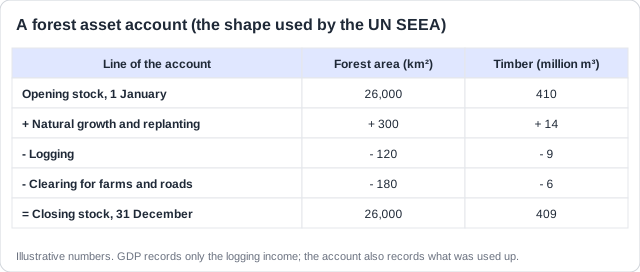
- An asset account: opening stock, plus growth, minus use, equals closing stock.
- Costa Rica's Central Bank keeps yearly forest, water and energy accounts.
- Its forest account counts ecosystem services and carbon, not only timber.
Costa Rica: who keeps the accounts
The Central Bank of Costa Rica, working with the World Bank's WAVES partnership from 2013. Accounts for forests, water and energy are now published every year.
Costa Rica: what they changed
The water account shows how much water farming, hydroelectric power and homes take, and what each pays. The accounts informed the National Development Plan 2015-2018.
Once nature has a value, it can enter a cost-benefit analysis. Environmental values are often found by contingent valuation.
Cost-benefit analysis
- A cost-benefit analysis (CBA) compares a project's total costs and benefits, in money.
- Environmental CBA adds environmental and social costs and benefits.
- Some are priced by markets (timber, fish); others by surveys (contingent valuation).
- If benefits are larger than costs, the project goes ahead.
Real example: a dam: A dam's benefits (electricity, water for farms) have market prices. The river's fish, the flooded forest and the homes of people moved away are harder to price, so they are easy to undervalue or leave out.
Challenges of an environmental CBA
- How do you put a money value on a species or an ecosystem?
- Some damage is irreversible: money cannot buy back an extinct species.
- Cultural and spiritual values are hard to count in money.
- Long-term impacts are uncertain.
- The discount rate makes future harm look small.
Get feedback like a real examiner
Submit your answers and get instant feedback — what you did well, what's missing, and exactly what to write to score full marks.
Costs and benefits that come later are shrunk to a value today using a discount rate.
Discount rates and the future
- A discount rate shrinks future costs and benefits to a value today.
- The higher the rate, the smaller future damage looks.
- So long-term harm, such as climate change, may be judged not worth preventing.
- This is unfair to future generations: an issue of intergenerational equity.
- A low rate gives the future more weight.
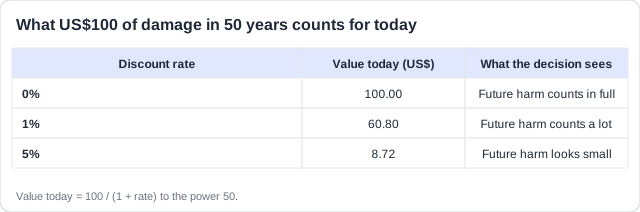
Why this is an ethical issue: A high discount rate treats damage to people not yet born as almost costless. This raises questions of intergenerational equity: should today's decisions put short-term gains ahead of the future?
Whose value counts?: Environmental accounting is problematic because it is hard to reach a consensus value that all stakeholders accept.
Why one value is hard to agree
- Different stakeholders value the same resource in different ways.
- Methods give different numbers for the same thing.
- Intrinsic value and cultural value have no market price.
- Irreversible losses cannot be traded against gains.
- So a consensus value that all stakeholders accept is hard to reach.
Real example: in 2017 Deloitte valued Australia's Great Barrier Reef at about A$56 billion, supporting about 64,000 jobs. Critics said the number left out the reef's value to its Traditional Owners and the value of its species in themselves. A tour company, a fisher and a conservation group would each give a different figure.
Advantages of valuation
- Makes environmental costs visible to policymakers
- Allows options to be compared
- Can justify spending on conservation
- Puts the environment into economic planning
Limitations of valuation
- Reduces nature to money
- Ignores intrinsic value
- Cultural values cannot be priced
- Values vary with the method used
- Future impacts are discounted
Learn what examiners really want
See exactly what to write to score full marks. Our AI shows you model answers and the key phrases examiners look for.
How this could come up: No paper has asked this statement on its own yet. Likely shapes: Paper 2 Section B (a), outline [4]; a Paper 1 lens question, 'Through the lens of economics, suggest...' [6]; and an essay on how useful economic tools are for sustainability [9].
A government wants to put a single money value on a large mangrove forest on its coast, used by fishers, tourists and a local community.
Outline why it is difficult to reach a consensus value for a natural resource.
Model answer plan
See the mark-by-mark plan — for / against / judgement, with marking guidance — in study mode.