The polluter-pays principle at Higher Level: This Higher Level statement is the economist's answer to market failure: make the polluter pay. It covers the tools environmental economics has created, and how well they work.
Practise this as you read
- Outline the polluter-pays principle and its tools.
- Compare a carbon tax with tradeable permits.
- Evaluate how far making the polluter pay reduces pollution.
Free preview
This is the free notes preview
You're reading the free notes. Aimnova Pro unlocks the full study experience — and you can try it with your first topic free to keep:
- FlashcardsLock in vocabulary and key terms with spaced repetition.
- Practice questionsAnswer exam-style questions and get instant AI marking.
- Mock exams & past-paper vaultSit full mocks and see exactly how examiners award marks.
- Personalised study planA daily plan built around your exam date and weak areas.
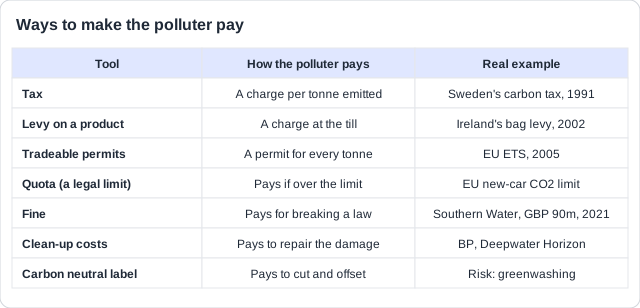
Whoever pollutes pays: When the market fails to prevent harm, the polluter-pays principle may be applied. The costs of stopping, managing and cleaning up pollution are covered by the polluter, to limit the burden on society. This tries to internalise the external cost.
The points to remember
- The polluter pays the costs of stopping, managing and cleaning up pollution.
- It is applied when the market fails to prevent harm (the harm was left out of the price).
- It internalises the external cost, so society no longer carries the burden.
- Tools: quotas, fines, taxes, tradeable permits, carbon neutral certification.
- It is international law: Principle 16 of the Rio Declaration (1992).
Remember it as: You made the mess, you pay to stop it, manage it and clean it.
Memorize terms 3x faster
Smart flashcards show you cards right before you forget them. Perfect for definitions and key concepts.
A tax, or a levy on a product, puts a price on the harm.
Taxes and levies
- A tax or levy adds a charge for each unit of pollution or each polluting product.
- The price rises towards the social cost, so people buy less and firms pollute less.
- Ideally the tax equals the external cost (a Pigouvian tax), which is hard to estimate.
- It gives a certain price, but not a certain cut in pollution.
- Its money can fund clean technology or help poorer households.
Real example: Sweden has taxed carbon dioxide since 1991; the rate is now over 100 euros a tonne, one of the highest in the world. Its emissions have fallen by about a third since 1990 while its economy grew.
Limits of a tax
- Hard to set: the external cost must be estimated, or the rate is wrong.
- Regressive: fuel and heating taxes hit poorer households hardest.
- Passed on: firms may raise prices instead of cutting pollution.
- Carbon leakage: firms may move to countries with no tax.
- Unpopular: so rates are often set low, with exemptions.
Watch two words: a tax can be regressive, and can cause carbon leakage.
Tradeable permits, or cap and trade, fix the total amount of pollution and let a market set its price.
Tradeable permits
- A government sets a cap: the total pollution allowed. It falls each year.
- Firms need a permit for each tonne; they can buy and sell spare permits.
- A firm that cuts cheaply sells spare permits; one that cannot, buys them.
- So pollution is cut where it is cheapest, and the total is certain.
- Design matters: a tight cap, few free permits, honest monitoring, a minimum price.
Real example: the EU Emissions Trading System, started in 2005, covers power stations, heavy industry and flights within Europe. Its cap falls every year, and emissions from the sectors it covers were about 47% below 2005 levels by 2023.
Carbon tax
- Simple to set up
- Price certainty: a predictable price signal
- Raises money for green projects
- Does not guarantee how much emissions fall
Cap and trade
- Quantity certainty: the cap guarantees the total
- Flexible: firms make the cheapest cuts
- Creates a carbon market
- Complex to run; the permit price can swing
Compare, do not list: In an evaluation, set the two side by side: a tax makes the price certain, a cap makes the amount certain. Taxes are often unpopular, while trading can be sold as a market solution, but in the early EU scheme too many free permits made the price collapse.
Know your predicted grade
Take timed mock exams and get detailed feedback on every answer. See exactly where you're losing marks.
Quotas, fines and clean-up bills make the polluter pay after the rules are broken or the damage is done. A quota sets the limit; offsetting is part of carbon neutral labels.
Quotas, fines, clean-up and labels
- Quotas: a legal limit; going over it costs money (EU car makers pay 95 euros per gram per car).
- Fines: polluters pay for breaking the law (Southern Water, GBP 90 million, 2021).
- Clean-up liability: the polluter pays to repair the damage (Exxon Valdez, Deepwater Horizon).
- Carbon neutral certification: a firm pays to cut and offset its emissions to earn a label.
- A label is only honest if the cuts are real; otherwise it is greenwashing.
Exxon Valdez, Alaska, 1989
A tanker hit a reef and spilled about 41 million litres of oil into Prince William Sound. Exxon spent about US$2 billion on the clean-up and paid about US$1 billion in a 1991 settlement. In 1990 the USA passed the Oil Pollution Act, making oil firms liable for spills.
Deepwater Horizon, Gulf of Mexico, 2010
BP's drilling rig exploded, killing 11 workers, and oil leaked for 87 days. In 2015 BP agreed to pay US$20.8 billion, the largest environmental settlement in US history.
Southern Water, England, 2021
A court fined the company a record 90 million pounds for thousands of illegal sewage discharges into rivers and the sea between 2010 and 2015.
In an essay, ask whether the polluter really pays, and whether paying stops the pollution.
Does the polluter really pay?
- Strength: a reason to cut pollution at the source, not just clean up later.
- Strength: fair: those who cause harm pay, not taxpayers or neighbours.
- Limit: the damage is hard to value, so payments are often too low.
- Limit: some polluters have gone, gone bankrupt or are abroad, so the public pays.
- Limit: lobbying wins low rates, free permits and exemptions.
- Limit: a payment cannot undo some harm, such as a death or an extinction.
When rules work better
- Very toxic substances: ban them outright
- A certain limit is needed fast, e.g. to protect health
- Simple to check and enforce
When the public pays instead
- A subsidy for clean energy is paid by taxpayers, not polluters
- It may add clean power without closing dirty plants
- Old, abandoned polluted sites are cleaned with public money
Get feedback like a real examiner
Submit your answers and get instant feedback — what you did well, what's missing, and exactly what to write to score full marks.
How it is asked: May 2026 Paper 2 Section B asked how far economic strategies and models can make communities more sustainable [9], naming the polluter-pays principle among them. A [9] is marked by markbands: terms, breadth, named examples, balance and a supported conclusion.
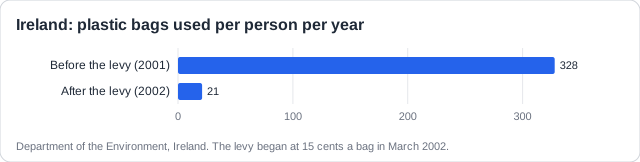
Ireland's plastic bag levy and Sweden's carbon tax both charge polluters for the harm they cause.
To what extent does the polluter-pays principle reduce pollution?
Model answer plan
See the mark-by-mark plan — for / against / judgement, with marking guidance — in study mode.