Greenwashing at Higher Level: This Higher Level statement looks at greenwashing: companies spending on a green image instead of on green practices. You will learn its signs, its biggest real cases, why it harms sustainability and how it is tackled.
Practise this as you read
- Define greenwashing.
- Identify signs of greenwashing in an advert or claim.
- Evaluate how far laws and consumers can stop it.
Free preview
This is the free notes preview
You're reading the free notes. Aimnova Pro unlocks the full study experience — and you can try it with your first topic free to keep:
- FlashcardsLock in vocabulary and key terms with spaced repetition.
- Practice questionsAnswer exam-style questions and get instant AI marking.
- Mock exams & past-paper vaultSit full mocks and see exactly how examiners award marks.
- Personalised study planA daily plan built around your exam date and weak areas.
Looking green instead of being green: Greenwashing, or 'green sheen', is where companies use marketing to give themselves a more environmentally friendly image. It is a form of misinformation: time and money go on looking sustainable rather than on changing practices to become sustainable.
The points to remember
- Greenwashing (or green sheen): marketing that gives a company a greener image than it has.
- Money and time go on marketing looking sustainable, not on changing practices.
- It is a form of misinformation: buyers and investors are misled.
- Classic case: oil companies claiming to move to clean energy while spending most on oil and gas.
Remember it as: Green paint, same engine.
Real example: in 2000 the oil company BP renamed itself 'beyond petroleum', with a green and yellow sun logo, yet most of its investment stayed in oil and gas. In 2023 it scaled back its plan to cut oil and gas production by 2030, from 40% to 25%.
Feeling unprepared for exams?
Get a clear study plan, practice with real questions, and know exactly where you stand before exam day. No more guessing.
Greenwashing is easier to spot once you know its usual tricks.
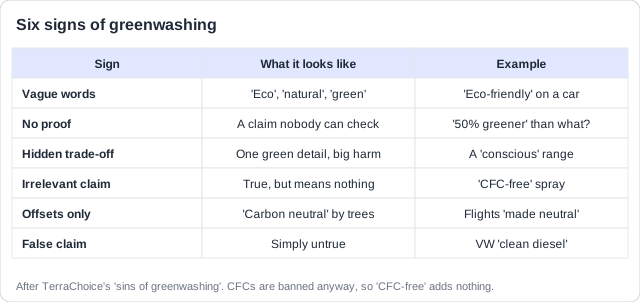
Six signs of greenwashing
- Vague words: 'eco', 'natural', 'green' with nothing measurable behind them.
- No proof: a claim that cannot be checked by anyone independent.
- Hidden trade-off: one small green feature hides a much bigger harm.
- Irrelevant claims: true but meaningless, such as 'CFC-free' (CFCs are banned anyway).
- Offsets only: 'carbon neutral' because someone else plants trees.
- False claims: simply untrue.
Real example: H&M marketed a 'Conscious' range of clothes made partly from recycled or organic material, while it kept selling huge numbers of fast fashion items. In 2022 the Dutch consumer authority found the claims unclear; H&M agreed to change them and gave 500,000 euros to sustainability causes.
The best-known case is not a vague word but a hidden lie, built into millions of cars.
Volkswagen 'dieselgate'
- From 2008 VW sold diesel cars advertised as 'clean diesel'.
- A defeat device cut emissions only during tests, in about 11 million cars worldwide.
- On the road they gave out up to 40 times the US limit for nitrogen oxides.
- Exposed in 2015 by US researchers and regulators; VW's chief executive resigned.
- Fines, buy-backs and repairs have cost VW over 30 billion euros.
The image
- Adverts sold diesel cars as 'clean diesel', cleaner than petrol.
The trick
- A defeat device switched on full pollution controls only in the test.
The truth
- On real roads the cars gave out up to 40 times the US limit for nitrogen oxides.
The cost
- Exposed in 2015; fines, buy-backs and repairs cost VW over 30 billion euros.
Memorize terms 3x faster
Smart flashcards show you cards right before you forget them. Perfect for definitions and key concepts.
Why it matters: Through the lens of economics, a market works only if buyers know what they are buying. Greenwashing feeds them false information, so money flows to the firms that look greenest, not to those that are.
The harm greenwashing does
- Buyers cannot make informed choices, so their money does not reward the greenest firms.
- It slows real change: firms look green without cutting harm.
- It is unfair to honest firms that spend money really cutting their impact.
- It undermines trust, so people ignore even true green claims.
- It weakens the polluter-pays principle: a cheap label replaces real cuts.
Not every green claim is greenwashing: A claim backed by measured, checked cuts is honest. Greenwashing is when the image runs ahead of the practice: vague, unproved, or resting on offsetting instead of real cuts.
Governments, courts and citizens are all pushing back. This links the economics lens to law.
How greenwashing is tackled
- Law: from 27 September 2026 the EU bans vague claims such as 'eco-friendly' without proof.
- The EU also bans 'climate neutral' claims that rest only on offsetting.
- Proof first: claims must be checked by an independent body (the EU's proposed Green Claims rules).
- Regulators and courts fine firms or order them to change adverts.
- Consumers, journalists and NGOs test claims and expose false ones.
Rules
- EU ban on vague claims, applies from 27 September 2026
- EU ban on 'climate neutral' claims based on offsets
- UK Green Claims Code, 2021
Limits
- Firms can shift to new, cleverer wording
- Checking every claim is slow and costly
- Rules differ from country to country
Know your predicted grade
Take timed mock exams and get detailed feedback on every answer. See exactly where you're losing marks.
How it could be asked: May 2026 Paper 2 named greenwashing in its economics-lens essay on economic strategies and models [9]. Likely shapes: Section B (a) outline [4], a Paper 1 part on an advert or fact file [2], or an essay [9].
H&M sold a 'Conscious' range of clothes made partly from recycled or organic material, while it kept selling huge numbers of cheap clothes.
Outline how greenwashing can slow progress towards sustainability.
Model answer plan
See the mark-by-mark plan — for / against / judgement, with marking guidance — in study mode.