Market failure at Higher Level: This Higher Level statement explains why free markets harm the environment: prices leave out the costs that pollution puts on other people, so society loses while the polluter does not pay.
Practise this as you read
- Define market failure and externality.
- Explain why a polluting good is overproduced.
- Outline how market failure adds to an ecological deficit.
Free preview
This is the free notes preview
You're reading the free notes. Aimnova Pro unlocks the full study experience — and you can try it with your first topic free to keep:
- FlashcardsLock in vocabulary and key terms with spaced repetition.
- Practice questionsAnswer exam-style questions and get instant AI marking.
- Mock exams & past-paper vaultSit full mocks and see exactly how examiners award marks.
- Personalised study planA daily plan built around your exam date and weak areas.
When the market gets it wrong: Market failure occurs when the allocation of goods and services by the free market imposes negative impacts on the environment. A factory that pollutes while it makes its goods creates a net welfare loss on society, at no cost to the factory.
The points to remember
- The free market decides what is made, how much, and who gets it, through prices.
- Market failure: that allocation imposes negative impacts on the environment.
- The cause: harm such as pollution is not included in the price.
- A polluting factory makes a net welfare loss for society, at no cost to the factory.
- Markets can also underproduce good things, such as protecting nature.
Remember it as: The factory sells the goods; everyone else pays for the smoke.
Real example: the World Bank estimated that air pollution cost the world about US$225 billion in lost earnings in 2013, because people were too ill to work or died early. Almost none of that cost was paid by the power stations, factories and vehicles that caused it.
Practice with exam-style questions
Answer exam-style questions and get AI feedback that shows you exactly what examiners want to see in a full-marks response.
Most environmental market failures come from externalities: costs or benefits that fall on a third party.
Externalities and social cost
- An externality is a cost or benefit that falls on a third party who did not choose it.
- Negative externality: a cost to others, e.g. factory smoke harming nearby residents.
- Positive externality: a benefit to others, e.g. a beekeeper's bees pollinating nearby farms.
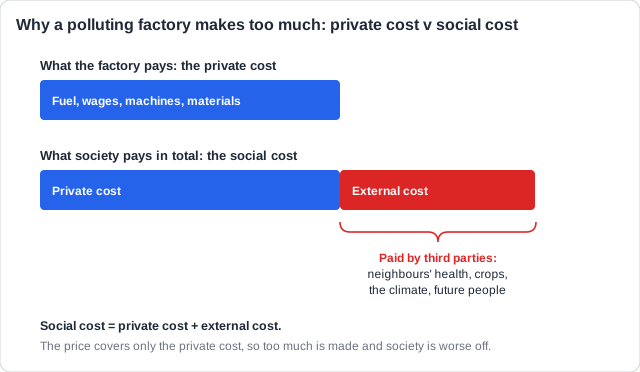
- Social cost = private cost + external cost: the true cost to society.
- Always say who bears the external cost and how.
Negative environmental externalities
- Air pollution from factories causing respiratory disease
- Agricultural runoff causing eutrophication in waterways
- Carbon emissions contributing to climate change
- Noise pollution from airports reducing property values
Because the price leaves out the external cost, the market makes too much of a polluting good.
Why the market overproduces
- The price reflects only the private cost (in economics, MPC), not the social cost (MSC).
- So the good is too cheap, more is bought, and the market overproduces it.
- Output goes past the level that is best for society: a welfare loss.
- The fix is to internalise the externality: make the polluter face the social cost.
- Ways: taxes, subsidies for clean options, cap-and-trade, regulation, property rights.
The greatest market failure: In 2006 the UK's Stern Review called climate change 'the greatest market failure the world has ever seen'. Those who burn coal, oil and gas do not pay for the damage their carbon dioxide causes to other countries and to future generations. Stern estimated that unchecked climate change could cost 5-20% of world GDP every year, against about 1% a year to cut emissions.
- Pigouvian tax
- A Pigouvian tax. It raises the price to the social cost, so less is made.
- Internalising an externality
- Making the polluter pay the full social cost, so the price tells the truth.
Feeling unprepared for exams?
Get a clear study plan, practice with real questions, and know exactly where you stand before exam day. No more guessing.
Markets also fail by making too little of things everyone needs but no one can be charged for.
Public goods and free riders
- A public good is non-excludable (no one can be kept out) and non-rivalrous (one person's use leaves as much for others).
- Examples: clean air, a stable climate, biodiversity, the ozone layer.
- Free rider problem: people enjoy the benefit without paying for it.
- So few pay, and the market underprovides protection: another market failure.
- Ocean fish stocks are only partly like this: they are rivalrous (see the tragedy of the commons).
Real example: the ozone layer protects every living thing from ultraviolet light, and no one can be stopped from benefiting. No firm could sell its protection, so the market never would have. It took a collective agreement, the Montreal Protocol of 1987, to phase out the gases that destroy it.
Name the type of failure: Overproduction of a harmful good (pollution) and underproduction of a public good (protection) are both market failures. Say which one your example shows.
A May 2026 paper linked market failure to a country's ecological footprint, biocapacity and ecological deficit. Mauritius has had a deficit since about 1971.
Market failure and the ecological deficit
- Firms release waste and pollution at no cost to them: a market failure.
- Those wastes add to the ecological footprint (land needed to absorb them).
- When wastes are more than the land can absorb, footprint passes biocapacity: a deficit.
- Pollution also damages ecosystems, which reduces biocapacity.
- Unpriced resources (e.g. forest) are overused, which also reduces biocapacity.
No cost
- Factories, hotels and vehicles release waste and emissions without paying for the harm.
Footprint up
- More land and sea would be needed to absorb those wastes, so the footprint grows.
Biocapacity down
- Pollution harms reefs, lagoons and forests, and unpriced land is cleared, so the island can supply and absorb less.
Deficit
- Footprint above biocapacity: Mauritius has been in deficit since about 1971.
Memorize terms 3x faster
Smart flashcards show you cards right before you forget them. Perfect for definitions and key concepts.
How it is asked: May 2026 Paper 1 showed a graph of Mauritius's ecological footprint and biocapacity, then asked how its sustainability had changed [2] and how market failure could add to its deficit [2].
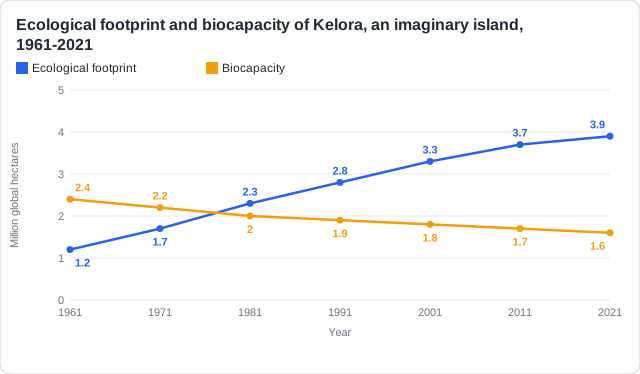
Figure 1 shows the ecological footprint and biocapacity of Kelora, an imaginary island, between 1961 and 2021.
With reference to Figure 1, outline how the sustainability of Kelora has changed between 1961 and 2021.
Model answer plan
See the mark-by-mark plan — for / against / judgement, with marking guidance — in study mode.
Then part (b), the market failure link:
Kelora's economy is based on tourism, fishing and a cement works.
Outline how economic market failure could contribute to the ecological deficit of Kelora, as shown in Figure 1.
Model answer plan
See the mark-by-mark plan — for / against / judgement, with marking guidance — in study mode.