Globalization at Higher Level: This statement is Higher Level only. It asks how world trade gives countries more of what they need, and why that can leave them less secure.
Practise this as you read
- Describe how globalization in an industry has impacted a country, from a fact file and a chart.
- Compare two societies' use of a resource with secondary data.
Free preview
This is the free notes preview
You're reading the free notes. Aimnova Pro unlocks the full study experience — and you can try it with your first topic free to keep:
- FlashcardsLock in vocabulary and key terms with spaced repetition.
- Practice questionsAnswer exam-style questions and get instant AI marking.
- Mock exams & past-paper vaultSit full mocks and see exactly how examiners award marks.
- Personalised study planA daily plan built around your exam date and weak areas.
More choice, more dependence: economic globalization gives countries more food, water and energy than they could produce alone, but makes them interdependent, so trouble far away can cut their supply.
The points to remember
- Trade lets countries buy what they lack, so supply increases: more choice, lower prices, all year.
- Countries become interdependent: each needs others to buy or sell.
- But a country that relies on imports can be cut off by war, disputes, disasters or price shocks.
- Exporters depend on world prices and foreign buyers they cannot control.
- So globalization can raise supply but lower national resource security.
Remember it as: Trade fills the shelf, but someone else holds the key.
Supply goes up
- More choice and lower prices
- Food out of season
- Resources a country does not have
Security can go down
- Supply cut by war or disputes
- Prices set by world markets
- Exporters depend on buyers
Feeling unprepared for exams?
Get a clear study plan, practice with real questions, and know exactly where you stand before exam day. No more guessing.
Europe's gas crisis of 2022 is the clearest recent case of energy interdependence turning into insecurity.
Energy: Europe's gas crisis, 2022
- In 2021 Russia supplied about 45% of the EU's gas imports, about 40% of all the gas it used.
- Cheap pipeline gas kept energy prices low for years: supply up.
- After Russia invaded Ukraine in 2022, Russia cut gas flows to Europe.
- In August 2022 gas prices hit a record of about EUR 340 per MWh, many times the usual level.
- The Nord Stream pipelines were damaged by explosions in September 2022.
- The EU bought LNG from the USA and Qatar, used more Norwegian gas and agreed to cut gas use by 15%.
What it shows: cheap Russian gas had increased supply for decades, but it tied Europe to one seller. When that seller cut supply, prices soared, factories cut output and governments spent billions helping households. Europe made itself more secure by buying LNG from many countries and cutting demand.
Food trade lets a desert country eat bread made from wheat grown thousands of kilometres away.
Food: wheat and the 2022 war
- Russia and Ukraine sold almost 30% of the wheat traded worldwide.
- Egypt, the world's largest wheat importer, bought much of its wheat from them.
- The 2022 war closed Ukraine's Black Sea ports, and wheat prices jumped.
- The Black Sea Grain Initiative (July 2022 - July 2023) shipped about 33 million tonnes.
- Trade feeds countries that cannot grow enough, but one war far away can raise their bread prices.
Water: virtual water. Water itself is rarely shipped between countries, but it travels inside food. Every tonne of imported wheat brings the virtual water used to grow it.
Water: Saudi Arabia's wheat
- Water is rarely shipped, but it moves inside traded goods as virtual water.
- Saudi Arabia once grew its own wheat using fossil water pumped from deep aquifers.
- To save that water, it ended wheat growing in 2016 and now imports all its wheat.
- Its water security improved, but its food now depends on other countries.
Memorize terms 3x faster
Smart flashcards show you cards right before you forget them. Perfect for definitions and key concepts.
Modern goods pass along a long supply chain. Cheap and efficient while it works, it fails when one link breaks, as the 2021 shortage of semiconductor chips showed.
Supply chains, and the exporter's side
- Products are made in long supply chains across many countries: cheap, but fragile.
- 2021: a shortage of chips cost carmakers about USD 210 billion and 7.7 million cars.
- Most of the most advanced chips are made in Taiwan; a drought there in 2021 threatened chip plants.
- Chile, the largest copper producer, ships most copper as concentrate to be smelted abroad.
- Exporters gain income, investment, ports and jobs, but little value added and prices set abroad.
- More mines mean more water use and degradation; smelting pollution moves to other countries.
Real example: in 2021 carmakers around the world stopped production lines because they could not get chips worth a few dollars each. The chips were made in a handful of plants, mostly in Asia, which could not keep up with demand. Interdependence works both ways: an exporter such as Chile depends on its buyers as much as they depend on it.
How globalization in copper has affected Chile
- Income: world demand means more extraction and export earnings.
- Little value added: most copper is sold as concentrate; other countries smelt it.
- Investment and ties: foreign TNCs fund mines; new ports open trade; trade builds closer ties with buyers.
- Water and land: more mines in the dry Atacama Desert use scarce water.
- Prices are set by world markets; competition from other producers can lower them.
- Risk: a break in the supply chain or a fall in demand hits Chile's economy.
To investigate how two societies use a resource, use secondary data and compare them per person.
Investigating a resource with data
- Use secondary data: World Bank, Our World in Data, Gapminder, or an industry body.
- Pick a named resource (steel, concrete, fertilizer) and two societies.
- Compare per person, not totals, so big and small countries can be compared fairly.
- Draw a bar chart to compare; a line graph to show change over years.
- A statistical test checks the pattern, e.g. Spearman's rank for a link between income and steel use.
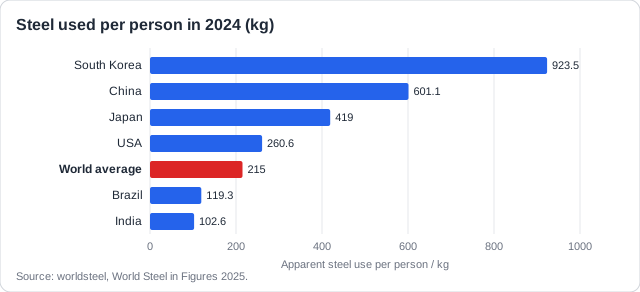
Reading it: China used about 601 kg of steel per person in 2024 and India about 103 kg, about six times less. China is building cities, railways and factories fast and makes much of the world's steel; India is earlier on that path, so its steel use is rising. Both trade iron ore and coal across the world to make it.
Know your predicted grade
Take timed mock exams and get detailed feedback on every answer. See exactly where you're losing marks.
How this comes up: Paper 1: using a fact file and a chart of exports, describe how globalization in an industry has impacted a country [2]. Paper 2 may ask you to outline or discuss the risks of interdependence.
In 2021 Russia supplied about 45% of the European Union's gas imports. After Russia invaded Ukraine in 2022 it cut its gas supplies, and in August 2022 European gas prices reached a record of about EUR 340 per MWh. The EU then bought more liquefied natural gas from the USA and Qatar.
Using this information, describe how globalization in the gas industry has impacted the European Union.
Model answer plan
See the mark-by-mark plan — for / against / judgement, with marking guidance — in study mode.