Natural income at Higher Level: The same statement as SL, with different real cases: Quebec's maple syrup, the Amazon's 'flying rivers', Namibia's conservancies and Singapore's forest reservoirs. At HL, link natural income to money: who earns it, and what happens to the capital.
Practise this as you read
- Sort natural income into goods and services.
- Match your answer to the question's words: service, product or economic value.
Free preview
This is the free notes preview
You're reading the free notes. Aimnova Pro unlocks the full study experience — and you can try it with your first topic free to keep:
- FlashcardsLock in vocabulary and key terms with spaced repetition.
- Practice questionsAnswer exam-style questions and get instant AI marking.
- Mock exams & past-paper vaultSit full mocks and see exactly how examiners award marks.
- Personalised study planA daily plan built around your exam date and weak areas.
The interest on nature's bank account: Natural capital provides natural income in terms of goods and services.
The points to remember
- Natural income is what natural capital yields: the 'interest' on nature's bank account.
- It comes as goods: things we take, such as fish, timber, fruit, nuts, honey and rubber.
- And as services: things nature does, such as climate regulation and flood prevention.
- Income can be economic: goods sold, or tourists paying to visit.
Remember it as: Capital is the tree; income is the fruit, the wood that grows, and the shade.
Real example: each spring, farmers in Quebec, Canada, tap their sugar maple trees and boil the sap into maple syrup. The trees, the capital, stand for a century or more; the sap, the income, comes back every year. Quebec makes about 72% of the world's maple syrup.
Know your predicted grade
Take timed mock exams and get detailed feedback on every answer. See exactly where you're losing marks.
Every piece of natural income is either a good (taken away) or a service (done in place).
Goods and services
- Goods are taken away and can be counted or sold: timber, firewood, fish, berries, charcoal, tea.
- Services happen while the ecosystem stands: storing carbon, holding soil, filtering water, cooling.
- More services: habitat for wildlife, pollination, oxygen, reducing floods.
- Cultural services: recreation, tourism, education, spiritual value.
- Ecosystems in cities give income too: cleaner air, cooler streets, higher house prices.
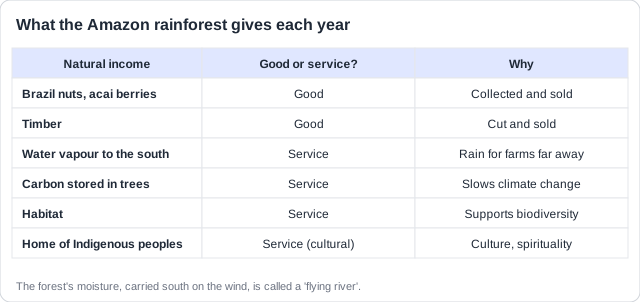
Real example: water vapour from the Amazon is carried south on the wind and falls as rain on farms in southern Brazil. Clearing the forest would cut the timber and nuts sold, and also this service.
Read the question's words: Papers ask for natural income in different words. Each word wants a different kind of answer.
Which answer does the question want?
- Asked for an ecological service? Give what nature does (carbon sink, holds soil), never a good.
- Recreation and tourism count as cultural services, but not when an ecological service is asked for.
- 'Photosynthesis' alone is not enough: say what it does (absorbs CO2, releases oxygen).
- Asked for a product? Name the product: rooibos tea, not just 'rooibos'.
Ecological service: accepted
- Absorbs CO2: a carbon sink
- Roots stop soil erosion
- Habitat for wildlife
- Filters water / keeps the water table up
Not accepted here
- Timber or food (goods)
- Tourism or recreation (cultural)
- 'Photosynthesis' alone
Real example: in Sri Lanka, cinnamon trees are cut back so they grow new shoots, whose bark is peeled and dried. Asked for a commercial product, write 'cinnamon spice', not just 'cinnamon trees'.
Economic value: 'Economic value of a forest as natural capital' wants something that earns money: timber, charcoal, rubber, berries to sell, or tourism.
Get feedback like a real examiner
Submit your answers and get instant feedback — what you did well, what's missing, and exactly what to write to score full marks.
Natural income is sustainable only while the capital that makes it is kept.
Living on the income
- Take only the income and the capital stays the same: it gives income again next year.
- Take more than the income and the capital shrinks: next year's income is smaller.
- For living capital, the income is the new growth: the extra fish, the extra wood each year.
A simple case: A bamboo grove grows new canes every year. Cut only the new canes and the grove stays the same size: you live on its income. Cut the whole grove and the income stops.
Real example: since 1996 Namibia has let rural communities manage the wildlife on their land through conservancies. They earn income from tourism and limited hunting, so they protect the animals, and numbers of elephants and lions have risen.
How this comes up: Paper 1, from the resource booklet: outline ways an ecosystem is natural capital, one point per mark.
In the middle of Singapore, the Central Catchment Nature Reserve is a rainforest surrounding four reservoirs.
Outline three ways in which the reserve is considered natural capital.
Model answer plan
See the mark-by-mark plan — for / against / judgement, with marking guidance — in study mode.