Energy sources at Higher Level: The same ideas as SL, with different countries: Kenya's geothermal power, Poland's coal, Denmark's wind and China's coal and solar. At HL these sources come back in energy security, fossil fuel depletion, nuclear power and batteries, so learn which are renewable now.
Practise this as you read
- Sort every source: renewable or non-renewable.
- Read energy charts: main source, percentages.
Free preview
This is the free notes preview
You're reading the free notes. Aimnova Pro unlocks the full study experience — and you can try it with your first topic free to keep:
- FlashcardsLock in vocabulary and key terms with spaced repetition.
- Practice questionsAnswer exam-style questions and get instant AI marking.
- Mock exams & past-paper vaultSit full mocks and see exactly how examiners award marks.
- Personalised study planA daily plan built around your exam date and weak areas.
Two kinds of energy source: Some energy sources keep coming back, like sunlight and wind. Others are a fixed stock: once used, they are gone.
The points to remember
- A renewable source is replaced by nature as fast as we use it: sunlight, wind, flowing water.
- A non-renewable source is finite: it formed over millions of years, far slower than we use it.
- Renewable: wind, solar, tidal, wood (biomass), geothermal, hydropower.
- Non-renewable: fossil fuels (coal, oil, natural gas) and nuclear (uranium).
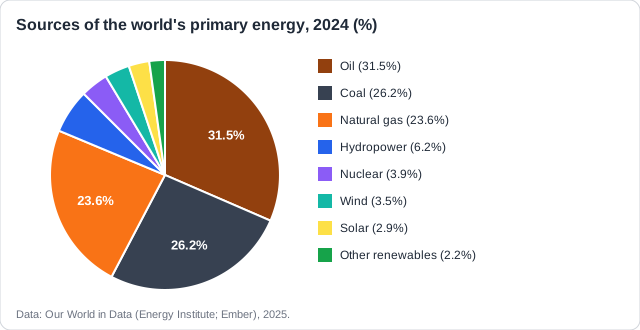
- In 2024 about 81% of the world's primary energy still came from fossil fuels.
Remember it as: Renewable comes back; non-renewable runs out.
Real example: Kenya makes about 45% of its electricity from geothermal power at Olkaria, in the Rift Valley (2024), more than from any other source.
Study smarter, not longer
Most students waste 40% of study time on topics they already know. Our AI tracks your progress and optimizes every minute.
There are two groups of non-renewable source: the three fossil fuels and nuclear power.
The points to remember
- Coal: a solid, from swamp plants buried for millions of years; the most carbon per unit of energy.
- Oil: a liquid, from buried sea plankton; fuels most transport and makes plastics.
- Natural gas: mostly methane, often found with oil; about half the CO₂ of coal per unit of energy.
- Fossil fuels are stored solar energy from ancient photosynthesis, so they are finite.
- Nuclear uses uranium, a mined metal that is finite: so nuclear is non-renewable, but low-carbon.
Fossil fuels
- Coal, oil, natural gas
- Burned to release heat
- Release CO₂ when burned
- Mined or drilled, e.g. by fracking
Nuclear
- Uranium fuel
- Fission
- Almost no CO₂ when running
- Finite: uranium is mined
Nuclear is not renewable: Nuclear power is low-carbon, but it uses uranium, which is mined and will run out. 'Low-carbon' and 'renewable' are different ideas.
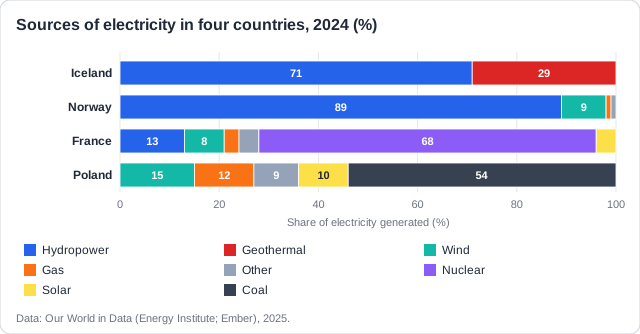
Real example: Poland still makes about 54% of its electricity from coal (2024), mined in its own Silesian coalfields.
Renewable sources are natural income: used well, they do not run out.
The points to remember
- Solar: panels (PV) turn sunlight into electricity; mirrors (CSP) heat a fluid to drive a turbine.
- Wind: turbines on land (onshore) or at sea (offshore), where winds are stronger and steadier.
- Hydropower: falling water from a dam, or a river's flow (run-of-river), turns turbines.
- Tidal: the rise and fall of the tide drives turbines in a barrage or in the sea.
- Geothermal: heat from hot rock, mostly near plate boundaries, makes steam.
- Wood and biomass: renewable only if what is burned is regrown.
Sun
- Solar panels; it also drives wind, rain and plant growth.
Moving air and water
- Wind turns turbines; rain fills reservoirs for hydropower.
Moon and Earth
- The Moon's pull makes tides; hot rock inside the Earth gives geothermal heat.
Wood is renewable only if regrown: Burning wood or crops is renewable only when new plants replace what is burned. Cutting a forest faster than it regrows uses it like a non-renewable stock.
Real example: Denmark makes about 58% of its electricity from wind (2024), much of it from offshore wind farms in the North Sea.
Practice with exam-style questions
Answer exam-style questions and get AI feedback that shows you exactly what examiners want to see in a full-marks response.
Most of the energy from all these sources ends up as electricity: power stations turn heat, falling water or wind into a current that travels along power lines.
The points to remember
- Most energy released from these sources is converted to electricity.
- In most power stations the source heats water to steam (or moves water or air) to spin a turbine.
- The turbine turns a generator, which makes electricity; solar panels make it directly.
- Electricity is easy to send far along power lines and to use in homes, industry and trains.
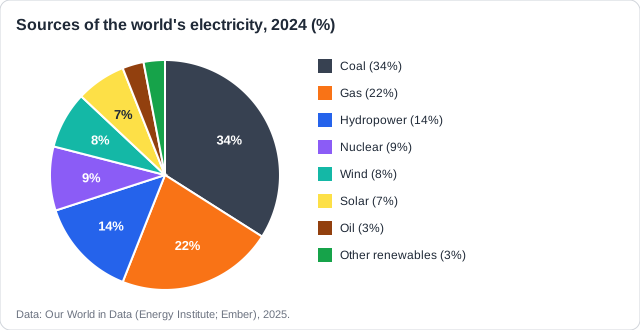
- World electricity 2024: coal 34%, gas 22%, hydropower 14%, nuclear 9%, wind 8%, solar 7%.
Source
Coal, gas, uranium or hot rock heats water; or wind or water moves.
Turbine
Steam, water or air spins the blades of a turbine.
Generator
The spinning turbine turns a generator.
Electricity
The current goes to homes and industry through the grid.
Real example: China made about 58% of its electricity from coal in 2024, yet it also built more solar panels and wind turbines that year than the rest of the world put together.
Papers give a chart of energy sources and ask for the main source, a percentage, or which sources are renewable. Practise on these four countries.
How to read an energy chart
- Identify / state the main source: the biggest slice or bar, written as its name.
- Percentage = part ÷ total × 100: add the parts first if the question groups them.
- Proportion renewable on a 100% bar = 100 − the non-renewable share.
- Show the working in two steps: the sum, then the division. Give the unit (%).
- Group carefully: nuclear is non-renewable; biomass is renewable.
Main source
France: the longest part of the bar is nuclear, 68%.
Group them
Poland non-renewable: coal 54 + gas 12 = at least 66%.
Use 100
Iceland renewable = 100 − 0 non-renewable = 100%.
Two slips that lose the mark: Counting nuclear as renewable. Giving a number with no working when the question says 'calculate': write the sum and the division.
Feeling unprepared for exams?
Get a clear study plan, practice with real questions, and know exactly where you stand before exam day. No more guessing.
How this comes up: Paper 1 (specimen; May 2026) and Paper 2 (May 2026): a chart of energy sources, then 'state the main source' [1] and a percentage of renewable or non-renewable energy [1-2].
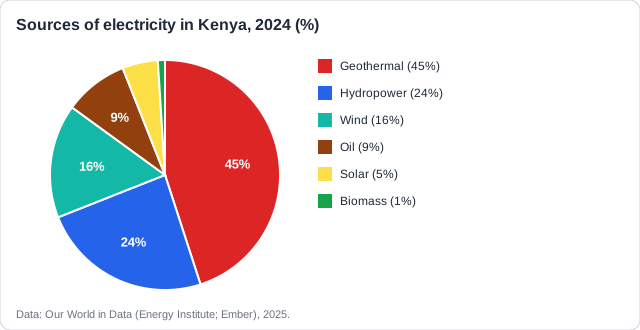
The figure shows the sources of electricity in Kenya in 2024.
(a) Identify the main source of electricity in Kenya.
(b) Calculate the percentage of Kenya's electricity that came from renewable sources.
Model answer plan
See the mark-by-mark plan — for / against / judgement, with marking guidance — in study mode.