Natural resources at Higher Level: The same statement as SL, with different real cases: Iceland's hydropower and geothermal heat, Brazil's sugar cane and China's cement. At HL, keep asking who uses a resource, and how fast.
Practise this as you read
- Sort each resource: raw material, source of energy, or both.
- Explain why resource use keeps rising, with numbers.
Free preview
This is the free notes preview
You're reading the free notes. Aimnova Pro unlocks the full study experience — and you can try it with your first topic free to keep:
- FlashcardsLock in vocabulary and key terms with spaced repetition.
- Practice questionsAnswer exam-style questions and get instant AI marking.
- Mock exams & past-paper vaultSit full mocks and see exactly how examiners award marks.
- Personalised study planA daily plan built around your exam date and weak areas.
Everything we use starts in nature: Natural resources are the raw materials and sources of energy used and consumed by society.
The points to remember
- A natural resource comes from nature and is used by people.
- It is a raw material (to make things) or a source of energy (to power things).
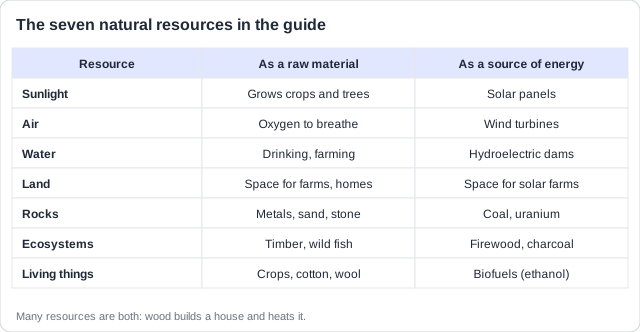
- The guide lists sunlight, air, water, land, rocks, ecosystems and living things.
- Society uses and consumes them: oil burned in a car is gone; land can be used again.
Remember it as: Seven to learn: sun, air, water, land, rocks, ecosystems, living things.
Real example: Iceland makes about 70% of its electricity from rivers fed by glaciers and about 30% from geothermal heat. Its seas give cod and haddock, a major export. Water, rocks, ecosystems and living things are all natural resources here.
Define it in two halves: A definition needs both halves: it comes from nature, and it is used by society as a raw material or a source of energy.
Know your predicted grade
Take timed mock exams and get detailed feedback on every answer. See exactly where you're losing marks.
Sort every resource by what society does with it: makes things from it, or gets energy from it.
Raw material or source of energy?
- Raw materials are made into goods: timber, metals, cotton, sand for glass and concrete.
- Sources of energy power society: sunlight, wind, falling water, coal, oil, gas, uranium.
- Ecosystems and living things give food, timber, fibres and fuel.
- Many resources are both: wood builds a house and heats it; water is drunk and turns turbines.
- Freshwater is scarce: only about 2.5% of Earth's water is fresh, and most of that is ice.
Real example: Brazil grows sugar cane on millions of hectares. The cane is made into sugar, a raw material for food, and into ethanol, which powers most of Brazil's cars. One living resource is both a raw material and a source of energy.
Name the resource, not the product: Electricity, petrol and steel are made by people. The natural resources are the falling water, the crude oil and the iron ore they come from.
Used and consumed: Society is using more natural resources every year, and some places use far more than others.
How much we use
- World extraction of materials tripled: about 31 billion tonnes in 1970, about 95 billion in 2020.
- Why: more people, higher living standards, growing cities and industry.
- Use is uneven: high-income countries use about six times more materials per person than low-income ones.
- Using a resource can use it up (coal burned) or wear it down (soil, fish stocks).
Real example: as China built roads, homes and cities, it used about 6.6 billion tonnes of cement in just three years, 2011 to 2013. The USA used about 4.5 billion tonnes in the whole of the 20th century. Fast growth of cities and industry drives resource use.
Use the data: When a figure shows resource use, quote two numbers and give a cause: more people, richer people, or bigger cities.
Get feedback like a real examiner
Submit your answers and get instant feedback — what you did well, what's missing, and exactly what to write to score full marks.
How this comes up: Paper 2, Section B (a): four points, each a resource linked to how a named society uses it.
Norway is one of the richest countries in the world, and most of its wealth comes from nature.
Outline four natural resources that Norway uses or sells.
Model answer plan
See the mark-by-mark plan — for / against / judgement, with marking guidance — in study mode.