Resource security at Higher Level: This statement is Higher Level only. It looks at how countries make sure of their food, water and energy: by using less, finding more or switching to something new.
Practise this as you read
- Outline ways to increase water, food or energy security, with an example.
- Evaluate a named country's strategies for resource security.
Free preview
This is the free notes preview
You're reading the free notes. Aimnova Pro unlocks the full study experience — and you can try it with your first topic free to keep:
- FlashcardsLock in vocabulary and key terms with spaced repetition.
- Practice questionsAnswer exam-style questions and get instant AI marking.
- Mock exams & past-paper vaultSit full mocks and see exactly how examiners award marks.
- Personalised study planA daily plan built around your exam date and weak areas.
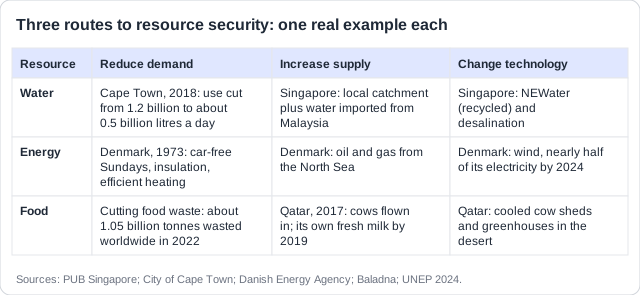
Use less, find more, switch: A society gains resource security in three ways: it cuts demand through efficiency or conservation, it increases supply, or it changes technology so it needs less of what it imports.
Three routes to resource security
- Reduce demand: use less, by efficiency (same job, less resource) or conservation (choosing to use less).
- Increase supply: find more, e.g. new reservoirs, new oil and gas fields, more farmland or imports.
- Change technology: switch to a different source, e.g. recycled water, wind power, greenhouses.
- New technology can cut reliance on imported resources.
- Most countries combine all three routes.
Remember it as: Use less, find more, switch.
Know your predicted grade
Take timed mock exams and get detailed feedback on every answer. See exactly where you're losing marks.
Singapore is a small island with little room to store rain. It added new supplies and new technology. Cape Town, in a drought, cut demand instead.
Water security
- Singapore has little land to catch rain and once relied on water piped from Malaysia.
- Its Four National Taps: local catchment, imported water, NEWater and desalination.
- NEWater can meet about 40% of demand; the import deal ends in 2061.
- Cape Town (2018): a drought brought Day Zero close; people were asked to use 50 litres a day.
- Use fell from about 1.2 billion to about 0.5 billion litres a day: demand cut by more than half.
Singapore: rain is collected from about two-thirds of the island as local catchment. Since 2003 it has turned used water into NEWater, and it runs desalination plants. By 2060 these two are meant to supply about 85% of its water, so it no longer depends on Malaysia.
Cape Town, 2018: After three dry years, Cape Town warned of Day Zero. Water limits, higher prices for heavy users and lower pressure in the pipes cut use by more than half, and the taps never ran dry.
Denmark used all three routes after the 1973 oil embargo showed how insecure imported oil was.
Energy security: Denmark
- In 1973 Denmark got about 90% of its energy from imported oil; the embargo hit hard.
- Conservation: car-free Sundays from November 1973; lower heating.
- Efficiency: better insulation and district heating using waste heat from power stations.
- Supply: oil and gas from Denmark's own part of the North Sea.
- Technology: wind turbines; by 2024 wind made nearly half of Denmark's electricity.
Denmark, 1973
- About 90% of energy from imported oil
- Oil prices rose nearly four times
- Car-free Sundays to save fuel
Denmark, 2024
- Wind: nearly half of its electricity
- Homes warmed by district heating
- Far less reliance on imports
Technology did the most: Danish firms became world leaders in wind turbines, so a country with no coal and little oil turned its windy coast into a secure, home-grown supply.
Get feedback like a real examiner
Submit your answers and get instant feedback — what you did well, what's missing, and exactly what to write to score full marks.
Qatar is a desert country that imported most of its food. In June 2017 a blockade by its neighbours showed how insecure that was.
Food security
- In June 2017 Qatar's neighbours closed its only land border; much of its food came that way.
- Supply: the firm Baladna flew in thousands of cows; Qatar made all its own fresh milk by 2019.
- Technology: cooled cow sheds and greenhouses let food grow in the desert.
- Demand: cutting food waste: about 1.05 billion tonnes of food was wasted worldwide in 2022.
- Less waste means the same food feeds more people with no extra land.
Real example: within weeks of the blockade, the Qatari company Baladna began flying in thousands of dairy cows from abroad and keeping them in cooled sheds. Qatar was making all its own fresh milk by 2019. It is supply plus technology, but at a high cost in energy and water.
Demand counts for food too: About a fifth of the food sold or served is wasted. Cutting waste, eating less meat, and better storage give more food security with no extra land.
Each route has strengths and limits, so most countries combine them.
Weighing the routes
- Reducing demand is usually cheapest and greenest, but needs people to change and can fade after a crisis.
- Increasing supply keeps life normal, but new dams, fields or wells can harm the environment.
- New technology cuts import reliance, but can cost a lot and use much energy.
- Desalination uses lots of energy and leaves salty brine.
- Efficiency can trigger a rebound effect: cheaper use leads to more use.
Reduce demand
- Cheap and quick (Cape Town)
- Less harm to the environment
- Needs people to keep it up
Increase supply or switch
- Secure for decades (Singapore, Denmark)
- Can cost a lot and use energy
- Desalination leaves brine
A trap: More efficient is not always less used: cheaper heating or cheaper fuel can lead to more use, the rebound effect. Say how the saving is kept.
Learn what examiners really want
See exactly what to write to score full marks. Our AI shows you model answers and the key phrases examiners look for.
How this comes up: Paper 2, Section B: outline [4] or evaluate [7] ways to increase the security of food, water or energy, with a named example. Paper 1 or Section A may show a chart of a country's sources.
In 1973 Denmark got about 90% of its energy from imported oil. By 2024 wind turbines made nearly half of its electricity.
Evaluate the strategies a named country has used to increase its energy security.
Model answer plan
See the mark-by-mark plan — for / against / judgement, with marking guidance — in study mode.