Natural capital at Higher Level: The same statement as SL, with different real cases: the Ogallala Aquifer, Norway's cod, rivers and oil, the Amazon and the Tonle Sap lake. At HL, think like an economist: what is the stock, and is it growing or shrinking?
Practise this as you read
- Separate the stock (capital) from what it yields (income).
- Give three types of natural capital with real examples.
Free preview
This is the free notes preview
You're reading the free notes. Aimnova Pro unlocks the full study experience — and you can try it with your first topic free to keep:
- FlashcardsLock in vocabulary and key terms with spaced repetition.
- Practice questionsAnswer exam-style questions and get instant AI marking.
- Mock exams & past-paper vaultSit full mocks and see exactly how examiners award marks.
- Personalised study planA daily plan built around your exam date and weak areas.
Nature's bank account: Natural capital is the stock of natural resources available on Earth.
The points to remember
- Natural capital is the stock of natural resources on Earth: what is there now.
- It works like money in a bank: a stock that can give an income each year.
- It can be living (a forest, a fish population) or non-living (groundwater, ice, metal ores).
- It is measured as an amount: hectares of forest, tonnes of fish, cubic metres of water.
- If the stock shrinks, there is less to use in the future.
Remember it as: Capital is the stock; income is what the stock gives each year.
Real example: the Ogallala Aquifer lies under eight US states and supplies about 30% of the groundwater used for irrigation in the USA. Where farmers pump faster than rain refills it, the stock of water is falling.
Feeling unprepared for exams?
Get a clear study plan, practice with real questions, and know exactly where you stand before exam day. No more guessing.
The guide asks for local examples of three types of natural capital. Sort them by whether, and how, the stock renews.
Three types of natural capital
- Living natural capital grows and reproduces: forests, fish stocks, farm soils' life, wild plants.
- Non-living capital renewed by natural cycles: fresh water in rivers and aquifers, the ozone layer.
- Non-living capital that does not renew in a human lifetime: oil, coal, metal ores, sand and gravel.
- Find all three locally: a wood or park, a river or aquifer, a quarry or mine.
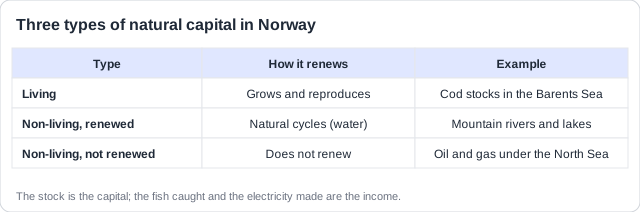
Real example: Norway's cod stock renews as fish breed; its rivers are refilled by rain and snow; its oil and gas took millions of years to form and will not be replaced. One country, three types of capital.
Three different types: Three examples of the same type, such as three forests, show only one type. Pick one living, one renewed by cycles, one that does not renew.
Stock or flow?: Questions often give a fact file and ask for natural capital. Separate the stock from what it yields.
Capital or income?
- Capital = the stock in the place: ice, water, nutrients, sediment, soil, trees, the fish population.
- Income = what flows from it: the fish caught, the timber cut, the electricity made, the tourism money.
- Asked for natural capital? Name the stock, never the income.
- Mentioning a use is fine: 'water, used for hydropower' still names the capital, the water.
Natural capital (the stock)
- Trees of the rainforest
- Its soil
- River water
Natural income (the yield)
- Brazil nuts collected
- Timber cut
- Rain the forest recycles
Real example: in the Amazon the trees, soil and river water are the capital; the Brazil nuts gathered each year are income.
Not income: Tourism, hydroelectric power and money earned are income, not capital. They score nothing when the question asks for natural capital.
Memorize terms 3x faster
Smart flashcards show you cards right before you forget them. Perfect for definitions and key concepts.
How this comes up: Paper 1, from the resource booklet: identify forms of natural capital in a fact file.
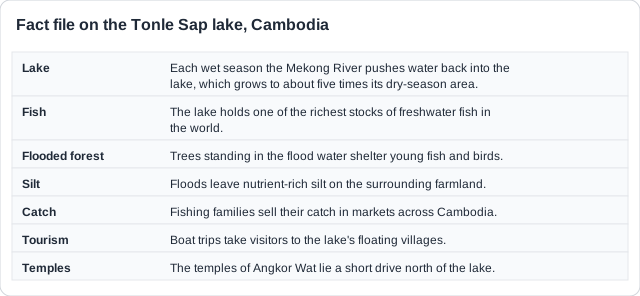
Figure 1 is a fact file on the Tonle Sap lake in Cambodia.
With reference to Figure 1, identify two forms of natural capital provided by the lake.
Model answer plan
See the mark-by-mark plan — for / against / judgement, with marking guidance — in study mode.