Public EIAs at Higher Level: This statement is Higher Level only. It asks what changes when an EIA is published: local people become stakeholders in the decision. Learn two real cases and weigh the merits of engaging everyone.
Practise this as you read
- Explain how a public EIA gives citizens a role in decisions.
- Evaluate engaging all stakeholders, with named cases.
Free preview
This is the free notes preview
You're reading the free notes. Aimnova Pro unlocks the full study experience — and you can try it with your first topic free to keep:
- FlashcardsLock in vocabulary and key terms with spaced repetition.
- Practice questionsAnswer exam-style questions and get instant AI marking.
- Mock exams & past-paper vaultSit full mocks and see exactly how examiners award marks.
- Personalised study planA daily plan built around your exam date and weak areas.
From affected to involved: When an EIA is made public, local people can read it and respond. They become stakeholders with a role in the decision, not just people it happens to.
The points to remember
- A stakeholder is anyone affected by or interested in a decision.
- A public EIA is published, so anyone can read what the project would do.
- Citizens can comment, speak at public hearings, campaign or go to court.
- The EU gives people at least 30 days to comment; the Aarhus Convention makes it a right.
- So local people move from being affected to taking part in the decision.
A secret EIA
- Only the company and officials see it
- Local knowledge is missed
- Mistakes and bias stay hidden
A public EIA
- Anyone can read and comment
- A public hearing lets people speak
- Errors can be challenged, even in court
Real example: the Aarhus Convention gives people in most of Europe the right to see environmental information and to take part in decisions. EU law gives at least 30 days to comment on an EIA.
Memorize terms 3x faster
Smart flashcards show you cards right before you forget them. Perfect for definitions and key concepts.
Case 1: a public that stopped a project. At Rosia Montana, in the mountains of Romania, the EIA process gave opponents a place to be heard.
Rosia Montana, Romania
- A company planned a gold mine using cyanide at Rosia Montana, Romania.
- About 2,000 people would move and four mountains would be dug away.
- Villagers, NGOs and historians used the public process to object.
- Tens of thousands protested across Romania in 2013; the government withdrew its support.
- In 2021 it became a World Heritage Site; in 2024 the company lost its claim for compensation.
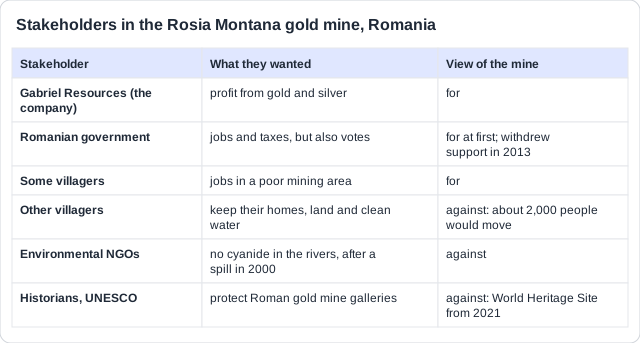
Why it mattered: the mine would have used cyanide, and people remembered the cyanide spill at Baia Mare, Romania, in 2000, which poisoned rivers as far as the Danube. The old Roman galleries under the village are now protected.
Case 2: a public that forced a fuller study, but did not get the result it wanted.
Standing Rock, USA
- An oil pipeline was routed under Lake Oahe, the water source of the Standing Rock Sioux tribe.
- The tribe said it was not properly consulted and only a shorter study was done.
- Protest camps and social media drew world attention in 2016.
- In 2020 a judge ruled that a full environmental impact statement was needed.
- The full study (2025) still let the oil flow: a voice is not a veto.
Route
- The Dakota Access oil pipeline crosses under Lake Oahe, just upstream of the Standing Rock Sioux reservation
Study
- In 2016 the US Army Corps of Engineers approved it after a shorter study, not a full environmental impact statement
Voice
- The tribe sued; thousands camped in protest, and social media spread the story worldwide
Ruling
- 2020: a judge ruled a full study was needed; the final study in December 2025 said the oil could keep flowing
Know your predicted grade
Take timed mock exams and get detailed feedback on every answer. See exactly where you're losing marks.
The guide asks you to weigh the relative merits of engaging ALL stakeholders. There are strong arguments on both sides.
Merits of engaging everyone
- Local knowledge: residents know where floods reach or fish spawn.
- Fairness: those who bear the harm get a say (environmental justice).
- Acceptance: a decision people helped shape is more likely to be accepted.
- Transparency: a public report makes corruption and bias harder.
Remember it as: More voices: better knowledge and fairness, but slower and louder.
Limits of engaging everyone
- Slow and costly: hearings, comments and court cases delay projects.
- Unequal voices: organised or wealthy groups are heard more than the poor.
- Hard to read: reports are long and technical, often not in local languages.
- NIMBY: local objections can block projects the whole country needs.
- Token consultation: views are asked for after the decision is made.
| Point | Real example |
|---|---|
| Fairness | Standing Rock: the people downstream won a full study (environmental justice) |
| Unequal voices | a tribe or a village has less money for lawyers than a pipeline company |
| NIMBY | from 2015, local objections could block new onshore wind farms in England (NIMBY); the rule was lifted in 2024 |
| Token consultation | if a pipeline is already being built, comments come too late (token consultation) |
How this comes up: Paper 1: identify the stakeholders in the case study, or explain why a public EIA matters to them. Paper 2: discuss or evaluate the merits of engaging all stakeholders, with named examples.
At Rosia Montana, Romania, villagers, NGOs and historians objected to a planned gold mine during its public EIA process, and the government withdrew its support in 2013.
Evaluate engaging all stakeholders in decision-making for development projects.
Model answer plan
See the mark-by-mark plan — for / against / judgement, with marking guidance — in study mode.