Renewable but unsustainable at Higher Level: This statement is Higher Level only. It asks why a resource that nature replaces can still be used in a way that cannot last, and who pays the price.
Practise this as you read
- Justify why a named renewable energy source is not always sustainable.
- Describe the pattern of forest gain and loss on a map.
Free preview
This is the free notes preview
You're reading the free notes. Aimnova Pro unlocks the full study experience — and you can try it with your first topic free to keep:
- FlashcardsLock in vocabulary and key terms with spaced repetition.
- Practice questionsAnswer exam-style questions and get instant AI marking.
- Mock exams & past-paper vaultSit full mocks and see exactly how examiners award marks.
- Personalised study planA daily plan built around your exam date and weak areas.
Renewable is not the same as sustainable: Trees, rivers, groundwater and fish are renewable. Yet the way we take, move and process them can still use them up or damage the environment.
The points to remember
- A resource is renewable if nature replaces it: trees regrow, rain refills rivers and aquifers, fish breed.
- But the means of using it can still be unsustainable.
- Look at four stages: extracting or harvesting, transporting, processing, and use.
- Unsustainable = used faster than it is replaced, or used in a way that damages the environment.
- So 'renewable' describes the resource; 'sustainable' describes how we use it.

Remember it as: Renewable is the resource. Sustainable is the use.
Learn what examiners really want
See exactly what to write to score full marks. Our AI shows you model answers and the key phrases examiners look for.
Timber regrows, so a forest can be harvested for ever, but only if trees are cut no faster than they grow back. clear-felling and the logging roads that bring the trucks in break that rule.
Timber: what goes wrong at each stage
- Harvesting: clear-felling faster than trees regrow; habitat and biodiversity lost.
- Bare soil erodes; rivers fill with sediment; less water is stored and recycled as rain.
- Fewer trees take in carbon dioxide; burning the waste releases more.
- Transporting: logging roads open the forest to settlers, hunters and farms; trucks burn diesel.
- Processing: sawmills and pulp mills use energy and can pollute rivers with chemicals.
Real example: on Borneo, the island shared by Indonesia, Malaysia and Brunei, about 30% of the forest was lost between 1973 and 2010. Satellite images show over 270,000 km of logging roads built in that time, reaching ever more remote, higher forest. Logs went to sawmills and pulp mills, and the roads let farmers and oil palm planters move in after the loggers.
A trap: Do not write that timber is non-renewable. It is renewable: the point is that it is harvested faster than it regrows, and harmed at every stage.
Renewable energy is a favourite exam choice: the energy source is renewable, but building and running the power station may not be.
Hydropower
- Hydropower is renewable: the water cycle keeps refilling the river.
- The dam floods forests, farms and homes, and blocks fish from migrating.
- It is built from non-renewable concrete and steel, using lots of fossil fuel.
- The reservoir traps silt, raising flood risk upstream; less water reaches wetlands and floodplains downstream.
- Access roads damage land; the reservoir loses water by evaporation; still water spreads parasites.
Real example: China's Three Gorges Dam on the Yangtze is the largest power station on Earth. Its reservoir stretches about 600 km upstream and flooded over a thousand towns and villages: about 1.3 million people were displaced. The dam traps silt that once built up farmland downstream, and it blocks the migration of fish such as the Chinese sturgeon.
Solar power
- Sunlight is renewable, but making panels uses fossil-fuel energy to purify silicon.
- Panels need metals from mines and plastics made from oil.
- Factories make toxic waste and use a lot of water; parts are shipped long distances.
- Panels last about 25-30 years, then become waste; big solar farms cover natural land.
Two traps: Name ONE renewable energy source and stay with it: only your best one counts. A non-renewable source (coal, nuclear) or no named source can score very little.
Never wonder what to study next
Get a personalized daily plan based on your exam date, progress, and weak areas. We'll tell you exactly what to review each day.
Water in an aquifer is renewable because rain soaks down to refill it. But recharge can be very slow, so pumping can take the water out far faster than it comes back.
Groundwater and fish
- Groundwater is renewable, but it can be mined: pumped out faster than recharge refills it.
- Then the water level falls, wells must go deeper and pumping costs more energy.
- Wasteful irrigation can leave salt in the soil.
- Fish breed, but overfishing takes them faster than they reproduce.
- Bottom trawling wrecks the seabed; bycatch kills other animals; big fleets burn lots of fuel.
Real example: the Ogallala aquifer lies under eight states of the US Great Plains. It supplies about 30% of the groundwater used for irrigation in the USA. Much of its water seeped in over thousands of years, and farms pump it far faster than rain refills it: in parts of Kansas and Texas the water level has fallen by more than 30 m, and some wells have run dry.
Fish are the same: Fish breed, but bottom trawling can take whole shoals and crush the seabed habitat they need, and bycatch kills turtles, sharks and dolphins that are not even wanted.
Using a resource brings real gains, but the costs often fall on different people. That is a question of environmental justice.
Who gains and who pays
- Benefits: jobs, income, taxes, export earnings and cheap energy or materials.
- Costs: people displaced, health harmed by polluted air and water, land of indigenous peoples taken.
- Profits often go to companies and cities; the harm stays local.
- Boom and bust: when the resource runs out, the jobs go too.
- Environmental justice: the poorest and least powerful often carry most of the harm.
Gains (Three Gorges)
- Clean electricity for cities
- Fewer floods downstream
- Jobs while it was built
- Ships can sail far inland
Costs (Three Gorges)
- About 1.3 million people moved
- Farmland and towns flooded
- Fish blocked; silt trapped
- Landslides on the reservoir's banks
The harm often lands on indigenous peoples, poorer communities and the countries that export raw materials, while the profits flow to companies and richer places that buy them.
Non-renewable extraction does the same harm, and more: Mining and drilling also strip habitats and pollute: acid water draining from mines, toxic tailings, sulfur dioxide from smelters, methane from coal mines, oil spills. Canada's Alberta tar sands are a well-known case. These resources cannot be replaced at all.
Stop wasting time on topics you know
Our AI identifies your weak areas and focuses your study time where it matters. No more overstudying easy topics.
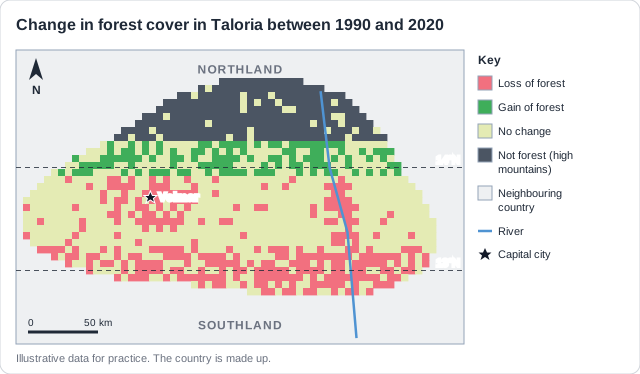
A Paper 1 booklet may show a map of where a country gained and lost forest and ask you to describe the pattern. Describe means say what the map shows, not why.
Describing a pattern on a map
- Say where each change is: north, south, east, west, centre, along the border, near the capital.
- Use the map's evidence: a latitude, a river valley, a named city.
- Describe both loss and gain, and where there was no change.
- Two marks = two separate pattern points; do not explain why unless asked.
Two marks, two pattern points
- Forest loss is concentrated in the south, south of 13°N, along the border with Southland, with more loss around the capital, Velmar, and along the river valley in the east.
- Forest gain is mainly in the north, north of 14°N, on higher ground just below the mountains where there is no forest.
How this comes up: Paper 2, Section B (b): justify, for a named source of renewable energy, that its production is not always sustainable [7]. Paper 1: describe the pattern of forest gain and loss on a map [2].
Hydropower is often described as a renewable, clean source of energy.
The use of renewable resources is not always sustainable because of the activities involved in their production. Justify this statement for hydropower, using a named dam.
Model answer plan
See the mark-by-mark plan — for / against / judgement, with marking guidance — in study mode.