EIA rules at Higher Level: This statement is Higher Level only. It asks why an EIA in one country is not the same as in another, what a baseline study is for, and which parameters an EIA should measure for a given project.
Practise this as you read
- Outline reasons why EIA guidance differs between countries.
- Suggest parameters and mitigation for a named project.
Free preview
This is the free notes preview
You're reading the free notes. Aimnova Pro unlocks the full study experience — and you can try it with your first topic free to keep:
- FlashcardsLock in vocabulary and key terms with spaced repetition.
- Practice questionsAnswer exam-style questions and get instant AI marking.
- Mock exams & past-paper vaultSit full mocks and see exactly how examiners award marks.
- Personalised study planA daily plan built around your exam date and weak areas.
Same tool, different rules: Almost every country uses EIAs, but each sets its own guidance. So the same dam could need a long public study in one country and a quick report in another.
The points to remember
- Most countries require EIAs, but their guidance differs.
- Which projects need one: a fixed list, or each project checked case by case.
- How deep it goes, who carries it out and who pays for it.
- Whether the public must be consulted, and for how long.
- Whether monitoring after the project is required, and how strongly rules are enforced.
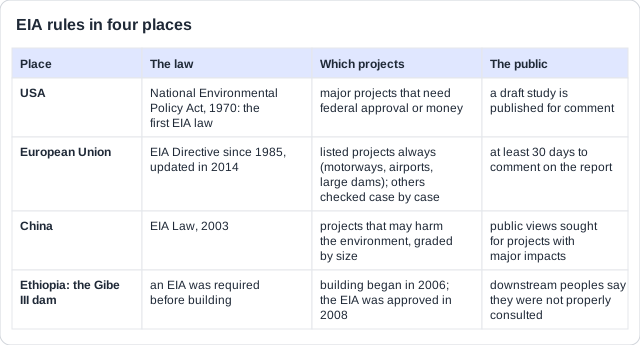
Real example: in the EU, a motorway or large dam always needs an EIA, while a smaller project, such as a small wind farm, is first screened.
Learn what examiners really want
See exactly what to write to score full marks. Our AI shows you model answers and the key phrases examiners look for.
Having a law is not enough: it must be enforced. Two real projects show what happens when the rules are weak.
Why guidance and its use differ
- Development first: a country short of electricity or jobs may approve a project fast.
- Few experts and little money to check reports.
- Weak laws or enforcement: building may start before the EIA is approved.
- Politics or corruption can override a poor report.
- Lenders' rules: banks such as the World Bank set their own EIA standards before they lend.
Dam
- Ethiopia's Gibe III dam on the Omo River, built to make electricity for a fast-growing country
Order
- Building began in 2006; the EIA was only approved in July 2008, against Ethiopia's own law
Gaps
- Critics said it lacked proper baseline studies, for example of people's health downstream
Downstream
- The Omo gives about 90% of Lake Turkana's water, and peoples along it depend on flood-retreat farming
Real example: the Rampal coal power station in Bangladesh stands about 14 km from the Sundarbans. UNESCO called its EIA questionable and asked for a new one, but it went ahead and began producing power in 2022: the country's need for electricity came first.
Whatever the rules, the heart of a good EIA is the baseline study. It is generally used to predict and evaluate impacts and to suggest how to avoid them.
What the baseline is for
- A baseline study records conditions before the project.
- It is used to predict and evaluate the possible impacts.
- It helps to suggest mitigation that avoids or reduces harm.
- Later monitoring is compared with the baseline to see what changed.
- Without a baseline, nobody can prove what harm the project caused.
Remember it as: Measure first, predict next, protect always.
With a baseline: Escondida, Chile
- Before this copper mine opened in 1990, its study looked at sea squirts on the coast
- They acted as an indicator species for tailings dumped in the sea
- Later counts could be compared with the first ones
Without one: Gibe III
- No proper baseline of people's health downstream
- Building had started before the EIA was approved
- Harm later on is hard to prove
Never wonder what to study next
Get a personalized daily plan based on your exam date, progress, and weak areas. We'll tell you exactly what to review each day.
You do not need to study one EIA in depth. You do need to suggest sensible parameters for a given project, across the environment, people and the economy.
Choosing parameters
- Environmental: water flow and quality, air, soil, habitats, key species.
- Social: homes and land lost, water for villages, culture, noise and views.
- Economic: jobs, income, other industries such as fishing and tourism.
- Choose parameters that fit the project: a dam is not a wind farm.
- Pair each parameter with a mitigation, e.g. fish numbers with a fish pass.
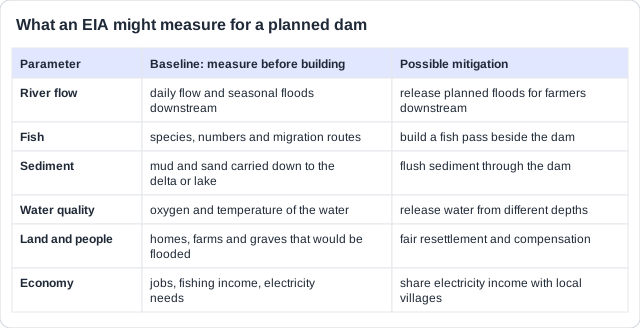
Change the project, change the list: For a wind farm, measure birds and bats, noise and the view. For a mine, measure groundwater, dust and the homes nearby. For a dam, as above, add a fish pass if fish migrate.
How this comes up: Paper 1: suggest parameters an EIA should measure for the project in the case study, or why a baseline study is needed. Paper 2: outline or explain why EIA rules differ between countries.
The Rampal coal power station in Bangladesh was built about 14 km from the Sundarbans mangrove forest after an EIA that UNESCO called questionable. In the European Union, a large power station always needs an EIA with at least 30 days of public comment.
Outline four reasons why the use of EIAs differs between countries.
Model answer plan
See the mark-by-mark plan — for / against / judgement, with marking guidance — in study mode.