Key Biodiversity Areas at Higher Level: An HL-only statement. Conservation money is short, so where should it go first? More than 16,000 sites have been identified as the places that matter most for the survival of the world's species.
Practise this as you read
- Outline what a Key Biodiversity Area is and how a site qualifies.
- Describe why two named areas are important for global biodiversity.
- Evaluate the use of KBAs to prioritise conservation.
Free preview
This is the free notes preview
You're reading the free notes. Aimnova Pro unlocks the full study experience — and you can try it with your first topic free to keep:
- FlashcardsLock in vocabulary and key terms with spaced repetition.
- Practice questionsAnswer exam-style questions and get instant AI marking.
- Mock exams & past-paper vaultSit full mocks and see exactly how examiners award marks.
- Personalised study planA daily plan built around your exam date and weak areas.
The places that matter most for the world: Key areas that should be prioritised for biodiversity conservation have been identified on the basis of the international importance of their species and habitats.
The points to remember
- A Key Biodiversity Area (KBA) is a site that contributes significantly to the global persistence of biodiversity.
- Sites are chosen for the international importance of their species and habitats.
- They hold species at risk of extinction or ecosystems at risk of collapse.
- They are identified with one global standard (IUCN, 2016), on land, in fresh water and at sea.
- More than 16,000 KBAs have been identified, so conservation can be prioritised.
| Biodiversity hotspot | Key Biodiversity Area | |
|---|---|---|
| Size | A huge region, e.g. all of Madagascar | A site with a boundary, e.g. one park |
| How many | 36 | More than 16,000 |
| Chosen for | 1,500+ endemic plants and 70%+ habitat lost | Globally important species or ecosystems |
| Used to | Focus funding on a region | Choose the exact places to protect |
Real example: Kaziranga National Park, on the floodplain of the Brahmaputra River in India, is a KBA. It holds about two thirds of the world's greater one-horned rhinos, about 2,600 animals, and most of the world's wild water buffalo.
Study smarter, not longer
Most students waste 40% of study time on topics they already know. Our AI tracks your progress and optimizes every minute.
A site becomes a KBA if it meets a set criterion. Here they are, shown through one site.
How a site qualifies
- Threatened species or ecosystems: at risk of extinction or collapse.
- Species with small ranges: endemic species found only in a small area.
- Large, intact ecosystems with little human damage.
- Places where many gather to breed, feed or rest on migration.
- Irreplaceable sites: what they hold exists nowhere else.
- A site needs to meet only one of these to qualify.
Threatened
- Giant tortoises, some critically endangered.
- The Galápagos penguin, endangered.
Small ranges
- Almost all its reptiles live nowhere else.
- So do about 80% of its land birds, such as Darwin's finches.
Intact
- About 97% of the land is national park.
- The sea around it is a marine reserve.
Many gather
- Almost all the world's waved albatrosses breed on one island, Española.
Irreplaceable
- Lose these islands and these species are lost from the Earth.
Remember it as: At risk, only here, untouched, crowded, irreplaceable.
In the exam, describe why a named area matters for global biodiversity. The Galápagos is one area; here is a second, told the same way.
What to say about a KBA, using Bwindi
- Name the species or ecosystem at risk, with its IUCN status.
- Give the share of the world population the site holds.
- Say what is found nowhere else (endemic species).
- Say what the world would lose if the site were lost.
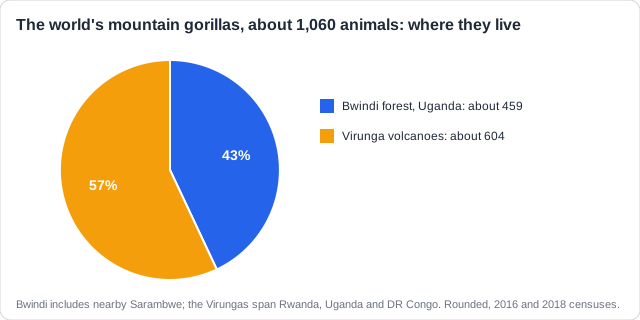
At risk
- Mountain gorillas are endangered.
- Only about 1,060 are left in the world.
Share of the world
- About 459 gorillas: nearly half of the species.
- Many birds found only in these mountains.
What the world would lose
- Half of a species, which lives nowhere else.
- An ancient forest rich in birds and butterflies.
Real example: Bwindi Impenetrable National Park is a steep, misty rainforest of about 330 km² in south-west Uganda. It is also home to about 350 bird species and is a World Heritage Site.
Practice with exam-style questions
Answer exam-style questions and get AI feedback that shows you exactly what examiners want to see in a full-marks response.
Why go to the trouble of naming KBAs? Money for conservation is short, so it must go where it saves the most.
Why identifying KBAs helps
- Prioritise: money and effort go first to the sites that matter most for the whole world.
- New protected areas: countries use KBAs to meet the target of protecting 30% of land and sea by 2030.
- Law and planning (HL.a): KBAs guide national plans and environmental impact assessments.
- Business and banks: lenders treat KBAs as critical habitat, so projects avoid them.
- Monitoring: KBAs are checked over time, showing where biodiversity is being lost.
Strengths
- One global standard, so sites can be compared
- Precise boundaries that can be managed
- Covers all groups: plants, animals, fungi
- Based on data, checked by experts
Limits
- A label is not protection: fewer than one in five is fully protected
- Little data on insects and fungi, so sites are missed
- Local people may lose access to land
- Money is still short in poorer countries
Real example: in 2022, at a United Nations conference in Montreal, almost every country agreed to protect 30% of land and sea by 2030, focusing on areas of particular importance for biodiversity, such as KBAs.
How this comes up: No paper has set this statement yet. The guide asks for at least two named areas, so the likely shape is Paper 2 Section B (a) [4]: two named KBAs, two points each. Paper 1 may give a fact file on a site and ask why it is important for conservation [2].
More than 16,000 Key Biodiversity Areas have been identified around the world.
With reference to two named Key Biodiversity Areas, outline why each is important for global biodiversity.
Model answer plan
See the mark-by-mark plan — for / against / judgement, with marking guidance — in study mode.
Use numbers and status: An IUCN status (endangered) and a share of the world population (nearly half) make each point precise and hard to miss.