Conflict in Key Biodiversity Areas at Higher Level: An HL-only statement. The richest places for wildlife are often rich in timber, oil and fertile land too. Who decides between cutting, protecting and using them wisely, and what happens to the species caught in between?
Practise this as you read
- Explain the conflict between exploitation, sustainable development and conservation in a KBA.
- Explain the reasons for the spread of palm oil in Malaysia and Indonesia and its consequences for biodiversity.
- Evaluate ways of balancing the three.
Free preview
This is the free notes preview
You're reading the free notes. Aimnova Pro unlocks the full study experience — and you can try it with your first topic free to keep:
- FlashcardsLock in vocabulary and key terms with spaced repetition.
- Practice questionsAnswer exam-style questions and get instant AI marking.
- Mock exams & past-paper vaultSit full mocks and see exactly how examiners award marks.
- Personalised study planA daily plan built around your exam date and weak areas.
Three pulls on one place: In Key Biodiversity Areas there is conflict between exploitation, sustainable development and conservation.
The points to remember
- Exploitation: using a KBA's resources for profit now: logging, mining, oil, plantations.
- Conservation: protecting its species and habitats, for example in a national park.
- Sustainable development: meeting people's needs today without harming the future, such as ecotourism.
- KBAs are rich in resources (timber, minerals, fertile land) and often lie in poorer countries, so the three clash.
- The costs of conservation often fall on local people, while the benefits are shared by the world.
Land use
- Farming expands into KBAs
- Towns, roads and other infrastructure
- Tourism that damages sensitive habitats
- Competing claims: conservation or development
Resource extraction
- Mining and oil drilling
- Logging of tropical forests
- Overfishing in marine KBAs
- Water diverted from rivers and wetlands
People and money
- Poverty drives unsustainable use
- Population growth raises demand for land
- Few other ways to earn a living
- Local people bear the costs; others gain
Real example: Virunga National Park in DR Congo, Africa's oldest national park (1925), is a KBA for mountain gorillas. From 2010 a British company, SOCO, searched for oil inside it (exploitation). After a worldwide campaign it stopped in 2014. The park now builds small hydroelectric plants and runs gorilla tourism, giving local people power and jobs (sustainable development).
Get feedback like a real examiner
Submit your answers and get instant feedback — what you did well, what's missing, and exactly what to write to score full marks.
The best-known conflict: oil palm plantations spreading across Malaysia and Indonesia, on the islands of Borneo and Sumatra, where many KBAs lie. Why has it spread so fast?
Why palm oil spread
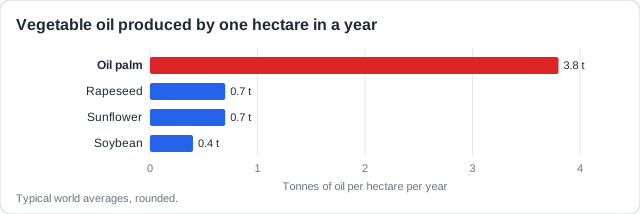
- High yield: oil palm gives about 5 to 10 times more oil per hectare than soy, rapeseed or sunflower.
- Huge demand: cheap, and used in about half of packaged supermarket products and in biofuel.
- Ideal climate: oil palm needs the warm, wet climate found near the equator all year.
- Export income: Indonesia and Malaysia produce about 85% of the world's palm oil.
- Jobs: millions work on plantations and smallholder farms; it lifts many rural families out of poverty.
- Government support: land and permits for plantations, and targets to blend palm oil into diesel.
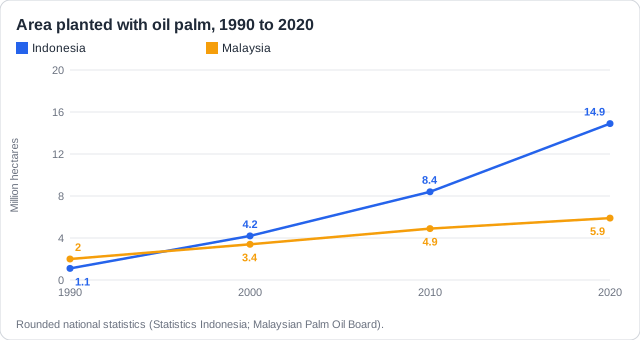
Real example: in Indonesia the area of oil palm grew from about 1 million hectares in 1990 to about 15 million in 2020, an area larger than Greece.
Where the plantations spread, much of the rainforest disappeared. What did that mean for biodiversity?
The consequences for biodiversity
- Deforestation: rainforest, one of the richest habitats, becomes a monoculture of one crop.
- Species loss: plantations hold far fewer species; most forest mammals and birds cannot live there.
- Endangered species lose habitat: orangutans, Sumatran tigers and rhinos, all critically endangered.
- Fragmentation: forest is left in small islands, so animals cannot move, feed or find mates.
- Peat fires: draining and burning peat swamps releases CO₂ and smoke haze, and kills wildlife.
- Pollution and conflict: fertiliser and pesticide run into rivers; orangutans raiding crops are killed.
Remember it as: Forest to monoculture: fewer species, fragments, fires.
Real example: Borneo lost nearly 150,000 orangutans between 1999 and 2015, as forest was logged, cleared and burned and animals were killed. In 2015, fires on drained peat burned about 2.6 million hectares of Indonesia, and the haze reached Singapore and Malaysia.
Learn what examiners really want
See exactly what to write to score full marks. Our AI shows you model answers and the key phrases examiners look for.
Can development go on without destroying KBAs? Several approaches try to balance the three pulls.
Ways to balance them
- Certification: the RSPO label (since 2004) shows palm oil grown without clearing valuable forest.
- Laws (HL.a): Indonesia stopped new permits in primary forest and peatland in 2011, permanently in 2019.
- Buyers (HL.b): firms pledge no deforestation; an EU law of 2023 bars imports from land cleared after 2020.
- Higher yields on existing farms, so smallholders earn more without clearing new forest.
- Corridors: replanted riverbanks link forest fragments, so animals can move between them.
- Land rights (HL.c): indigenous communities that have used forest sustainably keep it.
Who gains from plantations
- Companies and governments: export income
- Consumers worldwide: cheap oil
- Smallholders: a steady income
Who pays
- Forest wildlife: lost habitat
- Indigenous communities: lost land
- Everyone: carbon released, smoke haze
Real example: in Sabah, Malaysia, the Lower Kinabatangan Wildlife Sanctuary is a thin strip of forest along a river, surrounded by oil palm. Orangutans, proboscis monkeys and elephants crowd into it. Conservation groups and some plantation companies are replanting riverbanks to link the fragments.
The conflict is not solved: Only about a fifth of the world's palm oil is certified, laws are hard to enforce in remote forest, and a plantation still earns more today than standing forest.
How this comes up: No paper has set this statement yet. Likely shapes: Paper 2 Section B (b) [7], explain the reasons for and consequences of a named conflict, such as palm oil; and a (c) [9] on whether exploitation, sustainable development and conservation can be balanced.
Oil palm plantations now cover more than 20 million hectares of Malaysia and Indonesia.
Explain the reasons for the spread of palm oil plantations in Malaysia and Indonesia and the consequences for biodiversity.
Model answer plan
See the mark-by-mark plan — for / against / judgement, with marking guidance — in study mode.
Other conflicts you can use: Soy and cattle in the Cerrado of Brazil, mining in the Cerrado, logging in the Congo Basin, and oil in Virunga. Name the place and say who wants to exploit, conserve or develop sustainably.