Biodiversity hotspots under threat at Higher Level: An HL-only statement. Hotspots hold half of the world's plant species, and every one has already lost most of its natural habitat. What is destroying them, why would the loss be so large, and why is protecting them so hard?
Practise this as you read
- Outline how habitat destruction threatens biodiversity hotspots.
- Explain why losing a hotspot's habitat causes a large loss of biodiversity.
- Outline why tropical hotspots in lower-income countries are hard to conserve.
Free preview
This is the free notes preview
You're reading the free notes. Aimnova Pro unlocks the full study experience — and you can try it with your first topic free to keep:
- FlashcardsLock in vocabulary and key terms with spaced repetition.
- Practice questionsAnswer exam-style questions and get instant AI marking.
- Mock exams & past-paper vaultSit full mocks and see exactly how examiners award marks.
- Personalised study planA daily plan built around your exam date and weak areas.
Rich, and running out of room: Biodiversity hotspots are under threat from habitat destruction, which could lead to a significant loss of biological diversity, especially in tropical biomes.
The points to remember
- A biodiversity hotspot has at least 1,500 endemic plant species (0.5% of the world's) and has lost at least 70% of its original habitat.
- Endemic species live naturally in one area and nowhere else on Earth.
- The 36 hotspots cover about 2.4% of the land, yet half of all plant species and 43% of land vertebrates live only there.
- Most hotspots are in tropical biomes: rainforests, tropical islands and mountains.
- Their main threat is habitat destruction, which could cause a significant loss of biodiversity.
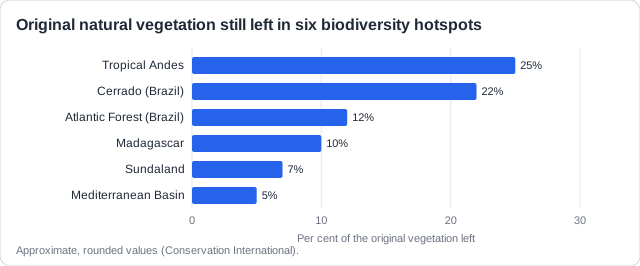
Real example: the scientist Norman Myers first mapped hotspots in 1988, to show where conservation money would save the most species. They include the Tropical Andes, the Mediterranean Basin, Sundaland and Madagascar.
Practice with exam-style questions
Answer exam-style questions and get AI feedback that shows you exactly what examiners want to see in a full-marks response.
Habitat destruction means natural habitat is removed or changed so much that its species can no longer live there. It is the biggest threat to every hotspot.
What destroys hotspot habitat
- Farming: forest and grassland cleared for crops such as soy and oil palm, and for cattle.
- Logging for timber, and fire used to clear land.
- Mining, roads and dams, which open remote areas to more clearing.
- Growing towns and cities as populations grow.
- What is left is split into fragments: small, isolated patches where populations shrink and die out.
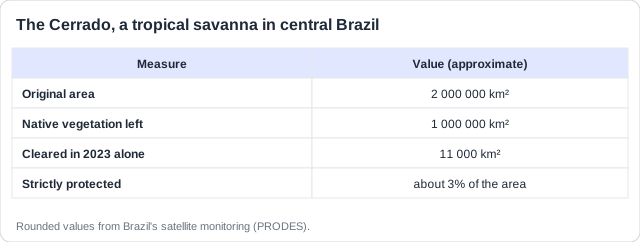
Per cent of habitat left
Left ÷ original × 100 = 1,000,000 ÷ 2,000,000 × 100 = 50%.
Years left at this rate
Left ÷ lost each year = 1,000,000 ÷ 11,000 = about 91 years.
Per cent endemic
Endemic ÷ all native species × 100. Round only at the end, as the question asks.
Real example: the Cerrado is a tropical savanna in central Brazil: a mosaic of grassland, dry forest, forest along rivers and rocky outcrops, with about 4,800 species of plants and vertebrates found nowhere else. About half has been cleared, mostly for soy fields and cattle.
Why would losing hotspot habitat cost so many species? Clearing one hectare there does far more damage than clearing one hectare almost anywhere else.
Why the loss would be so large
- Hotspot species are endemic: when their habitat goes, they have nowhere else to live.
- So a local loss becomes a global extinction: the species is gone from the Earth.
- Hotspots pack many species into a small area, so each hectare cleared removes more species.
- Many endemics have tiny ranges and small populations, so they are already rare and endangered.
- Most hotspots are tropical, where diversity is highest, so the loss is largest there.
- Fewer species means less resilient ecosystems and lost ecosystem services, such as medicines and clean water.
Remember it as: Endemic plus destroyed equals extinct everywhere.
Real example: the Atlantic Forest once covered about 1.3 million km² of Brazil's coast. About 12% is left, in small fragments between farms and cities such as São Paulo. The golden lion tamarin, a small orange monkey found only there, fell to about 200 animals in the 1970s: it had nowhere else to go.
Feeling unprepared for exams?
Get a clear study plan, practice with real questions, and know exactly where you stand before exam day. No more guessing.
Most hotspots are in tropical biomes, and most tropical biomes lie in lower-income, developing countries. That makes protecting them much harder.
Why tropical hotspots are hard to protect
- Poverty: many people depend on the land, clearing forest to farm, cut fuelwood or hunt.
- Money (economics): governments need export income and jobs from timber, mining, soy and palm oil.
- Weak enforcement (law): too few rangers, low budgets and corruption let illegal logging go on.
- Population growth raises the demand for land, food and fuel.
- Global demand: much of the soy, beef, palm oil and timber is bought by richer countries.
- Fairness (ethics): should poor local people pay the cost of saving species the whole world values?
Makes it harder
- People who need land to survive
- Export income from clearing
- Too few rangers, corruption
- Demand from richer countries
Can help
- International funding for protected areas
- Debt-for-nature swaps
- Jobs from ecotourism and park work
- Rich countries buying only deforestation-free goods
Real example: about 90% of Madagascar's species live nowhere else, including all of its more than 100 kinds of lemur. It is one of the world's poorest countries, and many farmers clear forest by tavy. In 2003 the government promised to triple its protected areas, and it swapped some foreign debt for conservation. But after a political crisis in 2009, illegal logging of rosewood surged inside national parks such as Masoala.
How this comes up: No paper has set this statement yet. Likely shapes: a Paper 2 Section B (a) [4] on the threats to a named hotspot or why it is hard to conserve, and Paper 1 data parts: calculate the per cent of habitat left or of species that are endemic [1], then explain why the loss matters [2].
Most of the world's 36 biodiversity hotspots lie in tropical biomes.
With reference to a named biodiversity hotspot, outline why tropical hotspots are difficult to conserve.
Model answer plan
See the mark-by-mark plan — for / against / judgement, with marking guidance — in study mode.
One reason per mark: Other valid reasons: demand for soy, beef and palm oil from richer countries; corruption; and the question of fairness, when poor local people pay the cost of protecting species the world values.