Three named species at Higher Level: Three different species from SL: the passenger pigeon, the Sumatran rhino and the Iberian lynx. At HL, look at who pays for conservation and who decides: laws, money and the rights of species all shape each story.
Practise this as you read
- Tell each species' story: causes, impacts, strategies.
- Judge each strategy with both sides and a conclusion.
Free preview
This is the free notes preview
You're reading the free notes. Aimnova Pro unlocks the full study experience — and you can try it with your first topic free to keep:
- FlashcardsLock in vocabulary and key terms with spaced repetition.
- Practice questionsAnswer exam-style questions and get instant AI marking.
- Mock exams & past-paper vaultSit full mocks and see exactly how examiners award marks.
- Personalised study planA daily plan built around your exam date and weak areas.
Three species, three outcomes: Some species go extinct when protection comes too late. Some are critically endangered but survive with help. Some recover when strong action comes in time. Learn one real species of each kind.
Why species decline: what to look for
- Habitat loss or degradation: forest cleared, rivers polluted or dammed.
- Overhunting, poaching or illegal trade, often because it was seen as a pest or a resource.
- A narrow range (endemic to one island or region), so every individual faces the same threats.
- Invasive species and disease brought by people.
- Slow reproduction, a specialised niche or a small gene pool, so it cannot recover from losses.
- Being a top predator: few in number to begin with, and often killed by people.
Remember it as: Habitat, hunting, range, invaders, slow breeding, top of the chain.
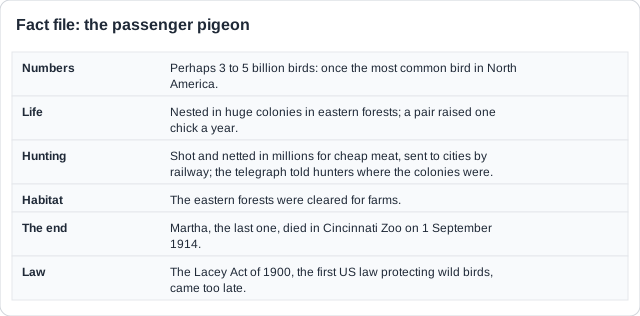
Extinct (HL example): the passenger pigeon. Billions nested in eastern North America's forests. Railways and the telegraph let hunters find the colonies and ship the birds to cities (overhunting for trade), while the forests were cleared (habitat loss). One chick a year (slow reproduction) could not replace the losses. Impact: its huge flocks had shaped the forests they fed and roosted in; its loss shocked the public and helped create the USA's first wildlife laws.
Early action works best: Protection that comes after a species is down to a handful, as with the thylacine's in 1936, is usually too late. Say so when you judge a strategy.
Learn what examiners really want
See exactly what to write to score full marks. Our AI shows you model answers and the key phrases examiners look for.
For a critically endangered species, ask what its loss would mean, for nature and for people.
The impacts of a species' decline or loss
- On ecosystems: biodiversity falls; the species it ate increase; species that ate it decline.
- If it is a keystone species, the effects cascade through the whole food web.
- Lost ecosystem services, such as pollination, seed spreading or cleaning up carcasses.
- On societies: lost tourism income, aesthetic beauty, and cultural or spiritual value.
- An ethical loss: a species with its own right to exist (biorights) is gone for ever.
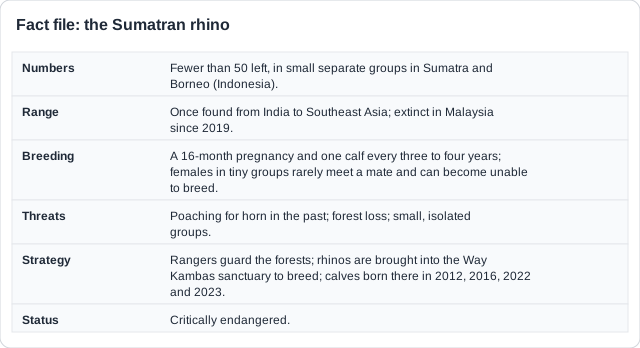
Critically endangered (HL example): the Sumatran rhino. Poaching for horn and forest loss left fewer than 50, in scattered groups where females rarely meet a mate (small gene pool, slow reproduction). Impacts: as a large browser it spreads seeds and shapes the forest; its loss would end a lineage millions of years old and remove a species with deep cultural value in Indonesia.
Ecosystems AND societies: The guide asks for both. Give at least one impact on the ecosystem (food web, biodiversity, services) and one on people (tourism, culture, ethics).
Some species have been moved to a lower-risk rank because people stepped in.
Strategies that have improved a status
- Legal protection: hunting bans, national laws and international agreements such as a whaling ban or CITES.
- Protected areas and habitat restoration.
- Captive breeding and release, or raising young safely before release (head-starting).
- Removing predators or invasive species, often on islands.
- Partnerships of governments, NGOs, local and indigenous people, and volunteers.
- The earlier the action starts, the more likely it is to work.
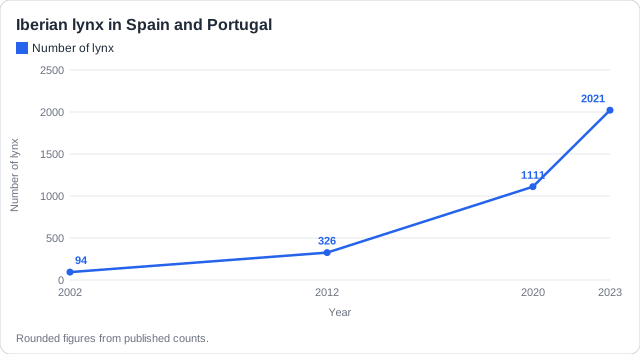
Improved by intervention (HL example): the Iberian lynx. Habitat loss, road deaths and two diseases that crashed its rabbit prey left about 94 in 2002. Captive breeding and releases, restocking rabbits, tunnels under roads and payments to landowners (partnerships) raised numbers to over 2000 by 2023, and it moved from critically endangered to vulnerable in 2024.
Improved is not safe: A better status does not mean the threats have gone: humpbacks still drown in fishing gear, lynx are still killed on roads. Mention this when you judge the strategy.
Never wonder what to study next
Get a personalized daily plan based on your exam date, progress, and weak areas. We'll tell you exactly what to review each day.
Exam questions give a fact file on a programme and ask you to evaluate it.
How to judge a strategy
- For: numbers rose; the status improved; other native species benefit; many partners share the work.
- Against: the cause of decline (habitat loss) is not fixed; low genetic diversity; very costly.
- Against: it depends on people: stop the help and numbers may fall; predators or poachers may return.
- Conclusion: weigh both sides and judge, e.g. 'saved from extinction, but not yet self-sustaining'.
- At most two points on each side count in a [3]; the judgement can be the third mark.
- For: separate populations spread the risk of one disease or disaster.
- Against: killing predators or taking eggs may be unethical; captive-raised animals may struggle when released.
Strengths
- Calves born in the Way Kambas sanctuary in 2012, 2016, 2022 and 2023.
- Rangers guarding the forest also protect other species there.
Limitations
- Still fewer than 50; groups too scattered to breed.
- Catching wild rhinos for breeding is risky and costly.
- Forest loss, the cause of decline, goes on.
A balanced conclusion: Although the sanctuary has bred four calves, fewer than 50 rhinos remain and their forest is still shrinking, so the strategy is buying time rather than securing the species.
The same steps for a law: the Iberian lynx has been protected by law for decades, and numbers recovered once the law was backed by habitat work; but lynx are still killed on roads and in illegal traps, so the law alone is not enough.
Legal protection: a trap: When judging a law, 'it worked because there are now enough to cull' is not accepted. Say which points show the law worked (numbers recovered) and which show it did not (legal shooting, poaching, culls).
How this comes up: Paper 2, Section B (b): explain the causes and consequences of the loss of a named species [7]; Paper 1: evaluate a conservation strategy from a fact file [3].
Some species have been lost within a single human lifetime.
Explain the causes, and the possible consequences, of the extinction of a named species due to human activity.
Model answer plan
See the mark-by-mark plan — for / against / judgement, with marking guidance — in study mode.