The tragedy of the commons at Higher Level: The same statement as SL, with different examples: the Peruvian anchoveta and the Baltic Sea. At HL the idea links to law, economics and ethics: who owns the sea, who pays for damage, and what users owe each other.
Practise this as you read
- Name the shared resource and why no one owns it.
- Match each solution to the user it limits.
Free preview
This is the free notes preview
You're reading the free notes. Aimnova Pro unlocks the full study experience — and you can try it with your first topic free to keep:
- FlashcardsLock in vocabulary and key terms with spaced repetition.
- Practice questionsAnswer exam-style questions and get instant AI marking.
- Mock exams & past-paper vaultSit full mocks and see exactly how examiners award marks.
- Personalised study planA daily plan built around your exam date and weak areas.
Everyone's, so no one's: The tragedy of the commons happens when a commons is used without limits. Each user takes a little more for themselves, and together they ruin it for everyone.
The points to remember
- The tragedy of the commons: a shared resource with unrestricted use gets overused.
- No one owns it, so no one is responsible for protecting it.
- Each user acts in self-interest: they gain all of what they take, but share the cost with everyone.
- Each takes only a little, but the combined effect is huge: the resource is depleted or ruined.
- Short-term gain wins over the long-term sustainable use that would benefit everyone.
Remember it as: If everyone takes a little too much, the whole system collapses.
A shared sea
Off Peru, anchoveta, small fish in cold, rich water, could be caught by any boat.
Self-interest
In the 1960s more and more boats fished them to make fishmeal, each earning from every tonne landed.
Shared cost
The shrinking stock was everyone's loss, so no single boat had a reason to stop.
Tragedy
The catch hit 12 million tonnes in 1970, then crashed: a lesson for every shared fishery.
The tension: The tension is between what is best for each user now and what is best for everyone over time: the shared benefit of sustainable use.
Never wonder what to study next
Get a personalized daily plan based on your exam date, progress, and weak areas. We'll tell you exactly what to review each day.
The first kind of tragedy is overharvesting: too many users take a living resource from the commons.
The points to remember
- Overharvesting: taking a living resource faster than it can replace itself.
- Every boat catches more to earn more, because a fish left in the sea may be caught by a rival.
- Catches rise, then the stock collapses: too few adults are left to breed.
- Everyone loses: the food, the jobs and the species.
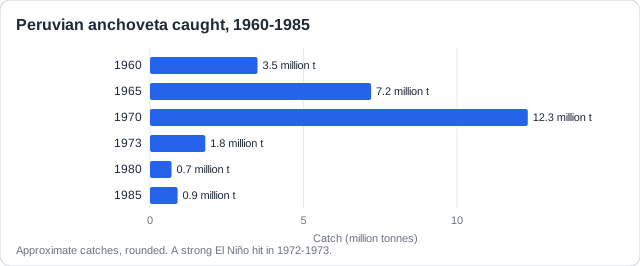
Real example: the Peruvian anchoveta catch rose to 12.3 million tonnes in 1970. When a strong El Niño hit in 1972-1973, the overfished stock crashed to 1.8 million tonnes, and seabirds that ate anchoveta died in millions.
Read the graph for the story: Quote the rise, the peak and the fall with numbers: 'from 12.3 million tonnes in 1970 to 1.8 million in 1973'.
The second kind is contamination: many users treat a shared place as a free place to dump their waste.
The points to remember
- Contamination: using a shared place as a free dump for waste.
- Each person, firm or country adds only a small amount, and no one owns the ocean or air.
- The waste builds up from all of them together, far from where it was made: 'out of sight, out of mind'.
- It harms natural systems and human food sources that everyone shares.
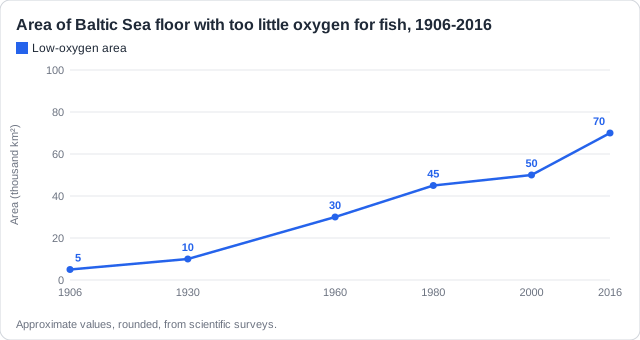
Real example: nine countries and about 85 million people drain into the Baltic Sea. Each farm and city adds a little nitrogen and phosphorus. Together they feed algae whose decay uses up oxygen, so about 70,000 km² of sea floor is now a dead zone where cod eggs cannot survive.
Name the case every time: In a question about a named place, mention it in your points. An answer about the tragedy of the commons in general, with no link to the case, gets at most half the marks.
Stop wasting time on topics you know
Our AI identifies your weak areas and focuses your study time where it matters. No more overstudying easy topics.
The tragedy of the commons matters for two big ideas: sustainability and biodiversity.
The points to remember
- Sustainability: the resource is used faster than it renews, so future users lose it.
- Biodiversity: target species crash, and food webs lose their prey or predators.
- Bycatch and pollution kill species that were never the target.
- Unmanaged commons are overused; pollution rises without rules.
- Damaged ecosystems lose resilience; well-managed ones can stay sustainable.
Sustainability
- Anchoveta were taken faster than they could breed, so the catch could not go on.
- Peru's fishmeal industry and its workers lost their income for years.
Biodiversity
- Millions of seabirds that fed on anchoveta starved in 1972-1973.
- In Baltic dead zones seabed animals die, and cod cannot breed there.
Why management matters: Biodiversity loss is not only about how much is used, but how it is managed. The same sea can be fished for centuries under limits, or emptied in decades without them.
The tragedy is not certain. Users can avoid it by agreeing limits and enforcing them, from the top or from the community.
The points to remember
- Agreements between countries sharing the resource, and laws with fines.
- Quotas, licences, limits on boats, closed seasons and bans keep catches below the maximum sustainable yield.
- Monitoring of the stock, so limits follow the science.
- Gear rules: bigger mesh and minimum sizes so young fish escape; less bycatch; no poison, explosives or trawling.
- No lost or dumped nets, which keep catching fish for years (ghost fishing).
- No-take zones and marine protected areas where stocks can breed.
- Other incomes for fishers, fish farming, and eco-labels; local rules agreed by the users themselves.
Remember it as: Agree it, limit it, watch it, enforce it.
Community
Lobster fishers in Maine, USA, share harbour fishing grounds and watch each other's traps.
Rules
Egg-carrying females are notched on the tail and must be released; very small and very large lobsters go back too.
Limits
The state limits the number of traps and licences, and fishers help to set the rules.
Result
Catches rose for decades: users who share a resource managed it well together.
Tie each way to fishing: 'Educate people' alone is too general. Say what is taught and to whom. Across borders, agreements such as HELCOM, which nine Baltic countries signed in 1974, set shared limits on nutrients and waste.
See how examiners mark answers
Answer exam-style questions with model answers. Learn exactly what earns marks and what doesn't.
How this comes up: Paper 1: a case study with a graph, then outline how people could avoid the tragedy of the commons [5].
Figure 1 shows the area of Baltic Sea floor with too little oxygen for fish. The sea is shared by nine countries, whose farms, cities and fishing fleets all use it.
Outline how the countries around the Baltic Sea could avoid the tragedy of the commons.
Model answer plan
See the mark-by-mark plan — for / against / judgement, with marking guidance — in study mode.